excl VAT

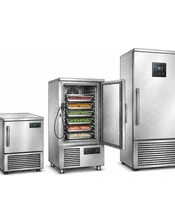
A blast freezer rapidly and controllably freezes fresh or prepared food to -18 °C before storage, transport or the next production stage. In professional kitchens, bakeries, pastry production and food manufacturing, select equipment by kilograms frozen per cycle, tray or trolley capacity and workflow. Blast chilling to +3 °C is a separate additional duty.
Compare INFRICO ABT and iLine IABT with TEFCOLD BLCA-X1: compact units, the counter-style ABT71M, upright cabinets and trolley chamber solutions. This guide explains sizing, declared cycle conditions, controls and accessories.
TEFCOLD rates chilling capacity from +70 °C to +3 °C in 90 minutes and freezing capacity from +70 °C to -18 °C in 240 minutes. These figures are useful for comparing models, while actual process time also depends on product type, portion size, layer thickness, packaging, loading pattern and airflow.
|
Model |
Best suited to |
Key points to check |
|---|---|---|
|
BLCA3X1 |
Small kitchens, restaurants and small batches |
3 × GN1/1; 12 kg chilling / 8 kg freezing; 230 V |
|
BLCA5X1 |
Restaurants, pastry kitchens and small-to-medium production |
5 × GN1/1; 18 / 14 kg; 230 V |
|
BLCA10X1 |
Higher-throughput restaurants, bakeries and production |
10 × GN1/1; 40 / 28 kg; 230 V |
|
BLCA14X1 |
Large batches, central kitchens and production |
14 × GN1/1; 55 / 38 kg; 400 V |
Blast chilling rapidly lowers the temperature of cooked or warm food to a chilled storage condition, while blast freezing takes the product into a frozen state. The chilling and freezing capacities of the same unit are different, so both kg-per-cycle figures must be evaluated separately.
If your workflow is mainly cook-and-chill, focus on chilling capacity. If you produce frozen semi-finished food, bakery products, desserts or ice cream, freezing capacity may be more important.
For a normal storage refrigerator, net volume is a useful capacity indicator. For a blast chiller/freezer, the decisive figure is how much product can be processed within a defined cycle. BLCA10X1, for example, holds 10 GN1/1 pans and is rated at 40 kg chilling / 28 kg freezing, making it a very different production tool from the 3-pan or 5-pan models.
Size the unit for the largest realistic batch, not for average daily turnover. A unit that is undersized for peak production will become a bottleneck.
BLCA3X1 is designed for smaller batches: 3 × GN1/1, 12 kg chilling and 8 kg freezing under the manufacturer’s test cycle. External dimensions are approximately 804 × 826 × 995 mm and the unit uses 220-240 V / 50 Hz.
It is a practical choice for a small restaurant, pastry operation or kitchen where blast chilling is needed regularly but batch sizes are modest.
BLCA5X1 provides 5 × GN1/1 capacity, 18 kg chilling and 14 kg freezing. External dimensions are approximately 804 × 826 × 1045 mm and the supply is 220-240 V / 50 Hz.
This size often suits restaurants or pastry kitchens where the 3-pan unit is too small but a tall 10- or 14-pan cabinet is not yet necessary.
BLCA10X1 is a full-height professional unit with 10 × GN1/1 capacity, 40 kg chilling and 28 kg freezing. TEFCOLD lists dimensions of approximately 804 × 815 × 1885 mm, 900 W input power and 220-240 V / 50 Hz supply.
It is an important step-up model when substantial throughput is required while retaining a single-phase electrical connection.
BLCA14X1 holds 14 × GN1/1 pans and is rated at 55 kg chilling / 38 kg freezing. It is approximately 800 × 815 × 2110 mm, has 2000 W input power and requires 380-400 V / 50 Hz.
Plan this model together with the kitchen layout and electrical installation. Check delivery access, ceiling and doorway heights, service space and three-phase power before ordering.
BLCA-X1 guides accept both GN1/1 and 600×400 Euronorm pans. This is especially useful in mixed restaurant/bakery workflows because gastronorm containers and bakery trays can be processed in the same unit.
Pans are generally not supplied as standard, so confirm the tray system you already use and how many pans are required for one complete cycle.
The included core probe allows the controller to monitor the actual internal temperature of the food rather than relying only on cabinet air temperature. A thick joint of meat, sauce in a deep container and a thin bakery product cool at very different rates.
Using the probe helps standardise repeated production and provides a more meaningful process endpoint. Position it according to your food-safety procedure in the representative slowest-cooling part of the product.
BLCA-X1 uses a programmable touch-screen controller. Operators can select preset programs or create and save their own recipes. TEFCOLD also specifies USB data transfer and HACCP-compliant data export.
This is useful in multi-shift operations because the same product can be processed using the same programmed cycle instead of relying on individual operator habits.
TEFCOLD lists preset special cycles for applications including fish, ice-cream hardening, drying and defrosting. This shows that the BLCA-X1 range can support more than classic post-cooking chilling.
A special cycle does not replace the product process specification. Load, recipe and final temperature still need to be validated for the actual food and production system.
The 12/8, 18/14, 40/28 and 55/38 kg figures are performance ratings under defined manufacturer conditions: +70 → +3 °C in 90 minutes for chilling and +70 → -18 °C in 240 minutes for freezing.
Large pieces, deep containers, thick packaging or overloaded pans can slow heat transfer. Select with reserve capacity and validate the real process using your own products.
Blast chilling performance depends on strong airflow around the food. Pans should not be loaded in a way that blocks air passages or creates one thick mass that is difficult to cool.
Distribute the product evenly over the available guides and follow the manufacturer’s instructions for loading and pan depth. Effective airflow is as important as refrigeration capacity.
BLCA3X1, BLCA5X1 and BLCA10X1 use 220-240 V / 50 Hz, while BLCA14X1 requires 380-400 V / 50 Hz. The manufacturer’s instructions recommend a separate electrical circuit and an accessible connection point.
Check three-phase availability before selecting BLCA14X1. Leave the ventilation and service clearances required by the specific model; do not box the condensing unit into furniture simply to make the cabinet fit.
After the chilling or freezing cycle, move the product to a normal refrigerator or freezer for long-term storage. The primary purpose of a blast unit is rapid processing, not warehousing.
Using it as a storage cabinet prevents the next production batch from being processed and reduces the value of the equipment.
A standard freezer is designed to maintain already-frozen food at a set storage temperature. A blast freezer must remove a large heat load from warm or hot food quickly using high airflow and process-specific control.
For this reason, comparing only the final temperature is misleading: a -18 °C storage freezer and a blast freezer perform different jobs.
First define the largest batch weight and whether chilling, freezing or both are required. Then check GN1/1 / 600×400 compatibility, pan count, available floor space, electrical supply and where the food will be stored after the cycle.
If the calculated load is close to the unit’s rated maximum, allow additional capacity. The blast chiller should support the production flow rather than create a queue between batches.
The terms are often used loosely. “Blast chiller/freezer” is more precise for BLCA-X1 because the same unit can both chill and freeze.
A blast chiller rapidly brings food into a chilled condition; a blast freezer rapidly takes it into a frozen condition. BLCA-X1 performs both duties.
TEFCOLD rates it at 12 kg chilling from +70 to +3 °C in 90 minutes and 8 kg freezing from +70 to -18 °C in 240 minutes.
18 kg chilling and 14 kg freezing under the manufacturer’s standard test-cycle conditions.
40 kg chilling and 28 kg freezing. It has capacity for 10 × GN1/1 pans.
55 kg chilling and 38 kg freezing. It holds 14 × GN1/1 pans and requires a 380-400 V supply.
Yes. TEFCOLD specifies guides for both GN1/1 and 600×400 Euronorm pans. Pans are normally ordered separately.
The BLCA-X1 range includes a core probe. It is very useful for controlling the real internal temperature of the food and standardising repeatable production cycles.
Yes. The touch-screen controller allows preset programs as well as user-created and saved recipes.
Yes. TEFCOLD specifies HACCP-compliant data export and USB data transfer for the BLCA-X1 range.
No. TEFCOLD specifies 380-400 V / 50 Hz. Confirm the electrical installation before delivery.
Its primary purpose is the rapid cycle. For long-term storage, transfer the food to a dedicated refrigerator or freezer.
Rapid cooling of hot food is the intended use, but batch size, container depth and program must comply with the model instructions and your food-safety process.
BLCA5X1 is rated at 18 kg chilling, but if 15 kg is a frequent maximum load or the product cools slowly, the additional reserve of BLCA10X1 may be more appropriate.
The existing TEFCOLD range is complemented by INFRICO ABT, iLine IABT and ABT 20 CBI models. Start with your largest actual batch in kilograms and the pan format used in your oven or production line. Chilling and freezing capacities refer to different cycles and must be considered separately.
ABT cycles are declared from +90 °C, while the IABT technical sheets specify a +70 °C starting temperature. Chilling reaches +3 °C in less than 90 minutes and freezing reaches −18 °C in less than 270 minutes. The existing TEFCOLD models use different declared cycle conditions. Compare starting temperatures and duration alongside the kilogram rating. Chamber air at −38 or −40 °C is not the final food temperature or a storage specification.
Use the chilling and freezing performance filters to match the batch. Tray capacity and tray format filters help match existing pans. ABT102S accepts 20 GN 1/1 pans or 10 levels of 800 x 600 trays; model numbering does not always equal GN pan capacity.
Check pan format, loading depth and airflow. Ordering extra trays does not add cabinet levels. Different tray formats are alternative working loads and their combined use must remain within cabinet capacity. For CBI, choose a GN 1/1, GN 2/1 or 600 x 400 trolley that fits the permitted dimensions and wheel arrangement. Trolleys and trays are optional. Check doorways, cabinet height, electrical supply and access to the top-mounted condensing unit.
A roll-in cabinet is particularly useful when reduced tray handling improves daily large-batch production. Compatible models offer a separate data recorder, sterilizer and Bluetooth or Wi-Fi options. Sterilization does not replace routine cleaning. INFRICO equipment carries a 2-year warranty. Each product links to the manufacturer data sheet and dimensional drawing.
No. ABT51L is rated for 20 kg chilling and 12 kg freezing. Select for the process you will use.
No. Materials, control functions, specification and declared cycle starting conditions differ.
No. Check batch mass, trolley dimensions and access. ABT201CBI and ABT202CBI have different chambers but the same declared 110/60 kg chilling/freezing capacity.
Additional trays and trolleys are selected as accessories. CBI identifies the included condensing unit, not an included trolley.
The range includes single-phase and three-phase models, and CBI has a top-mounted unit. Review the individual data sheet, access route and service clearance before ordering.
Start by comparing kilograms frozen per cycle, then check the initial food temperature, declared cycle time and tray or trolley capacity. An identical kilogram rating may have been declared under different test conditions.
| Range | Food freezing cycle | Chilling cycle | Selection point |
|---|---|---|---|
| INFRICO ABT, including CBI and chamber-style ABT20 | +90 → -18 °C in less than 270 min. | +90 → +3 °C in less than 90 min. | The rating starts with hotter food. |
| INFRICO iLine IABT | +70 → -18 °C in less than 270 min. | +70 → +3 °C in less than 90 min. | Consider the +70 °C starting point and EasyBlastChiller specification. |
| TEFCOLD BLCA-X1 | +70 → -18 °C in 240 min. | +70 → +3 °C in 90 min. | Compare the declared cycle duration too. |
For example, ABT101L and IABT101L both have a 25 kg freezing rating, but ABT starts at +90 °C and IABT at +70 °C. A hotter batch of the same mass imposes a higher initial thermal load. Kilograms alone therefore do not describe the complete duty or guarantee an identical processing time for your product.
The “Temperature range, °C” filter in this category identifies the declared FOOD chilling and freezing cycles. It is separate from the cabinet-air adjustment range. “Blast freezing capacity → -18 °C, kg” is the batch-sizing filter; “Blast chilling capacity → +3 °C, kg” is a separate duty. Actual time depends on the food, layer thickness, packaging, loading and airflow.
INFRICO ABT71M is a counter-style blast freezer that can be planned in the kitchen work-counter area. Its 1468 × 700 × 940 mm cabinet accommodates 7 GN 1/1 trays and freezes up to 18 kg per cycle. This format suits workflows that benefit from a lower, wider unit. For larger batches, select an upright or roll-in model against the required mass and tray capacity.
The ABT touch-screen instructions describe food-probe or time-controlled cycles, custom settings and a recipe book. Available programs depend on the exact controller, factory settings and fitted accessories. IABT models use EasyBlastChiller control; additional ABT functions must be checked against the selected specification.
Fish sanitation is a controlled freezing-and-holding program. The manual describes successive stages: reaching the selected food temperature, holding for the selected period and switching to conservation. It helps manage a repeatable fish-processing procedure under the business's production and food-safety controls. A general “freezing to -18 °C” claim alone does not define this entire process.
Thawing is controlled defrosting of frozen food, including fish, before a subsequent production step. The described touch-screen controller offers light, medium and heavy load selections and manages temperature phases and time. Food thawing is separate from both fish sanitation and evaporator defrosting.
The controller manual describes management of cabinet disinfection equipment; a UV cycle requires the appropriate fitted equipment and enabled function. A touch screen alone does not mean that equipment is included. Compatible models offer additional equipment. The cycle operates with the door closed and is interrupted if it opens. It supplements normal cabinet washing and cleaning and is not intended to sterilise food.
Slow cooking and proofing in the controller documentation require the relevant additional capabilities and equipment. Check availability for the actual machine specification. EVCO touch-screen controller information.
Choose by batch mass, trolley format and workflow, not trolley count alone. A larger chamber does not automatically offer more processing capacity: ABT201 and standard ABT202 both process 110/60 kg, while standard ABT203 and ABT204 process 200/130 kg per chilling/freezing cycle. Enhanced ABT202CP/SP/PP versions offer 230/130 kg; ABT203CP/PP and ABT204CP/PP offer 400/260 kg. Match additional loading space or higher performance to the production requirement.
GN 1/1, GN 2/1 and 600 x 400 identify the pans or trays. Overall trolley dimensions are always larger than tray dimensions, allowing for the frame, guides and wheels. The following INFRICO trolleys each have 20 levels.
| Trolley | Tray format | Levels | External dimensions (W x D x H), mm |
|---|---|---|---|
| CBGN2011 | GN 1/1 | 20 | 455 x 635 x 1787 |
| CBGN2021 | GN 2/1 | 20 | 660 x 755 x 1787 |
| CBE20 | 600 x 400 | 20 | 530 x 705 x 1787 |
Columns show alternative single-format loads; do not add their quantities together. For example, ABT202C holds two GN 1/1 trolleys or one GN 2/1 or one 600 x 400 trolley. ABT203 takes three GN 1/1 or two larger trolleys; ABT204 takes four GN 1/1 or three larger trolleys. S/SP versions use compatible Rational trolleys, not general CBGN/CBE models.
| Model | GN 1/1 | GN 2/1 | 600 x 400 |
|---|---|---|---|
| ABT201CBI | 1 | 1 | 1 |
| ABT202CBI | 2 | 1 | 1 |
| ABT201C / ABT201P | 1 | 1 | 1 |
| ABT202C / ABT202P | 2 | 1 | 1 |
| ABT202CP / ABT202PP | 2 | 1 | 1 |
| ABT201S | 1 Rational | — | — |
| ABT202S / ABT202SP | — | 1 Rational | — |
| ABT203C / ABT203P | 3 | 2 | 2 |
| ABT203CP / ABT203PP | 3 | 2 | 2 |
| ABT204C / ABT204P | 4 | 3 | 3 |
| ABT204CP / ABT204PP | 4 | 3 | 3 |
Important: actual capacity depends on overall trolley dimensions. Another trolley of the same GN format may have a larger frame or different wheelbase. Check the door opening, usable chamber depth, trolley height and airflow clearances. The manufacturer’s “Free internal dimensions” are door opening width x height x usable chamber depth, not tray dimensions or approval for every trolley.
C/CP keeps the entire trolley and wheels inside. S/SP is for compatible Rational trolleys with their wheels outside. P/PP has two opposite doors for entry on one side and exit on the other. The added final P in CP/SP/PP means enhanced performance; PP combines pass-through access with enhanced performance. Choose the available factory version using “Modifications” on the product page.
Single-trolley ABT201 suits compact installations and direct trolley loading. Two-, three- and four-GN-1/1-trolley units combine more trays in one load and reduce manual transfers. Two doors suit a layout with separate loading and unloading directions. Select enhanced performance for the actual food mass and available cycle time, so the investment helps reduce production queues rather than merely adding unused space.
Trolleys and trays are additional. The RAMABT21 ramp is for compatible C/P/CP/PP versions, excluding S/SP and CBI. Bluetooth and Wi-Fi are alternative optional connections. Rational trolley compatibility and price for S/SP require an individual quotation.
Chamber-style ABT20 units with remote condensing units are supplied disassembled for assembly on site. The standard condensing unit is included, but assembly, installation, connection, refrigeration pipework and commissioning are excluded. Scope and cost are agreed individually for the site, condensing unit location, pipework route and services. Consultation and a separate installation quotation are required before ordering.
Manufacturer trolley compatibility table – PDF, page 23
TEFCOLD models belong to the BLCA series; INFRICO series follow the manufacturer’s family names. Tray count applies to shelf-type appliances. For trolley models, compare trolley capacity, external trolley dimensions and freezing output rather than assuming a fixed tray count for every trolley.