excl VAT

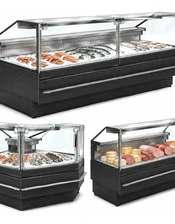
Refrigerated serve-over counters are horizontal commercial refrigeration units designed for displaying and holding meat, delicatessen, dairy products, prepared foods, salads, fish and other fresh products in assisted-service retail. Customers see the product through the front glass while staff access it from the rear, so the counter performs three functions at once: it keeps products at the required temperature, creates an attractive display and forms a practical workstation for the salesperson.
When choosing a refrigerated counter, do not focus only on length or price. Two externally similar counters can differ substantially in refrigeration principle, usable display depth, temperature uniformity, under-storage capacity, energy consumption, front-glass construction, rear worktop width and the ambient conditions in which they are designed to operate. Start with one question: what will you sell, and under what conditions?
Commercial serve-over counters can use static (gravity) or dynamic (ventilated) refrigeration. Both have a valid application, but they distribute cold in different ways.
Static cooling. Cold air moves naturally through the display without a forced fan stream. Unpacked products are exposed to less intensive airflow, so their surfaces dry more slowly. This matters for fresh meat, some prepared foods and other unpackaged products where appearance depends on retaining natural moisture and avoiding a dry surface film.
Static refrigeration is, however, generally less energy-efficient. With natural convection, a lower refrigerant evaporating temperature is often required to transfer enough cooling from the evaporator. The lower the evaporating temperature, the greater the pressure difference the compressor must overcome and the lower the overall refrigeration efficiency. Dynamic airflow improves heat transfer and makes it possible to distribute cooling more evenly and operate the circuit more efficiently.
Dynamic cooling. Fans circulate cold air through the display and, where fitted, through the refrigerated under-storage. Temperature is distributed more evenly, recovers faster after service or replenishment, deeper displays can be used, and the counter generally copes better with higher heat loads. Dynamic cooling is particularly valuable in intensive retail operation and during summer when room temperature approaches the climate-class limit.
Important: forced airflow can dry unpackaged products more quickly. Premium manufacturers reduce this effect by using larger evaporator surfaces and lower air velocities. When evaluating a counter for meat or delicatessen, do not judge it only by the word “ventilated”; consider the complete construction and the manufacturer’s design.
Practical conclusion: if the highest priority is minimising drying of unpackaged product, a static model can be suitable. If temperature uniformity, a large display, higher energy efficiency and more stable performance under heavier loads matter more, a dynamic counter is often the more rational choice. Compare actual models by kWh/24 h and energy class.
A large proportion of horizontal refrigerated serve-over counters are designed for climate class 3 - approximately +25 °C ambient temperature and 60% relative humidity. This is not a “recommended value with spare capacity”. As conditions approach the limit, the refrigeration system works significantly harder; above the limit it may no longer maintain the declared product temperature.
Do not install the counter where it is heated by direct sunlight, ovens or other heat sources. Condenser and ventilation openings must remain clear. If the sales area regularly exceeds +25 °C in summer, select equipment rated for a higher ambient temperature rather than choosing only by design or display size.
For example, current TEFCOLD SOCA ventilated counters are declared for climate class 3 and operation up to +25 °C / 60% RH, so this specification should be treated as a real design condition.
Buyers often compare counters by overall length, but in retail the actual display area and depth are more important. Dynamic premium meat counters can offer display depths of around 900 mm, allowing substantially more product to be presented per metre of counter length.
Products must not be stacked all the way to the front glass. Manufacturers define a maximum loading height, often marked by a line or stated in the manual. In classic models with under-storage, the permitted product layer may commonly be around 15 cm, although the exact value depends on construction. Exceeding the limit disrupts the cold-air path and the upper products may no longer remain within the required temperature range.
When comparing two counters, therefore, assess the manufacturer’s stated display area, depth and loading limit rather than simply estimating how much appears to fit.
Most traditional assisted-service refrigerated counters have additional refrigerated storage below the display. It can hold reserve stock of the same products so staff can replenish the display quickly without walking to a separate refrigerator or cold room.
This is particularly useful in smaller butcher, dairy or delicatessen shops where every square metre matters. In some larger models the under-storage is designed to accept standard 600 x 400 mm crates, making very efficient use of the available space.
If a store already has adequate separate refrigeration or a cold room, a supermarket-type counter without under-storage can be more rational. Removing the lower storage allows more of the cabinet to be devoted to the customer-facing display and makes it possible to use stepped decks and create a deeper visual presentation.
For fresh meat or delicatessen, prioritise a stainless-steel display deck. Painted steel may look attractive, but stainless steel better withstands intensive cleaning and long-term commercial use.
Even more care is needed for fish, salads, marinated or fermented products. Salt, vinegar, mayonnaise, marinades and other aggressive substances accelerate corrosion of metal components. For these applications, choose a model specifically suited to the product and any additional evaporator or internal-component protection offered by the manufacturer.
Fish display can require a very different solution from meat. For example, the TEFCOLD SOCA-F range uses a 50 mm deep ice bed, ventilated cooling and temperature class 3M1 - a good illustration of why a standard meat counter should not automatically be selected for fish.
A serve-over counter is not just refrigeration equipment; it is the salesperson’s daily workstation. Before buying, check the width of the rear worktop and whether it can accommodate scales, packaging materials, a label printer, cutting board and other necessary equipment.
Worktop material also matters. Granite is generally durable and resistant to everyday mechanical wear, while stainless steel is practical from a hygiene and cleaning perspective. If the standard depth is insufficient, check before ordering whether the manufacturer offers an additional rear shelf or worktop extension.
Curved glass gives a classic butcher or delicatessen-counter appearance. These models often have a substantial aluminium or metal canopy above the display, incorporating lighting and sometimes providing a more practical structure for lightweight work accessories.
Straight glass creates a more modern appearance and often improves visibility from above. The key question is how it opens for cleaning. A front glass panel that lifts or hinges forward significantly improves daily hygiene. Current SOCA models use lift-up glass, while SPID front glass folds forward - a practical difference, not merely a styling detail.
LED lighting is standard in many commercial counters, but lamp wattage alone is not the key factor. Meat counters may use a special light spectrum that enhances the natural colour of the product. It should not mislead the customer, so the aim is an attractive but natural appearance.
With multi-level risers or a deep 900 mm display, light position and beam angle become even more important so that products at the front and rear are equally visible.
Two counters with a similar purchase price can have very different final project costs if one includes important accessories and the other requires them as options. Always compare the complete specification.
For example, current TEFCOLD SOCA models feature a 900 mm stainless-steel display deck, anti-mist front glass, LED lighting, a rear stainless-steel shelf and two electrical sockets, while multiple units can be joined into a continuous retail line using an optional joining kit.
Before buying, check whether the display base is level or inclined towards the customer. A slight slope improves product visibility, but some packages or GN containers can slide on smooth stainless steel. If you sell products in a particular type of tray, box or container, check stability before ordering.
Newer commercial counters increasingly use natural refrigerant R290. It has a very low climate impact and enables efficient compact systems. The refrigerant name alone, however, does not determine operating cost: the entire refrigeration circuit, insulation, evaporator, fans, glass and control system all contribute.
Longer counters with integral condensing units may use several independent refrigeration circuits. This can improve reliability because part of the counter may continue cooling if one circuit fails, depending on the exact design. Large retail lines may instead use cabinets connected to an external central refrigeration system; this should be treated as a complete store-refrigeration project.
If one counter is not enough, many professional ranges can be joined into a continuous line. This allows 2.5 m, 3.75 m or even longer meat and delicatessen displays and may include corner modules, checkout units or modules for other functions.
Not every range offers corner pieces, low-glass self-service variants, heated modules for hot food or freezer versions for semi-finished products. If you are planning a complete line rather than one independent counter, agree the full layout first and only then choose the range.
Corner modules are often dynamically cooled and may have no lower refrigerated storage, so the total reserve capacity of the line can be lower than its overall length suggests.
Not all refrigerated counters are designed for meat cuts or delicatessen to be placed directly on the display deck. Models designed for GN 1/1 containers are convenient for sandwiches, salads, prepared foods or ingredients where the product is presented in standardised pans.
The current TEFCOLD SPID range is offered in five sizes, uses ventilated refrigeration and automatic defrost, has a protective glass structure and accepts GN 1/1 pans. These models are especially suitable for delicatessen, sandwich and prepared-food areas where hygiene, fast service and a modular container layout are important.
Start with the product, not the counter length. Fresh meat requires attention to display material, temperature uniformity and drying intensity. Delicatessen requires good visibility, GN-pan or riser layout and comfortable service. Fish requires corrosion-resistant materials and a suitable ice-display solution. Salads and marinated products require resistance to more aggressive environments. Intensive retail benefits from dynamic cooling, a large display and fast temperature recovery.
Then assess the room: maximum summer temperature, humidity, provision for heat rejection, aisle width and staff working area. Finally compare actual models by display area, refrigerated storage capacity, energy use, standard equipment and available options.
If you are planning a multi-counter line, corner solution, remote condensing unit or a counter for fish or aggressive products, contact us before ordering. In these cases the correct solution depends on the layout of the complete retail area, not only on one technical data sheet.
In a static counter, cold air moves naturally, so unpackaged products are exposed to less airflow and dry more slowly. In a dynamic counter, fans actively circulate air, giving more uniform temperature, faster recovery and more efficient use of deeper displays. Dynamic cooling can also allow the refrigeration circuit to operate at a higher evaporating temperature and is generally more energy-efficient.
No. Static cooling dries unpackaged product less, but premium dynamic counters use larger evaporators and lower air velocities to reduce drying substantially while also providing more uniform temperature and a larger display.
In practical terms, the equipment is designed for ambient conditions of approximately +25 °C and 60% relative humidity. If the room is hotter in summer, choose a model rated for the higher conditions or address room cooling.
Not recommended. Direct sunlight and other heat sources significantly increase refrigeration load and can prevent the counter from maintaining the declared product temperature.
Only up to the manufacturer’s stated loading limit. In many classic counters with lower storage this can be around 15 cm, but the exact height depends on the design. Exceeding the limit interferes with airflow and the upper products may warm up.
It holds reserve stock of the same products so staff can replenish the display without walking to another refrigerator or cold room. This is particularly useful in small shops where every square metre of storage matters.
When reserve stock is held in a separate cold room or cabinet and the priority is to maximise customer-facing display space. Supermarket-type models without lower storage can use a larger visual display and stepped risers.
Not always. Fish, ice and salty conditions create a higher corrosion risk. Use a model designed for fish, with more corrosion-resistant materials and a suitable display such as an ice bed.
Stainless steel withstands intensive cleaning, moisture and long-term commercial use better. Painted steel can be attractive and less expensive but is generally less resistant in aggressive environments.
Strongly recommended. Lift-up or forward-hinged glass makes daily cleaning and hygiene much easier. Always check this when considering a straight-glass model.
It helps maintain clear product visibility under higher humidity or temperature differences. Depending on the design, the solution may use warm-air flow, heated glass or another anti-condensation method.
Yes, if the range provides joining kits and the necessary modules. Not every range offers corners, checkout units or self-service variants, so the whole line should be planned before individual units are ordered.
Display area and depth. Two counters of the same overall length can provide very different usable merchandising space. Compare total display area, depth, loading height and, when relevant, lower refrigerated storage volume.
No. R290 is a modern natural refrigerant, but energy consumption is determined by the complete appliance design. Compare energy class and kWh/24 h, not only the refrigerant type.
When the counter will be used for fish or aggressive products, when a multi-module line, corners, self-service or remote refrigeration is planned, or when the retail location has difficult temperature or space conditions. In such cases a catalogue data sheet alone is not enough.