excl VAT

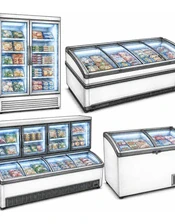
Commercial freezers are designed to hold, display and sell frozen products in shops, supermarkets, convenience stores, petrol stations, HoReCa and other professional retail environments. However, “commercial freezer” is not one single equipment type. Some cabinets are primarily for reserve stock, others are designed for maximum product visibility, while supermarket islands form complete frozen-food merchandising zones.
The current range includes FR and CF solid-lid chest freezers, the compact ST160 glass-lid chest freezer, UF and ATOM MAXI upright display freezers, SHALLOW and TWIN supermarket islands, the variable-speed SFI cooler/freezer, MTF wall freezer/cooler modules and the MTF Mini top-case display designed to sit above another freezer. Comparing litres or the lowest temperature alone therefore does not tell you which unit is right for the job.
Start by defining the function: reserve storage, shelf-based display, island merchandising or flexible switching between chiller and freezer mode. Then compare net volume, display area, temperature range, cooling method, defrost system, climate class and energy consumption.
|
Type / range |
Best suited for |
Key points to check |
|---|---|---|
|
FR / CF solid-lid chests |
Frozen reserve stock, ice cream and storage where visible merchandising is not the main goal. |
Net volume, baskets, manual defrost, lid finish and mobility. |
|
ST160 glass-lid chest |
Small visible ice cream or frozen-food display. |
Compact footprint, product visibility, 105 l net volume and manual defrost. |
|
UF upright displays |
Compact vertical display with a heated glass front. |
Static versus ventilated version, shelving, defrost method and climate class. |
|
ATOM MAXI |
Larger premium upright frozen-food merchandising. |
1/2/3 doors, ventilated cooling, self-closing heated doors and display area. |
|
SHALLOW / TWIN |
Supermarket islands and high-volume frozen-food merchandising. |
Display area, dual refrigeration systems, static cooling, island geometry and cooler/freezer mode. |
|
SFI CF VS |
Flexible island display with lower running cost potential and mode switching. |
Variable-speed compressor, -24…-18 / -1…+8 °C, glass lids and island joining. |
|
MTF / MTF VS |
Using vertical wall space while keeping a chest cooler/freezer underneath. |
Ventilated cooling, heated doors, VS efficiency, installation height and service access. |
|
MTF Mini |
Additional vertical freezer display above a chest freezer. |
Support structure, overall height, -23…-18 °C and static cooling. |
A solid-lid chest freezer and a glass display freezer can have similar net capacities but serve different roles. A solid lid reduces heat ingress and hides the contents, making it rational for reserve stock or back-of-house storage. Glass and lighting are useful when the cabinet itself is part of the sales display.
The first question should therefore be “does the customer need to see the product without opening the cabinet?” If not, an FR / CF chest freezer can be the simpler choice. If yes, consider a glass-lid chest, upright UF / ATOM MAXI or a supermarket island.
FR and CF ranges are classic static chest freezers with hinged solid lids. Current models are available in several sizes and include baskets, thermometer, defrost-water drain and castors. “S” versions use a stainless-steel lid while the standard versions use a painted lid.
A representative CF700 SL offers around 600 l net volume, a -24 to -14 °C range, climate class 4, static cooling and manual defrost. TEFCOLD lists energy class D and around 3.28 kWh/24 h. This construction is not a premium merchandising cabinet, but it is a very practical way to hold a large quantity of frozen stock.
ST160 shows the visible-display alternative: a compact freezer with a hinged tempered-glass lid, about 105 l net volume and the same simple static / manual-defrost concept. Even within chest freezers, storage and merchandising are different use cases.
An upright display freezer uses store height efficiently and allows customers to see products on shelves in the same way they would in a glass-door chiller. UF200 and UF400 families include white, stainless-steel and newer black finishes, as well as different cooling configurations.
UF400G and UF400SG use heated glass doors, electronic control, fixed freezing shelves, a -24 to -10 °C range and climate class 4, with a static / fan-assisted concept and manual defrost. UF400VGB is a ventilated version with adjustable shelves and fully automatic electric defrost. The practical difference is air distribution and daily maintenance, not simply the letter in the model name.
For frequently replenished shelf displays, a ventilated version can be easier to manage. For a simpler configuration with fixed freezing shelves, a static model may be sufficient. Always verify consumption and defrost method for the exact model.
ATOM MAXI is a higher-display-class upright freezer range with 1, 2 or 3 glass doors. It uses ventilated cooling, automatic defrost, adjustable shelves, vertical LED lighting and heated self-closing triple-glazed doors. The DBB version uses black interior and exterior finishes.
The ATOM MAXI F1DBB example has 390 l net volume, 0.84 m² display area, a -22 to -18 °C operating range and climate class 3. In this format, display area and door count are more useful planning values than gross litres.
Island freezers are intended for larger retail floors where customers approach the display from several sides. Net volume matters, but display area, island width, lid access, load line and customer circulation around the cabinet are equally important.
SHALLOW 150-CF offers around 400 l net volume and 0.92 m² display area. It can switch between freezer and cooler mode, uses static cooling, automatic defrost and two refrigeration systems. The reduced depth is useful where you want an island display without sacrificing too much aisle width.
TWIN 220A-CF is much larger at around 1255 l net and 2.65 m² display area, again with two refrigeration systems. It operates at -24 to -18 °C in freezer mode or -1 to +15 °C in positive-temperature mode, making it suitable for seasonal or promotional flexibility.
SFI CF VS combines an island format, cooler/freezer switching and an energy-saving variable-speed compressor. SFI145B-CF VS offers 422 l net, 0.96 m² display area and -24 to -18 / -1 to +8 °C modes. It uses static cooling and automatic hot-gas defrost.
A variable-speed compressor can adapt more closely to the actual load rather than repeatedly cycling at full output. This can be valuable for 24/7 retail equipment, but the correct comparison is still the actual kWh/24 h data of equivalent sizes.
MTF is designed for a specific retail layout: it stands on tall supports so a chest cooler or freezer can sit underneath. This creates two independent merchandising zones in the same floor footprint - horizontal below and vertical above.
MTF185 / 210 / 250 can switch between -24 to -18 °C freezer mode and -1 to +8 °C cooler mode. They use ventilated cooling, automatic defrost and heated self-closing glass doors. VS versions use variable-speed compressors.
TEFCOLD lists the MTF250 VS at energy class C and about 9.16 kWh/24 h, compared with energy class E and about 23.92 kWh/24 h for the standard MTF250. This is a strong model-specific illustration of why similar-looking cabinets should not be compared on width or purchase price alone.
MTF Mini is a more compact top-case freezer designed to sit above a chest freezer. It has two heated self-closing glass doors, adjustable shelves, an illuminated canopy and a -23 to -18 °C operating range. Unlike the larger switchable MTF models, MTF Mini is a dedicated freezer.
It is not a normal floor-standing cabinet. TEFCOLD specifies that a supporting stand must be built and the cabinet lifted onto it, so it should be planned as part of the retail fixture.
Static freezers distribute cold without forced air circulation through the whole display. This simple concept is common in chest freezers and large islands. In a horizontal freezer, dense cold air also remains in the cabinet more effectively when the lid is opened.
Ventilated cooling actively moves air and provides more even shelf temperatures, making it especially useful in upright display freezers. ATOM MAXI and UF “V” models use this approach. It is not automatically superior in every application; choose the system that matches the cabinet format and replenishment pattern.
Simple FR / CF chests and some static UF models use manual defrost. Ice build-up therefore needs planned defrosting and temporary relocation of the products.
SHALLOW, TWIN, SFI and most ventilated upright models use automatic defrost. SFI uses hot-gas defrost. Automatic defrost reduces manual work but does not remove the need to clean condensers, gaskets, sliding tracks, condensate areas and ventilation openings.
The temperature difference across freezer glass is large, so condensation control is more demanding than on a positive-temperature cooler. UF, ATOM MAXI and MTF use heated glass; ATOM MAXI also uses triple-glazed insulated doors.
Heated glass does not make location irrelevant. Avoid external doors, strong humidity, direct sunlight and direct air-conditioning streams because they increase heat load, energy consumption and condensation risk.
Many commercial display freezers operate around -24 to -18 °C or a similar range, while the UF family extends up to around -10 °C depending on the model. Set temperature according to the frozen product specification and your HACCP plan rather than simply choosing the lowest available setting.
A retail freezer is primarily designed to maintain the temperature of already frozen product. It is not a blast freezer for quickly freezing large quantities of warm food.
Climate class describes the ambient test conditions for which the equipment is designed. Current products commonly use climate class 3, around +25 °C / 60% RH, or class 4, around +30 °C / 55% RH. SFI and TWIN are examples of class 3; FR / CF, UF and MTF are commonly class 4.
This is a real design limit, not a catalogue formality. Entrances, shop windows, hot-food areas and enclosed niches can create a much higher local heat load than the room average.
Net volume is important for a storage chest, but not sufficient for a display freezer. In an upright cabinet, shelf count and dimensions matter; in an island, display area and permitted load line are critical. Overloading can block air paths or place products in a warmer zone.
TWIN 220A-CF, for example, combines 1255 l net with 2.65 m² display area, while SFI145B-CF VS offers 422 l and 0.96 m². These figures are far more useful for merchandising planning than external dimensions alone.
SHALLOW and TWIN use two refrigeration systems. TEFCOLD presents this as redundancy, increasing reliability and helping manage a large cabinet load. If one circuit fails, however, food safety decisions must still be based on the actual product temperature and the site HACCP procedure.
Energy use is strongly affected by cabinet design. A solid-lid chest, an upright glass-door freezer and a 2.6 m² supermarket island perform different jobs, so their kWh/24 h figures should not be treated as a universal ranking.
Compare energy class, kWh/24 h and annual kWh between similar formats and sizes. Variable-speed compressors deserve particular attention in high-duty 24/7 applications because whole-life operating cost can outweigh the initial purchase-price difference.
Do not block air intake or exhaust openings or push the cabinet against a wall unless the exact installation instructions allow it. The condenser needs airflow and a service technician needs access to the refrigeration unit, controller and condensate system.
For island layouts, allow space for lids, replenishment trolleys and customer circulation. MTF and MTF Mini require special attention to overall height and support structure. Check the exact installation drawing before fixed furniture or cladding is manufactured.
Professional models are designed for commercial duty, heavier loading, product display and specified climate classes. Depending on the format they may include heated glass, LED lighting, electronic control, large display areas or modular island options.
A chest freezer gives a large storage capacity with a simple construction and is ideal for reserve stock. An upright freezer uses height efficiently and makes individual products much easier for customers to see and find.
Not universally. A solid lid is rational when storage is the priority and the contents do not need to be displayed. Glass is useful when customers need to see the product before opening the freezer.
It means the controller can switch the cabinet between a positive-temperature cooling mode and a negative-temperature freezer mode. SFI, TWIN-CF, SHALLOW-CF and MTF are examples of this flexible format.
Mode changes should be planned. Products that are suitable for one temperature regime may not be suitable for the other. Remove or relocate stock and follow the specific operating instructions.
Static cooling is simple and works very well in chest and island formats. Ventilated cooling is valuable in upright shelf displays because it distributes cold air more evenly and improves temperature recovery after door openings.
It is particularly useful in intensive retail equipment because it reduces manual defrost work. Simple FR / CF chests may use manual defrost, which is robust but needs planned maintenance.
Because of the large temperature difference and room humidity. Heated glass helps, but condensation risk also increases near external doors, in high humidity, in direct air-conditioning streams or close to heat sources.
They describe the ambient test conditions. In practice class 3 is commonly around +25 °C / 60% RH and class 4 around +30 °C / 55% RH. Always check the exact product data.
A retail freezer is primarily intended to maintain already frozen goods. Large quantities of warm product should be frozen in equipment designed for rapid freezing.
They improve reliability and help manage a large cabinet load. During a fault, however, product decisions should still be based on actual temperature and food-safety procedures.
It can adapt more closely to the required cooling load and can significantly reduce consumption in 24/7 equipment. Compare the actual kWh/24 h values of equivalent VS and non-VS models.
Net litres are very important for a storage chest. For upright or island merchandising, display area, shelf dimensions and load line often describe the commercial value more accurately.
When planning an island line, an MTF system above a chest freezer, several switchable cooler/freezer cabinets or installation in a constrained space. The whole store geometry and ventilation should then be checked, not only one product data sheet.