excl VAT

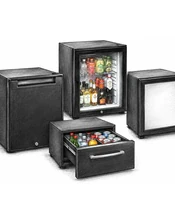
Hotel minibars are compact refrigeration units designed to give guests convenient access to chilled drinks and snacks without disturbing their rest. Capacity and the lowest temperature shown in a data sheet are not enough to choose the right unit: the key criteria are cooling technology, noise, real pull-down capacity, energy consumption and correct furniture integration.
The current range covers several clearly different solutions: completely silent absorption-operated TM and TM-G minibars, compressor-operated TM-C and TM-GC models with smart operating modes, and TD minibar drawers. These groups are not merely design variations - they are intended for different operating priorities.
Minibars are most commonly used in hotel rooms, serviced apartments and resorts, but they are also suitable for meeting rooms, offices, spas, sports and golf clubs and other locations where a small, discreet and quiet drinks cooler is required.
|
Type / range |
Noise |
Main advantage |
Best suited for |
|---|---|---|---|
|
Absorption TM / TM-G |
0 dB(A) |
Absolute silence, no compressor or fan |
Bedrooms where complete silence matters more than fast pull-down |
|
Compressor TM-C / TM-GC |
approx. 38 dB(A) while compressor runs |
Faster pull-down, lower temperature and lower energy use |
Warmer rooms, higher turnover and faster temperature recovery |
|
TD minibar drawers |
approx. 38 dB(A) |
Easy integration and excellent overview of contents |
Premium interiors, bedside furniture and custom cabinetry |
This is the most important choice in the category. An absorption minibar and a compressor minibar may look almost identical, but their cooling principle, pull-down speed, noise level and energy consumption are fundamentally different.
Absorption minibar. There is no compressor or fan, so TEFCOLD TM and TM-G models operate at 0 dB(A). This is the strongest option for hotel sleeping areas where absolute silence is the first priority. The system has limited cooling capacity, however, and cabinet temperature is more dependent on ambient conditions, door openings and correct installation.
Compressor minibar. TM-C and TM-GC models use a compressor. They cool newly loaded drinks faster, recover temperature more effectively after the door has been opened and cope better with warmer rooms. Noise while the compressor is operating is around 38 dB(A), while the smart operating profile can shift active compressor operation to periods when the room is likely to be unoccupied.
The 0 dB(A) rating of an absorption minibar is literal: there is no compressor or fan producing mechanical operating noise. This makes it a rational choice in exceptionally quiet bedrooms where even a short compressor cycle is undesirable.
A compressor minibar is not completely silent while the compressor is running, but approximately 38 dB(A) is still a low sound level. TEFCOLD compressor minibars add a programmable SMART operating profile, SLEEP mode for forced quiet periods and FAST-cool for rapid pull-down, allowing higher cooling performance to be balanced with guest comfort.
Energy performance should be compared in kWh/24 h rather than rated input power alone. TEFCOLD states approximately 0.52-0.53 kWh/24 h for the updated 2025 absorption TM range and about 0.63 kWh/24 h for the glass-door TM-G models. By comparison, compressor-operated TM-C solid-door models are listed at roughly 0.15-0.16 kWh/24 h and TM-GC glass-door models at about 0.31-0.35 kWh/24 h.
This matters particularly in hotels operating dozens or hundreds of minibars. A small daily difference per room becomes a substantial annual operating cost across the entire property. Absolute silence and minimum energy use are therefore separate priorities and should be evaluated independently.
Absorption cooling has less spare capacity. In practice, the achievable temperature difference from the room is limited, so an absorption minibar should not be judged in the same way as a compressor refrigerator in a hot room. Nominal temperature ranges also differ between specific TM models, so the lowest number in one product specification should not be interpreted as a guarantee that every absorption minibar will reach that temperature under all conditions.
If the room becomes very warm in summer, the door is opened frequently or warm drinks are loaded repeatedly, a compressor model is the safer choice. It has more cooling reserve and a shorter pull-down time.
A hotel minibar is designed primarily for beverages and room-service snacks. In particular, an absorption minibar should not automatically be used for perishable food simply because its specification shows a positive refrigeration temperature. The TEFCOLD absorption minibar manual explicitly warns that the internal temperature may not be low enough to prevent food spoilage.
If a product requires a regulated and tightly controlled cold chain, choose a professional food refrigerator designed for that purpose rather than a hotel minibar.
• Solid door - discreet, easy to blend into a restrained hotel interior and generally more energy efficient than an equivalent glass-door unit.
• Glass door - lets the guest see the drinks and snacks immediately and can support minibar sales. TEFCOLD updated the TM-G range in 2025 with triple glazing, reducing energy consumption and cabinet depth.
• Lock - useful in hotels, offices and other locations where access needs to be controlled; it is available on the TM and TM-G ranges.
A glass door is not automatically the better choice. If the minibar is concealed inside furniture and the contents are not part of the sales presentation, a solid-door model is often more rational. If you want the guest to see the offer before opening the minibar, glass has a clear commercial advantage.
TD models open like a drawer. This layout is particularly convenient in bedside units and custom furniture because guests can see the full selection from above without crouching in front of a low swing door.
For example, TD50C is a compressor-operated drawer with 45 l net capacity, a stated 38 dB(A) noise level, approximately 0.29 kWh/24 h energy consumption and a +5...+12 °C operating range. It is supplied without a finished front or handle and is intended for integration into existing furniture. TD50A is the corresponding finished-front alternative.
The most common minibar installation mistake is to treat it like a simple cabinet box and seal it inside furniture. Every refrigeration appliance must reject the heat removed from the cooled compartment back into the room. If warm air cannot leave the furniture cavity, condensing temperature rises, operating cycles become longer, energy consumption increases and cooling performance suffers.
The TEFCOLD absorption minibar manual specifies at least 2 cm clearance from the wall and states that the top ventilation grille must remain unobstructed. For furniture integration it calls for air inlet and outlet openings of at least 200 cm² each. Requirements vary by model, so we recommend confirming the niche and airflow layout with us before custom furniture is manufactured.
• In direct sunlight, which heats the cabinet and increases the refrigeration load.
• Next to radiators, heaters, ovens or other heat sources.
• Inside a closed furniture cavity without a clear warm-air outlet.
• On an uneven or strongly tilted surface. Correct levelling is particularly important for absorption operation.
If an absorption model has been significantly tilted during handling or transport, the manual recommends allowing it to stand upright for a period before switching it on. Ventilation outlets must not be covered by decorative panels, luggage or other room items.
SMART operating profile. Active compressor operation can be timed for periods when the room is likely to be empty. A thermal storage element helps maintain the cold during quiet periods. The objective is to reduce audible compressor operation while guests are resting.
FAST-cool. Used to pull the minibar or newly loaded drinks down to temperature more quickly when the normal profile is not sufficient, for example before an unexpectedly early guest arrival.
SLEEP mode. Temporarily forces a quiet period. It is useful when guest comfort at a particular moment takes priority over maximum temperature recovery speed.
In a minibar, real bottle and can arrangement matters as much as nominal volume. A smaller unit may hold one row of drinks, while a larger one can accommodate two. Adjustable shelves and door racks make it easier to organise bottles of different heights.
Hotels should plan capacity around realistic daily sales rather than simply buying the largest unit. An oversized minibar consumes valuable furniture and room space, while an undersized one requires more frequent replenishment. With a glass door, visual fill is also important: a half-empty display is less attractive to the guest.
An absorption system has no compressor, but this does not mean the minibar requires no care. Ventilation openings and the heat-rejection area must remain clean. The TEFCOLD manual recommends periodically cleaning the rear cooling assembly, approximately once a year, to remove dust.
Clean the interior with a mild detergent and avoid aggressive abrasives or chlorine. If a minibar will remain unused for a long period, empty and clean it, dry it completely and leave the door slightly open to prevent mould and odours.
• Hotel bedroom where absolute silence is the first priority - absorption TM or TM-G.
• Warmer room or frequent loading of warm drinks - compressor TM-C or TM-GC.
• Large hotel portfolio where operating cost matters - compare the actual kWh/24 h of the specific compressor and absorption models.
• Where product visibility and additional sales matter - glass door.
• Where the minibar should visually disappear into the interior - solid door or integrated drawer.
• Custom cabinet or niche - confirm the ventilation path first, then manufacture the furniture.
An absorption minibar is completely silent because it has no compressor or fan, but it has lower cooling capacity and is more sensitive to room temperature. A compressor minibar cools newly loaded drinks faster, recovers temperature more effectively and generally uses less electricity, but there is a low level of sound while the compressor operates.
Yes. TEFCOLD TM and TM-G absorption ranges are rated at 0 dB(A) because there is no compressor or fan in the cooling system. This is their main advantage in sleeping areas.
In the current TEFCOLD ranges, compressor models are generally more efficient. Updated TM/TM-G absorption units are listed at about 0.52-0.63 kWh/24 h, while TM-C/TM-GC compressor models are roughly 0.15-0.35 kWh/24 h depending on door type and model.
Its cooling reserve is limited, so cabinet temperature can rise as room temperature rises. If the room becomes very warm in summer or the minibar is used intensively, a compressor model is the more reliable choice.
Hotel minibars are primarily intended for beverages and room-service snacks. The TEFCOLD absorption minibar manual warns that its internal temperature may not be low enough to prevent food spoilage. Use a professional food refrigerator for products that require a controlled cold chain.
Requirements depend on the model. The TEFCOLD TM absorption manual specifies at least 2 cm rear clearance, an unobstructed top grille and at least 200 cm² each for air inlet and outlet when built into furniture. We recommend checking any custom niche with us before the furniture is made.
No. The unit must reject heat into the room. If it is sealed into furniture without a clear inlet and outlet airflow path, cooling performance decreases, operating cycles lengthen and energy use may increase.
Choose glass when you want guests to see the drinks and snacks and encourage minibar sales. A solid door is more discreet, generally more energy efficient and easier to integrate visually into a restrained room design.
It integrates neatly into bedside or custom furniture and gives the guest an excellent top-down overview of the contents when opened.
FAST-cool accelerates pull-down, for example after loading warm drinks. SLEEP mode temporarily suppresses audible compressor operation when quietness at a particular moment is the priority.
Yes. Correct levelling is important for absorption operation, so the unit should stand on a level surface and be adjusted using its feet.
No. They are also used in offices, meeting rooms, spas, sports and golf clubs, serviced apartments and other locations requiring a compact and attractive drinks cooler.