excl VAT

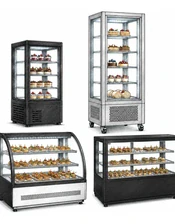
Refrigerated display cases are designed to keep products at the required temperature while presenting them clearly and attractively to the customer. This is not one universal equipment type: a countertop display case near the till, a pastry display counter, a vertical panoramic display case and a display freezer solve different tasks.
In this category, the choice is usually between compact countertop models, LCT-type pastry display counters, newer low-energy PDA3-CTF display counters, vertical panoramic UPD models and special refrigerated or frozen display units. The right choice depends on the product, the display location, the required temperature, airflow, glass construction and everyday service convenience.
Before choosing a display case, start with practical questions: what product will be displayed, how long it will stay in the display, whether it is sensitive to drying, whether visibility from all sides is needed, what the ambient temperature is and whether the unit will be placed near doors, sunlight, heat sources or an air-conditioning airflow.
|
Situation |
Typical display case type |
Why |
|
Impulse sales near the till |
Countertop panoramic display case |
Small footprint, good visibility and convenient presentation for desserts, snacks or drinks. |
|
Cakes, pastries and desserts in a cafe |
LCT or PDA3-CTF pastry display counter |
Larger display area, rear sliding doors, LED lighting and convenient service access. |
|
Sandwiches, snacks and prepared food |
Display case with electronic controller and suitable temperature range |
Accurate temperature control and clear presentation are important. |
|
Maximum visibility from several sides |
Vertical 360° panoramic display case |
Products are visible from multiple directions and the height of the room is used efficiently. |
|
Frozen desserts or frozen products |
Display freezer |
Frozen products require freezing temperatures such as -22...-18 °C, not a positive refrigerated range. |
Several display cases may show a similar temperature range in the catalogue, but that does not mean they are equally suitable for every product. A cake, a sandwich, a chocolate dessert, packed salad and a drink behave differently in a display case.
Temperature is only one part of the decision. Air movement, moisture loss, product sensitivity to drying, packaging, display time and door opening frequency must also be considered. Ventilated cooling helps keep the temperature more even, but delicate uncovered products may dry faster if they stay in the airflow for too long. In that case, reduce display time, use suitable packaging or choose the display case according to the specific product.
Countertop display cases such as UPD60 or UPD80-type models are suitable for small displays on a bar, counter or near the till. They work well when the product must be visible from several sides but there is no space for a large floor-standing unit. They are commonly used for desserts, snacks, sandwiches, pastries, drinks or other impulse-sale products.
Their main strength is compact size and visibility. Their limitation is smaller volume and display area, so they should not be treated as the main long-term storage solution for larger quantities of product.
LCT-type display cases are a more robust countertop solution for pastries and desserts. They may have curved or flat front glass, stainless steel and glass construction, rear sliding doors, LED lighting and ventilated cooling. They are a good choice for cafes, bakeries or dessert counters where easy staff access from the rear is required.
Curved glass has a softer, more classic look, while flat glass often looks more modern and fits minimalist interiors. In practice, the shape is only one factor; ease of cleaning, rear-door convenience and the actual display area are just as important.
Floor-standing pastry display counters are intended for more professional presentation. The newer PDA3-CTF range replaces the previous LPD-3F range and features EU energy class B, temperature class 3M1, LED lighting under each shelf, rear sliding doors, front glass that can hinge forward for cleaning and an easy-to-clean condenser filter.
These models are worth choosing when the display must be not only cold but also visually representative: for pastries, cakes, desserts, sandwiches, prepared food or delicatessen products where visibility, a stable operating regime and convenient daily service matter.
Vertical panoramic display cases use the height of the room and allow products to be seen from several sides. They are suitable for desserts, cakes, prepared foods, drinks or premium displays where the case is visible in the sales area, not only behind the counter.
Their main advantage is visibility. However, because of the large glass area, they are particularly sensitive to location: direct sunlight, heat sources, entrance doors or air-conditioning airflow can increase condensation, energy consumption and make temperature maintenance more difficult.
Some panoramic models are not designed for positive refrigerated temperatures but for frozen product display. For example, a UPD400-F-type unit operates in the freezer range and is used for frozen products, desserts or frozen goods. It should not be confused with a +2...+8 °C refrigerated display case; it is a different temperature regime and a different use case.
Refrigerated display cases commonly use several temperature ranges: +2...+12 °C for compact countertop displays, +2...+8 °C for pastry displays, -1...+5 °C for 3M1 floor-standing display counters and -22...-18 °C for frozen displays. The numbers must always be interpreted together with the product type.
An electronic controller with a temperature display provides better control and makes the operating regime easier to monitor. This is especially important for food products where temperature is not only a matter of presentation, but also of safety and quality.
|
Practical rule |
Many refrigerated display cases use ventilated cooling. Fans distribute cold air more evenly through the display, helping to stabilise temperature across the shelves.
However, airflow can also dry sensitive products. Uncovered sliced desserts, sandwiches, salads or soft pastries may lose moisture faster. Products should not be kept in the display too long, should be covered or packed when appropriate, and the shelves should not be loaded in a way that blocks air circulation.
For a pastry or snack display, gross volume in litres is not always the most useful number. Often the more important question is how much usable shelf area is available, how deep the shelves are, whether the products can be arranged in a clear single layer and whether the customer can see the full display.
A small countertop unit may be highly effective near the till, while a larger floor-standing display counter provides more display area and better service ergonomics. When comparing models, look at total display area in m², shelf count, shelf dimensions and rear-door access.
A refrigerated display case sells through visibility as much as through temperature. Double-glazed glass, anti-fog front glass, heated or better-insulated glass zones, suitable LED lighting and easy access for cleaning directly influence product visibility.
Condensation usually appears when warm humid air reaches a cold glass surface. If the display case stands near entrance doors, in front of an air conditioner, in direct sunlight or in a very humid room, even a good unit may fog more often. This does not necessarily mean a fault; the cause is often installation location or ambient conditions.
LED lighting in refrigerated display cases is not only decorative. It helps the customer see the product, enhances colours and creates a clean, bright display. In PDA3-CTF-type counters, LED lighting under each shelf improves visibility on the lower display levels as well.
Lighting should not be the only selection criterion. If the product is sensitive to light, heat or drying, correct temperature, airflow, short display time and hygienic daily maintenance are more important.
|
Built-in installation |
Climate class indicates the ambient conditions under which the manufacturer tests the unit. Refrigerated display cases with large glass surfaces are sensitive to ambient temperature and relative humidity. For example, climate class 3 is commonly associated with about +25 °C and 60% RH, while class 4 is commonly associated with about +30 °C and 55% RH, depending on the manufacturer data.
This matters in small cafes, shops with large windows, summer trading locations or rooms where the temperature changes significantly during the day.
A good refrigerated display case should be attractive and easy to maintain. In practice, it matters whether the rear doors are convenient, whether the front glass can hinge forward for cleaning, whether shelves are easy to remove, whether the condenser filter is accessible and whether automatic defrost suits the daily operating routine.
A dirty condenser, blocked vents, overfilled shelves and poor installation location often cause more problems than the model itself. Maintenance convenience should therefore be part of the selection process.
If you need a small display near the till or bar, look at countertop UPD or LCT models. If the priority is presentation of cakes, pastries, desserts, sandwiches or prepared food, larger LCT or PDA3-CTF-type display counters are usually more suitable. If visibility from all sides matters, choose a vertical panoramic display case. If the products are frozen, choose a display freezer rather than a refrigerated display case.
If unsure, tell us what you plan to display, the required temperature, how long the product will stay in the display, the planned installation location and whether the unit will be built into a niche. With this information, the right equipment can be selected much more accurately than by litres or price alone.
A display refrigerator is usually a cabinet with glass doors for drinks or packed products. A refrigerated display case is more often used for active presentation of desserts, pastries, sandwiches, prepared food or products served by staff.
Not always. The temperature range may be similar, but product sensitivity to drying, airflow and display time can differ. The display case should be selected according to the specific product.
A countertop unit is suitable for small product quantities, impulse sales near the till, coffee areas or bars. It is not the main long-term storage solution for large quantities.
Choose it when you need a larger display area, representative product presentation and convenient service from the staff side. These units suit cafes, bakeries, dessert shops and delicatessen areas.
3M1 indicates that the unit is suited to retail chilled product conditions. Such models are better suited for products that require a lower and more stable regime, for example around -1...+5 °C.
Yes, if products are kept uncovered in the airflow for a long time. Ventilated cooling improves temperature evenness, but sensitive products may need shorter display time, packaging or covering.
The usual cause is warm humid air around the display. Entrance doors, draughts, air-conditioning airflow, direct sunlight and high room humidity all increase condensation risk.
Not recommended if direct sunlight reaches it. The large glass area receives heat, increasing refrigeration load, energy consumption and condensation risk.
A practical rule is at least 6-8 cm, but the manual for the specific model is more important. If the unit is installed into a niche or between furniture, air intake and hot air discharge must be checked in advance.
Only if sufficient ventilation and service access are preserved. We recommend consulting us before this type of installation.
Not in a way that blocks air circulation. Products should be arranged so that cold air can move through the display.
Compare not only price and volume. Check display area, shelf dimensions, temperature class, controller type, kWh/24h, climate class, cleaning convenience and installation requirements.