excl VAT

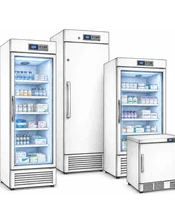
Laboratory refrigerators are specialised refrigeration appliances designed for laboratories, research centres, healthcare facilities, pharmaceutical companies, universities and other organisations where it is important not only to keep materials cold, but to maintain controlled and monitored temperature conditions.
This category includes laboratory refrigerators in different capacities – from compact models for smaller quantities of samples or reagents to full-height and high-capacity laboratory refrigeration cabinets. Depending on the application, models are available with glass or solid doors, different usable capacities and different levels of temperature monitoring, data logging and alarm functionality.
Many laboratory refrigerators in this category operate within a temperature range of approximately +2…+16 °C, but the correct model should always be selected according to the storage requirements specified for the materials being stored.
At first glance, a laboratory refrigerator may look similar to a conventional refrigerator, but their intended use is very different.
The main purpose of a domestic or commercial refrigerator is to keep food or drinks sufficiently cold. Short-term temperature fluctuations are usually not critical in these applications.
In a laboratory, the situation is different. The stability of reagents, samples, diagnostic materials and other temperature-sensitive products may depend on how consistently and evenly temperature is maintained throughout the entire cabinet.
For this reason, laboratory refrigerators are selected not only by their thermostat range but also by factors such as:
uniform cold-air distribution;
temperature stability;
rapid temperature recovery after door opening;
visual and audible temperature alarms;
connection for an additional temperature probe;
temperature data logging;
alarm history;
integration with an external monitoring system.
This is why professional laboratory refrigeration should not be evaluated only by cabinet volume and nominal temperature range.
These two equipment groups are closely related, but their intended use is not exactly the same.
Medical or pharmaceutical refrigerators are primarily designed for medicines and pharmaceutical products. Their typical storage range is +2…+8 °C.
Laboratory refrigerators may provide a wider operating range, for example +2…+16 °C, allowing them to be used for reagents, diagnostic materials, samples and other laboratory products whose storage conditions differ from the standard pharmaceutical +2…+8 °C range.
The most important selection criterion is not simply whether a cabinet is called “medical” or “laboratory”. It is the required temperature of the stored material, permitted temperature variation and your organisation’s monitoring and documentation requirements.
If you need to store medicines requiring +2…+8 °C, we also recommend reviewing our Medical Refrigerators category.
Smaller refrigerators in approximately the 130 l class are suitable for laboratories, treatment rooms and departments that store relatively small quantities of temperature-sensitive materials.
Their main advantage is their compact external size. Some models can be positioned under a worktop or combined with another independently controlled unit within the same working area.
They are a practical solution when a full-height refrigeration cabinet would be unnecessarily large.
Laboratory refrigerators in approximately the 385 l class are designed for larger quantities of reagents, samples and other laboratory materials.
Their vertical design makes efficient use of floor space, while adjustable shelving allows the interior to be adapted to containers of different sizes.
For many medium-sized laboratories, this is the most versatile format.
Where a large volume of laboratory materials must be stored in one cabinet, high-capacity models of approximately 500–600 l or more may be more appropriate.
These are well suited to central laboratories, research centres and other facilities where large storage capacity and frequent daily access are required.
Laboratory refrigerators may be equipped with glass or solid doors.
Glass doors allow staff to see the contents without opening the cabinet. This is particularly useful when samples or reagents need to be located frequently. Fewer unnecessary door openings also mean less warm air entering the cabinet.
Solid doors generally provide better thermal insulation and lower energy consumption. They are a sensible choice where visual access to the contents is not required.
A glass door is therefore not automatically “better”, and a solid door is not simply a lower-grade option. They are designed for different working routines and priorities.
Laboratory refrigerators commonly use fan-assisted cooling, where a fan circulates cold air throughout the cabinet.
Its purpose is to reduce temperature differences between shelves and to help the cabinet recover more quickly after the door has been opened.
This is important because the temperature shown on the controller does not necessarily tell you the temperature at every location inside the refrigerator.
For this reason, when comparing laboratory refrigerators it is worth considering not only the nominal temperature range but also the manufacturer’s declared temperature fluctuation and temperature gradient.
Entry-level professional laboratory refrigerators may include visual and audible temperature alarms.
More advanced models may also offer:
integrated temperature data logging;
Bluetooth connectivity;
a mobile application;
temperature and alarm history;
RS485 communication;
external alarm contacts;
connection for an additional temperature probe;
backup power for the electronic controller.
These features do not change the basic purpose of the refrigerator. Their value is that they help users identify problems more quickly and provide evidence of the conditions under which materials were stored.
For laboratories where temperature control forms part of a quality system, audit procedure or research protocol, data logging and alarm history may be considerably more important than a relatively small difference in purchase price.
Before choosing a model, consider the following questions:
What will you store? Reagents, samples, diagnostic materials or other products?
What temperature range is required? For example, +2…+8 °C or a wider +2…+16 °C range?
How much storage capacity do you need? A compact 100–130 l cabinet or a larger full-height model?
Do you need to see the contents without opening the door? If yes, a glass door may be preferable.
Do temperature data need to be recorded?
Does the refrigerator need to connect to a building or laboratory monitoring system?
Is a specific standard, certificate or audit requirement applicable?
If you are unsure which model is suitable, provide us with information about the materials being stored, required temperature range, required capacity and monitoring requirements. We can help select the most appropriate laboratory refrigerator.
A laboratory refrigerator is a professional refrigeration appliance designed to store temperature-sensitive laboratory materials under controlled conditions. Compared with a standard refrigerator, greater emphasis is placed on temperature stability, alarms, monitoring and, depending on the model, data logging.
This depends on the specific model. Laboratory refrigerators in this category may typically offer an operating range of around +2…+16 °C. The required temperature should always be determined by the storage requirements of the specific material.
It depends on the refrigerator’s intended use, technical specifications and the storage requirements of the medicine. For medicines requiring +2…+8 °C, a dedicated pharmaceutical or medical refrigerator is usually the more appropriate choice.
Medical refrigerators are primarily designed for medicines and pharmaceutical products, usually within the +2…+8 °C range. Laboratory refrigerators may offer a wider operating range and may be designed for reagents, samples and other laboratory materials.
For some non-critical materials this may be technically possible, but a domestic or commercial refrigerator is not automatically suitable for controlled laboratory storage. Where specific temperature stability, alarm or documentation requirements apply, specialised equipment should be used.
Temperature gradient describes the difference in temperature between different locations inside the refrigerator. The smaller the gradient, the more uniform the storage conditions across different shelves and areas of the cabinet.
A temperature alarm warns staff when the cabinet temperature moves outside the defined limits. This allows faster response to an open door, power failure, refrigeration fault or other problem.
No. Some models provide only a temperature display and alarm, while more advanced versions may log temperature data, store alarm history or transmit data through Bluetooth, USB or RS485.
A glass door is more convenient when staff frequently need to see the contents without opening the cabinet. A solid door may be preferable where visibility is unnecessary and lower heat gain and energy consumption are priorities.
Not every laboratory refrigerator is suitable for blood, plasma or other biological materials. These products may be subject to specific storage and equipment requirements. The refrigerator must be selected according to the exact requirements of the material and applicable procedures.
For smaller laboratories or individual treatment rooms, a compact refrigerator of approximately 100–130 l may be sufficient. For medium storage requirements, full-height cabinets of approximately 300–400 l are often practical. Central laboratories or facilities storing larger quantities may require 500–600 l or larger models.
Many professional laboratory refrigerators have lockable doors, but this should be confirmed in the specification of the specific model. A lock is useful where access to reagents, samples or other stored materials must be restricted.
This depends on your organisation’s quality procedures and the requirements of the stored materials. Where continuous temperature history is required, use a refrigerator with integrated data logging or a separate independent temperature data logger.