excl VAT

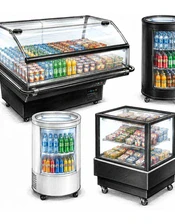
Commercial impulse coolers and freezers are not only designed to keep products cold. Their main purpose is to place the product where customers notice it, can reach it easily and can add it to their basket with minimal friction. This makes product visibility, access from several sides, mobility, glass construction, branding potential and location in the customer flow just as important as temperature and capacity.
Our current range contains 14 models serving different retail tasks: compact CC45, CC55 and CC77 can coolers, the LOJ100 promotional display unit, PDC90SL-2 and PDC126 VS SL LED island coolers, high-capacity KBAK104 and KBAK104PLUS beverage coolers, the dual-purpose UHD201 cooler/freezer, the mobile CF78 impulse freezer and four stainless-steel BHC bottle chest coolers. These products should not be treated as one uniform equipment type.
The key rule is simple: choose an impulse unit according to the product, the required temperature, how customers will access it and where the cabinet will actually stand. The best sales position is not automatically the best refrigeration position, so merchandising logic must always be balanced with the technical operating conditions of the equipment.
• For cans and a smaller amount of chilled beverages near the checkout or at events – choose a mobile CC can cooler.
• For 360° product visibility in the centre of a shop floor – consider a PDC island cooler with transparent sides and sliding glass lids.
• For high-volume beer, soft drink or bottled beverage storage – consider KBAK or BHC horizontal beverage coolers.
• If one cabinet must be used either as a cooler or as a freezer – UHD201 offers two operating modes.
• For frozen impulse products such as ice cream and frozen desserts – CF78 is a dedicated mobile impulse freezer.
• If branding is a major part of the promotion – choose a cabinet with a body, canopy or surface specifically suitable for branded graphics.
Impulse refrigeration is typically positioned in an active customer decision zone rather than in a storage area: near checkouts, in a central aisle, in a promotional zone, next to a complementary product or wherever the customer has a short opportunity to make an additional purchase. TEFCOLD also positions island coolers and mobile can coolers around product visibility, easy access and impulse sales.
“Impulse” does not necessarily mean “open”. Some cabinets use transparent flip-flop lids, some use sliding glass lids and others are closed horizontal bottle coolers. The common principle is that the product remains easy to see or reach, while the cabinet is practical to reposition and replenish.
The CC range is primarily intended for canned and bottled beverages. For example, TEFCOLD specifies fan-assisted cooling, fast pull-down, a transparent flip-flop lid, castors and a +2…+12 °C temperature range for the CC45. The controller is mechanical. This is a classic impulse beverage cooler for checkouts, promotions, tastings and events, and the cylindrical body is well suited to custom branding.
The CC45 holds approximately 44 standard 330 ml cans, which is often a more useful way to understand practical capacity than litres alone. Larger CC55 and CC77 models follow the same principle: they are mobile beverage coolers, not precision +2 °C food-storage cabinets.
The CC, KBAK and BHC ranges use mechanical thermostats. As with other beverage display coolers, the lower figure in the stated temperature range should not be interpreted as a guarantee of precision control at that exact temperature. Mechanical thermostats have greater control inertia and are best suited to beverages that simply need to remain consistently chilled.
PDC and UHD island units use electronic controllers, allowing more precise temperature management. Even then, the storage requirements of the actual product and the temperature classification of the specific model must be checked.
The key strength of the PDC range is product visibility. PDC90SL-2 has transparent Plexiglas sides, two sliding glass lids, castors and optimised airflow. TEFCOLD specifies a -1…+5 °C operating range, ventilated cooling, an electronic controller and climate class 3. It is therefore more than a simple beverage tub: it is a refrigerated retail island for packaged products suitable for that temperature range.
PDC126 VS SL LED is a larger and more advanced version. TEFCOLD specifies 190 l net volume, 1.51 m² total display area, -1…+5 °C, ventilated cooling, electronic control, LED lighting and a variable-speed compressor. The variable-speed system is intended to better match cooling output to demand, and TEFCOLD highlights the model for lower energy use and noise compared with conventional impulse island designs.
Sliding glass lids reduce the amount of warm room air entering the display while maintaining quick customer access. Transparent sides make the products visible from several directions, which is particularly useful in a central retail island.
KBAK models are horizontal beverage coolers with solid sliding lids. They offer less 360° product visibility than PDC islands, but provide substantial refrigerated storage for beer, soft drinks and beverage crates close to the sales area. TEFCOLD specifies 226 l net volume for KBAK104 and 250 l for KBAK104PLUS. Both operate at approximately +1…+8 °C with static cooling and a mechanical thermostat.
KBAK104PLUS adds stronger mobility and bumper protection, making it practical in busy retail environments where the cooler is frequently repositioned. Think of this type of equipment as refrigerated beverage stock directly in the selling area rather than a panoramic display case.
The BHC range is built for high volumes of bottles and cans. Cabinet width increases from approximately 1005 to 2505 mm, while net volume rises from around 155 to 565 l. The range uses static cooling, mechanical control and a +2…+8 °C operating range. Stainless-steel construction is easy to clean and well suited to bars, events and high-throughput beverage service areas.
Choose the BHC size according to real beverage throughput and available wall length. A larger unit stores more, but also consumes more floor space. If product visibility is the priority, a PDC or other glazed display solution may be stronger; if stock volume and quick replenishment are more important, BHC is usually the more rational format.
UHD201 is unusual because it can operate in two different modes: approximately -2…+5 °C as a cooler or -24…-18 °C as a freezer. TEFCOLD specifies electronic control, ventilated cooling, automatic hot-gas defrost, sliding glass lids, glazed sides, braked castors and an adjustable false base that can change the display height.
This flexibility can be valuable for seasonal retail: the same cabinet may display frozen products in one period and chilled products in another. The operating mode changes the purpose of the entire cabinet, so products should be removed and the unit allowed to stabilise at the new temperature before restocking. It is not a two-zone cabinet operating at two temperatures simultaneously.
CF78 is designed for frozen impulse products. TEFCOLD specifies a -22…-14 °C range, fast pull-down, an internal divider system, transparent flip-flop lid, strong castors and good branding potential. It is well suited to individual portions, ice cream, frozen desserts and other products that benefit from being placed close to the customer decision point.
Do not confuse it with a CC can cooler. The external format may look similar, but the temperature range and intended product are completely different.
Both principles are present in this category because they serve different purposes. In CC, PDC and UHD products, moving air helps restore cabinet temperature after restocking or lid opening and distributes cooling more evenly across the display. That is useful in intensive impulse retailing.
KBAK and BHC beverage chest coolers use static cooling. This is logical for bottled and canned drinks: the products have high thermal mass and do not require the same precision air-temperature control as more sensitive fresh foods. Cooling type should therefore be matched to the product and operating pattern rather than treated as a simple “better/worse” comparison.
The easier a product is to reach, the stronger the impulse-sales ergonomics – but also the greater the potential heat load. This is why modern island coolers often use sliding glass lids: products remain visible and easy to access, while the refrigerated space is not continuously open to the room.
PDC126 is a good example of energy efficiency being addressed with more than lids alone: it also uses a variable-speed compressor and efficient fans. Compare energy use by kWh/24 h or kWh/year, not just by input power in watts.
Impulse equipment needs an active retail position, but not every high-traffic location is technically suitable. Good merchandising positions include checkout areas, main customer routes, cross-merchandising points, promotional zones and central islands. However, the cabinet should not stand directly beside frequently opened external entrance doors where it is exposed to warm, humid air.
Avoid direct sunlight, ovens, radiators, cooking equipment and other heat sources. Air-conditioning or strong ventilation should not blow directly onto the cabinet. These conditions increase the refrigeration load and can encourage condensation on glass or lids.
In other words, the “best sales position” should also pass a refrigeration check. If necessary, send us a floor plan or photo before finalising the checkout or island layout and we can help assess the position.
Plug-in impulse coolers reject heat into the room through the condenser. Air intake and discharge grilles must therefore not be blocked by boxes, promotional panels or furniture. Even if the cabinet is mobile, a permanent merchandising installation must still preserve the manufacturer’s required clearance around the refrigeration unit.
If you want to integrate a cooler into a checkout desk, custom island, niche or other furniture, contact us before the furniture is manufactured. We can check the condenser air path, required service access and whether the selected model is suitable for the proposed built-in arrangement.
Different impulse models are designed for different ambient conditions. For example, CC45 and KBAK104 are climate class 4 with a stated maximum ambient of about +30 °C / 55 % RH, while PDC90SL-2 and PDC126 are climate class 3, around +25 °C / 60 % RH. This matters in warm stores, kiosks, summer events and any location close to an entrance.
Operating above the design ambient can increase energy use, extend compressor run time, reduce temperature stability and increase the risk of condensation. Climate class is therefore a genuine selection criterion, not just a number on a data sheet.
Impulse refrigeration is often repositioned for promotions, seasons or changing customer flow, so mobility matters more than it does with many fixed cabinets. CC and CF formats are easy to move, while PDC and UHD islands use stronger castors and some have brakes. PDC, KBAKPLUS and UHD also use bumper protection to reduce damage in busy retail areas.
After moving the cabinet, make sure it is stable, braked castors are locked, the power cable is not stretched or trapped and condenser ventilation remains unobstructed.
Cylindrical CC and CF models, LOJ100 with its illuminated canopy and several other impulse cabinets are well suited to custom graphics and brand communication. This is particularly useful for beverages, ice cream, seasonal products and supplier-funded promotions.
Branding must never cover ventilation grilles, controls or service access. The graphic design should follow the technical construction of the cabinet, not obstruct it.
For impulse refrigeration, practical selling capacity is often more important than nominal litres. For can coolers, compare the number of 330 ml cans or bottles. For island coolers, consider net volume and total display area. For horizontal beverage coolers, internal dimensions, divider layout and replenishment ergonomics may matter more than gross volume.
An oversized cabinet does not automatically sell more if it obstructs the aisle or creates an awkward customer route. An undersized cabinet that staff must replenish constantly can also be inefficient. The best size balances sales rate, replenishment frequency and available floor space.
Some impulse models such as the CC and CF ranges are promoted for fast pull-down. Even so, an impulse cooler is not a blast chiller. Filling it with a large quantity of room-temperature beverages or warm products will increase the internal temperature and force the compressor to run hard for a period of time.
For best results, replenish the display with products that are already chilled, and use a dedicated storage refrigerator or other suitable equipment to pre-chill large warm loads.
• First decide whether the product is a beverage, chilled food or frozen product.
• Check both temperature range and controller type: mechanical control is practical for drinks, while electronic control allows more precise temperature management.
• Decide whether 360° product visibility or maximum stock capacity is more important.
• For central islands and promotional zones, consider castors, brakes and bumper protection.
• Check climate class against the real ambient temperature and humidity of the location.
• Do not place the cabinet by an external entrance, in direct sunlight, next to heat sources or in a direct air-conditioning stream.
• If the unit will be integrated into furniture or a niche, confirm ventilation and service access before ordering.
• Compare energy use in kWh/24 h or kWh/year rather than input watts alone.
• If branding is important, select a cabinet whose body and construction are suitable for custom graphics.
If you are unsure, send us the product type, target temperature, approximate sales volume, available dimensions and a photo or plan of the intended location. That information allows us to select an impulse unit that not only looks good, but also operates correctly in the real retail environment.
An impulse unit is designed for very high product visibility and easy customer access. It is often lower, mobile, island-shaped or cylindrical and is placed directly in the customer flow. Conventional display coolers are more often used as permanent vertical refrigerated displays.
When you need a compact, mobile beverage cooler near the checkout, at an event, in a promotion zone or next to a complementary product. The CC range is primarily intended for cans and bottles.
Its intended use is beverages and it uses mechanical control. For temperature-sensitive food that requires precise storage conditions, choose a commercial cooler with electronic control and a stated food-storage application.
When visibility from several sides and a large retail display are the priorities. PDC models have transparent sides and sliding glass lids, making them suitable for central shop-floor and aisle positions.
PDC126 uses a variable-speed compressor, LED lighting, ventilated cooling and offers a 1.51 m² total display area. TEFCOLD designed it to better combine product visibility with energy efficiency.
No. The cabinet can be switched to one of two modes: approximately -2…+5 °C or -24…-18 °C. It is not a two-temperature-zone cabinet.
CF78 is a mobile impulse freezer for frozen products such as ice cream and frozen desserts, with an operating range of approximately -22…-14 °C.
It should not stand directly beside frequently opened external doors. Warm, humid air increases the refrigeration load and may cause condensation. Choose a high-traffic location with more stable ambient conditions.
No. Direct air-conditioning or strong ventilation can disturb heat exchange and increase condensation on glass. Keep the cabinet away from strong air streams.
Only after checking the ventilation design of the specific model. Condenser air intake and discharge must remain open. If you are planning a niche or checkout installation, confirm the layout with us before furniture production.
It describes the ambient temperature and relative humidity conditions for which the cabinet is designed. Climate class 3 commonly corresponds to about +25 °C / 60 % RH, while class 4 is around +30 °C / 55 % RH.
Not universally. Ventilated cooling offers faster temperature recovery and more even air distribution in intensive displays. Static cooling is rational in bottle and can chest coolers where the products have high thermal mass and do not need precision air-temperature control.
Compare kWh/24 h or annual kWh, the energy class and the useful capacity. Input power in watts alone does not show real daily consumption because compressors do not run continuously at the same load.
Yes, but cooling will take time and the refrigeration system will be heavily loaded. For best results, replenish the display with pre-chilled drinks.
Yes, when the unit is part of a branded promotion. Just make sure graphics never cover ventilation grilles, controls or service access points.