excl VAT

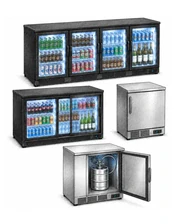
Backbar coolers are commercial beverage refrigerators designed to keep bottles, cans and, in specialist models, KEGs within immediate reach of the bartender. Their value is not just refrigerated volume. A well-selected backbar improves workflow, reduces unnecessary staff movement and helps keep drinks at a stable serving temperature even during busy service.
The range includes several levels of equipment: compact BA and DB glass-door backbars, heavier-duty CBC models with stainless steel interiors, premium SERRCO by TEFCOLD systems, and dedicated KEG coolers. This means that asking only “how many litres does it hold?” is not enough. You should consider what will be stored, how frequently the doors will be opened, how many people work behind the bar, the available installation space and how the heat from the refrigeration system will be removed.
The key principle is simple: design the workflow first and choose the cooler second. If the bar furniture is built before the refrigeration equipment is selected, the result is often a compromise in door access, ventilation, capacity or serviceability.
|
Group |
Typical use |
Key selection criterion |
|
BA / DB glass-door backbars |
Bottles and cans where visibility and fast access matter. |
1/2/3 doors, hinged or sliding, real bottle/can capacity and energy class. |
|
CBC heavy-duty range |
Busy bars where robust construction, stainless interior and intensive cleaning are priorities. |
Glass or solid doors, stainless shelves, door/drawer configuration and workload. |
|
SERRCO SCL / SGD |
Premium bars and projects where the refrigeration is designed as part of the complete workstation. |
Modularity, machine-unit side, service access and bottle/KEG use case. |
|
CKC / SFK KEG coolers |
Draught beer KEGs and high-throughput bar service. |
KEG type and quantity, beer-line routing, machine position and cooling stability. |
|
KSC / SKB KEG storage |
Larger reserve stock for high-volume bars, restaurants and event venues. |
Required KEG capacity, logistics, condensing unit and service access. |
A backbar cooler sits behind or under the bar worktop so that the bartender can reach frequently used drinks with minimal movement. A countertop cooler is placed on the work surface and is normally used for a small visible range or impulse sales. An upright glass-door cooler provides much more vertical capacity, but requires staff to turn away from the workstation and move more frequently.
In high-volume bars, a backbar is part of workflow design rather than simply a refrigerator. Fast-moving products should be positioned in the most accessible zones, while reserve stock can be kept in a larger upright cabinet or separate cold store.
A one-door model suits a small bar, café or secondary station. A two-door backbar is often the most versatile format, allowing different drink groups to be organised separately. A three-door model makes sense in higher-volume venues or where several staff members need broad access at the same time.
Capacity should be assessed in real containers, not litres alone. TEFCOLD lists, for example, approximately 96 x 330 ml bottles or 161 x 330 ml cans for the BA11H; around 143 bottles or 276 cans for the BA21S; and around 218 bottles or 380 cans for the BA31H. These figures are far more useful when planning bar stock than a gross volume number.
Hinged doors provide full access to the shelves and are generally easier for loading. They work best when there is enough aisle space behind the bar. Self-closing hinges, where fitted, also reduce the risk of a door being left open during a busy shift.
Sliding doors save aisle space because they do not swing into the workstation. This is valuable in a compact bar, but opening one side partially blocks the other, so hinged doors can be more convenient when several bartenders use the same cabinet. Sliding tracks also need regular cleaning in a bar environment.
Glass doors let staff see stock levels instantly and help locate a specific bottle quickly. They are also useful when the backbar is visible to customers and the drink display forms part of the bar design. BA and DB ranges are primarily focused on visible bottle and can storage.
Solid doors are practical when the contents do not need to be displayed, when KEGs are stored, or where robust storage is the priority. CBC and SERRCO ranges include solid-door options. A solid door also removes glass condensation from the equation, but actual energy efficiency should always be judged by the specific product data rather than door material alone.
BA and DB are classic beverage backbar ranges. Both use ventilated cooling, electronic temperature control, adjustable shelving and LED lighting. TEFCOLD highlights variable-speed compressor technology in the current BA range and states approximately 59% lower energy consumption than the previous BA generation. For the current DB range, the manufacturer states an improvement of approximately 56% compared with the previous generation.
BA is positioned as the more premium range, with aluminium-framed glass doors, chrome shelving and A or B energy class models. DB is a simpler standard range with a strong balance of capacity, price and energy performance. The right choice depends on workload and build quality requirements, not just purchase price.
CBC models are designed for more demanding commercial operation. They use stainless steel interiors and shelves and are available with glass or solid doors. This makes them a strong option for busy bars where the cabinet is loaded frequently, cleaned intensively and expected to withstand a higher daily workload.
With CBC, construction and workflow may matter more than a small difference in volume. Depending on the configuration, doors can also be replaced with pull-out drawers, allowing the workstation to be tailored around actual product flow.
SERRCO by TEFCOLD is aimed at premium bar projects where refrigeration is integrated into the complete workstation. SCL offers multiple widths, fast temperature pull-down and a removable refrigeration unit for faster servicing. SGD models can be used for bottles and KEGs, with glass or solid doors and different hinge-side options.
These systems are best selected before the bar furniture is manufactured. Overall width, machine-unit location, door direction, shelf layout, KEG use and service access should be coordinated in the project. Modularity is most valuable when refrigeration is designed into the bar from the start.
For draught beer, simply placing a KEG in a cool area is not enough. The KEG temperature must remain stable and the cooler needs to be coordinated with the dispensing system and beer-line route. CKC models are intended for 20 l KEGs, while SERRCO SFK models are designed for different KEG types and include dedicated beer-line pass-throughs.
SFK models are available with the refrigeration unit on the right or left, so service access and beer-line direction should be known before ordering. Larger KSC or SKB products are no longer typical undercounter backbars; they are larger KEG storage solutions for high-volume bars, restaurants, events or more complex draught systems.
Modern BA, DB, CBC and SERRCO backbars use electronic controllers and ventilated cooling. Air circulation helps distribute cold air quickly and recover cabinet temperature after door openings. This is especially important in a bar where doors may be opened many times per hour.
A typical temperature range for many backbar models is around +2 to +10 °C. This is ideal for chilled beverages, but a backbar should not automatically be treated as a universal food refrigerator. If perishable food is stored, the food requirements, cabinet stability and intended application must be checked carefully.
For white or sparkling wine, a backbar can be a practical service solution. If different serving temperatures or long-term wine storage are required, a dedicated wine cooler is normally the better choice.
Ventilated cooling and fast pull-down help the cabinet recover after door openings or replenishment. They do not turn a backbar into a blast chiller. Large quantities of room-temperature beer, water or soft drinks should ideally be pre-chilled or loaded in stages, especially before the busiest service period.
A cabinet can physically fit into a furniture opening and still be unable to operate correctly. The compressor and condenser must reject heat into the surrounding air. If hot air is trapped inside a closed niche, condensing pressure rises, compressor run time increases, energy use goes up and cooling performance can deteriorate.
Air intake and exhaust arrangements differ between ranges, so one universal 6-8 cm clearance rule should not be applied blindly to every backbar. Some models are intended for freer installation, while premium modular systems are designed differently. If the cooler will be enclosed by furniture or fitted under a continuous counter, contact us before the furniture is manufactured so the ventilation openings, niche dimensions and service access can be checked for the exact model.
Many BA, DB, CBC and SERRCO models are climate class 4, which corresponds to standard test conditions of approximately +30 °C and 55% relative humidity. In practice, the microclimate next to a glasswasher, beneath an enclosed counter or beside a kitchen can be much hotter than the general room temperature.
If the air around the condenser is too warm, even a high-quality cooler may run almost continuously. The temperature inside the installation niche is therefore just as important as the published cabinet temperature range.
Compare kWh/24 h, annual kWh and energy class rather than input watts alone. Current BA and DB ranges use energy-saving variable-speed compressors that can adapt their operation to the cooling demand.
Always compare products of similar size and purpose. A three-door heavy-duty CBC serves a very different capacity and workload from a one-door BA. The lowest absolute kWh figure is not automatically the best commercial choice if the cabinet is too small and staff constantly open the doors or run out of chilled stock.
A backbar sits close to the bartender, so noise matters more than it would in a storage room. Current TEFCOLD and SERRCO examples can be found around the 41-44 dB(A) range, but the exact figure is model-specific and should be checked in the technical data.
Furniture resonance can matter as much as the published sound level. Uneven floors, panels pressing against the cabinet or a poorly designed niche can amplify vibration. The cooler should be stable and levelled on its adjustable feet.
Backbar condensers quickly collect dust, textile fibres, sticky sugar residue and other airborne contamination. A dirty condenser rejects heat less effectively, increasing operating temperatures and energy consumption. Condenser cleaning should be part of routine preventative maintenance.
Door gaskets, sliding tracks, shelves and condensate areas also need regular cleaning. SERRCO premium models specifically emphasise fast service access and removable refrigeration units because downtime behind a bar directly affects sales.
A backbar is installed behind or under the bar worktop for fast access during service. A countertop cooler sits on the work surface and is normally used for a smaller visible range or impulse sales.
Sliding doors are best where the staff aisle is narrow. Hinged doors provide more complete shelf access and can be more convenient when several bartenders share the same cabinet.
No. Modern double-glazed models can achieve very good energy classes. Compare the actual kWh/24 h and energy class of the specific product rather than judging by the door material alone.
It depends on the container size. Manufacturer figures for 330 ml bottles, 330 ml cans or 500 ml PET bottles are more useful than litres. For example, BA11H holds about 96 x 330 ml bottles, while BA31H holds about 218.
Backbars are primarily designed for beverages. Packaged food should only be stored when the cabinet temperature and the product storage requirements are compatible. For perishable food, a professional food refrigerator is usually the safer choice.
Only if the exact model has adequate ventilation and service access. Physical fit is not enough. Select the cooler before the furniture is manufactured and check the air path for that model.
There is no single universal figure for every backbar because intake and exhaust layouts differ. Follow the specific installation instructions. For enclosed niches, contact us before furniture manufacture.
Typical causes are frequent door openings, loading large quantities of warm drinks, a hotter underbar environment or restricted condenser airflow. Check ventilation and condenser cleanliness first.
It is better to avoid direct airflow. It can encourage condensation and create unstable local conditions around the doors. Avoid positioning the cooler directly beside external doors or windows as well.
When draught beer KEGs need stable chilled storage connected to a dispensing system. The cooler is selected according to KEG type, quantity, beer-line routing and service side.
Some SERRCO SGD models are specifically designed for both bottles and KEGs. Traditional CKC or SFK models should be selected around their intended KEG configuration.
It means faster temperature recovery after door openings or replenishment. It does not mean the cabinet is intended to chill a large quantity of room-temperature drinks rapidly.
Under standard test conditions it generally corresponds to around +30 °C and 55% RH ambient. In a bar, the actual temperature inside the cabinet niche can be higher than the room temperature.
When the bar is being designed as a professional system and modularity, KEG integration, serviceability and a carefully planned workflow are priorities.