excl VAT

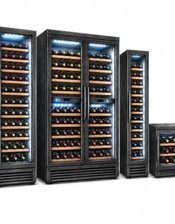
Commercial wine coolers are not simply refrigerators for making bottles cold. Their purpose is to maintain a stable temperature suitable for the wine style, reduce unnecessary temperature swings, and provide practical bottle storage and presentation. For a restaurant, wine bar, hotel or specialist retailer, the first distinction is between wine storage and preparing wine for service.
Our current range includes single- and dual-zone TEFCOLD TFW wine coolers, the compact undercounter SC85 BLACK, high-capacity CPV1380E and CPP1380E cabinets, and DKS95 Bag-in-Box wine dispensers. The right solution therefore depends first on whether one group of wines will be held at one temperature or whether, for example, white and red wine need to be service-ready at different temperatures at the same time.
Bottle count alone is not enough. Consider the number of temperature zones, the actual operating range, bottle shape, shelf layout, door and glass type, ambient conditions, ventilation and whether the wine is being held for immediate service or for longer-term ageing.
|
Requirement |
What to consider first |
|
One wine group / one service temperature |
Single-zone TFW-F or TFW-S. The +5…+18 °C range allows one stable setpoint to be chosen for the wine style. |
|
White / rosé and red wines must be ready at different temperatures |
Dual-zone TFW-2 range. TFW200-2 operates at approximately +5…+10 °C and +10…+18 °C; larger TFW300/400 models follow the same two-zone principle. |
|
Small wine stock below a bar counter |
SC85 BLACK: compact, approx. 22 x 750 ml bottles, +2…+10 °C. Particularly suitable for white and rosé wine. |
|
Large single-zone display behind glass |
CPV1380E: approx. 118 x 750 ml bottles, +1…+18 °C, tinted glass door, electronic control and LED lighting. |
|
Large capacity where customer-facing display is not required |
CPP1380E: approx. 118 x 750 ml bottles, +1…+18 °C, solid door, one temperature zone. |
|
Wine served from Bag-in-Box by the glass or carafe |
DKS95 dispensers: 2 x 20 l or 3 x 10 l BiB, +3…+9 °C, dedicated serving taps. |
For longer-term ageing, the priority is a cool and constant environment rather than a different “perfect serving temperature” for each style. WSET recommends approximately +10…+15 °C for wine stored for ageing. Frequent and substantial temperature swings are more harmful than a small but stable deviation from a theoretical ideal.
Serving temperature is a separate requirement. Light white wines are generally served colder, full-bodied whites slightly warmer, light reds cooler than modern room temperature, and full-bodied reds around +15…+18 °C. In hospitality, a wine cooler is therefore often used to ensure that the bottle reaches the table already close to its intended serving temperature.
|
Wine style |
Practical serving-temperature direction |
|
Sparkling |
approx. +6…+10 °C |
|
Light white / rosé |
approx. +7…+10 °C |
|
Full-bodied white |
approx. +10…+13 °C |
|
Light red |
approx. +12…+15 °C |
|
Medium-bodied red |
approx. +14…+16 °C |
|
Full-bodied red |
approx. +16…+18 °C |
These are practical serving ranges rather than mandatory settings for every wine. Guidance from the producer, sommelier or the specific style should take priority. Excessive chilling can suppress aroma, while serving wine too warm can reduce freshness and make alcohol more prominent.
A single-zone cabinet is the rational choice when the whole cabinet has one purpose. A restaurant might dedicate one cabinet to white and rosé wines at +8…+10 °C and another to reds. Single-zone TFW200-F / TFW400-F and the corresponding S versions offer a broad +5…+18 °C operating range, but the complete cabinet still works at one temperature at a time.
A dual-zone model is useful when two groups of wine need different service temperatures within one cabinet. For example, TEFCOLD specifies +5…+10 °C and +10…+18 °C for the TFW200-2F, with a limited maximum temperature difference between the zones. Two zones therefore do not mean two completely independent refrigerators with unrestricted setpoints.
If almost all your wine is held at one temperature, paying for dual zones may add little value. If you sell substantial volumes of both white and red wine by the glass every day, dual-zone storage is usually much more practical.
The TFW range is the most wine-specific part of the current assortment. It combines electronic control, fan-assisted cooling, wooden wine shelves, LED interior lighting, high/low temperature alarm and reversible doors. TFW200 and TFW400 are available as single- or dual-zone versions. The F and S versions mainly differ in door styling: F uses a frameless glass appearance, while S adds a stainless-steel door frame and handle.
The sizes range from the narrow TFW100-S at about 19 standard 750 ml bottles to single-zone TFW400 models rated for approximately 165 standard bottles. TEFCOLD rates the TFW400-2F dual-zone model at about 163 bottles. These capacities are indicative and depend on bottle geometry and shelf arrangement.
The TFW operating manual specifies a water tray intended to reduce the risk of corks drying in low humidity and a carbon filter to reduce unwanted odours. This is not precision active humidity control. It is better described as a wine-oriented cabinet environment than as a laboratory humidity-controlled chamber.
CPV1380E and CPP1380E are large single-zone cabinets with a +1…+18 °C operating range and capacity for roughly 118 standard 750 ml bottles. Both use electronic control and fan-assisted cooling, but their purpose differs.
CPV1380E has a tinted glass door, LED lighting and optional presentation shelves, making it suitable for restaurants, wine bars and retail where the bottle should remain visible. CPP1380E uses a solid door and has no interior display light, so it is more suited to back-of-house storage where presentation is not required. A solid door also naturally reduces light entering the cabinet.
Tinted glass helps reduce light exposure, but “tinted glass” should not automatically be interpreted as a certified UV-filter specification. Where formal UV protection is important, verify the exact technical documentation for the specific model.
SC85 BLACK is designed for situations where a small wine cooler is needed below a bar or service counter. TEFCOLD rates it for about 22 standard 750 ml bottles and a +2…+10 °C temperature range. This makes it particularly logical for white and rosé wine and some sparkling styles, but it is not the best choice if red wine needs to be held continuously at +15…+18 °C for service.
It is a good example of why the words “wine cooler” alone do not define suitability. Always check the actual temperature range against the wine list.
DKS95-2/20L and DKS95-3/10L are not traditional bottle display cabinets. They are chilled Bag-in-Box wine dispensers. The first is designed for two 20 l BiB packs and the second for three 10 l packs, with taps for serving into glasses or carafes. Both operate at approximately +3…+9 °C.
These models use static cooling and a mechanical controller. That is appropriate to their role: they hold chilled BiB wine for consistent service rather than managing the precise service temperatures of different bottled wines. If you serve larger volumes of wine by the glass, a BiB system can simplify service and reduce opened-bottle waste. TEFCOLD notes that the required BiB connectors are not supplied with the unit.
Wine-cooler capacity is normally calculated using standard 750 ml bottles and a defined shelf layout. Burgundy, Champagne, sparkling-wine, magnum and designer bottles can be wider or taller, so real capacity may be lower.
If your list contains a large share of Champagne or non-standard bottles, evaluate internal shelf dimensions and actual bottle arrangement rather than relying only on the headline bottle count. We can help check this before ordering.
For longer-term storage, bottles sealed with natural cork are traditionally stored on their side so the cork remains in contact with the wine. WSET also recommends side storage for cork-sealed wines. Screwcap bottles do not require this orientation.
Wooden shelves are useful beyond appearance. They support horizontal bottle storage and tend to feel less “rattly” than thin metal wire shelving. Shelf count and configuration directly affect real capacity. Where label presentation matters, check whether the model accepts presentation shelves or allows a suitable shelf angle.
Bright light and direct sun are undesirable for long-term wine storage. WSET recommends storing wine away from bright light, including UV sunlight. Even a cabinet with tinted glass should not be positioned in direct sunlight.
Interior LED lighting is useful for presentation but does not need to run continuously. The TFW operating instructions even include an automatic light-off function to reduce energy use. In retail and hospitality, use lighting as a display tool rather than as a permanent light source for stored wine.
Avoid changing the setpoint several times per day for each bottle. A refrigeration system has thermal inertia, and the wine inside a glass bottle changes temperature slowly. It is better to assign a clear purpose to each zone - for example +8 °C for whites or +16 °C for reds - and keep that setting stable.
If a room-temperature bottle must be chilled quickly, a wine cooler is not a blast chiller. An ice-and-water bath or another rapid-chilling method will work faster, while the wine cooler should be used to keep service stock at a stable ready-to-pour temperature.
An excessively dry environment can be undesirable for natural corks during long-term storage. TFW instructions therefore specify a water tray intended to reduce cork drying in low humidity. This is a useful feature, but it is not the same as an electronically controlled humidifier maintaining an exact relative-humidity setpoint.
For a high-value ageing collection where a defined RH range is a formal requirement, choose a system that explicitly specifies active humidity control. For typical hospitality service, the TFW approach is practical, but it should not be marketed as laboratory-grade humidity regulation.
Continuous vibration is undesirable for wine intended for longer ageing. WSET recommends avoiding environments where bottles are exposed to strong ongoing vibration. In practice, place the cabinet on a stable floor and not directly next to strongly vibrating equipment.
Also avoid direct sunlight, ovens, radiators and other heat sources. Many TFW models are climate class 4 and TEFCOLD specifies a maximum ambient of approximately +30 °C / 55% RH, while CPV1380E has a different declared ambient limit. Always check the model-specific specification rather than applying one ambient limit to every wine cooler.
Not every wine cooler is a built-in appliance. If condenser air is drawn in or discharged through the rear or lower part of the cabinet, enclosing it tightly can impair heat rejection and increase compressor run time. Physical fit does not automatically mean that built-in installation is permitted.
If you plan to install a wine cooler inside cabinetry, below a worktop, in a niche or between tall cabinets, contact us before ordering. We can check the intake and exhaust arrangement, required clearances and service access for the specific model. Ventilation grilles must never be blocked by decorative panels.
Wine coolers are often located in customer-facing areas, so noise can matter as much as energy use. TEFCOLD specifies approximately 39-40 dB(A) for many TFW models, making them suitable for restaurants and bars, while large CPV-type display cabinets can be noticeably louder. Always compare the exact model.
Compare energy use using kWh/24 h or kWh/year rather than input wattage alone. As an example, TEFCOLD lists approximately 0.40 kWh/24 h for TFW200-2F and 0.48 kWh/24 h for TFW400-2F. A larger cabinet does not necessarily consume proportionally more energy, so energy per stored bottle can also be a useful comparison.
Start with your wine list and service workflow, not with the cabinet model. Define how many bottles must be kept service-ready, which wine styles account for most sales, the desired serving temperatures and whether the bottles need to be visible to customers.
• If the entire cabinet will run at one temperature, choose a single-zone model.
• If chilled whites and warmer reds need to be ready simultaneously, consider a dual-zone TFW.
• If presentation matters, prioritise glass / tinted doors and presentation-shelf options.
• If back-of-house storage and lower light exposure matter more, a solid-door CPP-style cabinet can be more rational.
• For undercounter use, verify the SC85 temperature range and ventilation arrangement.
• For wine-by-the-glass from BiB, choose a dedicated dispenser rather than a bottle cabinet.
• For many non-standard bottles, do not rely only on the catalogue 750 ml bottle count.
If you are unsure, send us your wine list, required bottle count, preferred service temperatures and available space. This gives a much more reliable basis for selection than price or litres alone.
A wine cooler is designed around a broader and more precisely controlled temperature range, horizontal bottle storage, wine shelves and presentation. TFW cabinets also use a water tray to reduce cork-drying risk in low humidity and a carbon filter for odour control. A standard drinks cooler is usually designed simply to keep beverages cold.
For longer-term ageing, WSET recommends approximately +10…+15 °C with good temperature stability. Serving temperatures for different wine styles may be different.
Modern room temperature is often +20…+23 °C, which is too warm for serving many red wines. Full-bodied reds often show best around +16…+18 °C, with lighter reds served cooler.
When two groups of wine need different service temperatures at the same time, for example white at +8 °C and red at +16 °C. Always verify the operating limits of each zone.
No. For example, TEFCOLD specifies approximately +5…+10 °C and +10…+18 °C for TFW200-2F, with a limited maximum difference between zones. Check the exact model before ordering.
For long-term storage, natural-cork bottles are generally stored on their side so the cork does not dry out from the inside. Screwcap wines do not require this orientation.
Avoiding an excessively dry environment is useful for natural corks during long storage. TFW cabinets use a water tray, but this is not precision active humidity control. If a defined RH range is required, choose equipment that explicitly specifies it.
Tinted glass reduces light exposure, but tinted glass and a certified UV filter are not automatically the same specification. Verify the manufacturer documentation if formal UV protection is required.
It is not recommended. Direct sun heats the cabinet and bottles, increases refrigeration load and is undesirable for long-term wine storage.
Only where the specific ventilation design permits it. Contact us before ordering for a niche or built-in installation so intake, exhaust and service clearances can be checked.
Catalogue capacity is calculated with standard 750 ml bottles. Champagne, Burgundy, magnum and other wider or taller bottles use more shelf space and may require a different layout.
Both are large single-zone cabinets for roughly 118 standard bottles. CPV uses a tinted glass door and LED lighting for display, while CPP uses a solid door and is better suited to closed storage.
It is a compact undercounter wine cooler for approximately 22 standard bottles, operating at +2…+10 °C. It is particularly suitable for white and rosé wine in a bar or service area.
They are chilled BiB wine dispensers with serving taps. Versions are available for 2 x 20 l and 3 x 10 l packs. They are dedicated wine-service appliances rather than bottle display cabinets.
Compare kWh/24 h or kWh/year together with capacity and number of temperature zones. Input wattage alone does not represent actual annual electricity use.