excl VAT
Product code: MD40DC-P301BEQ
Available quantity 2 weeks
| Manufacturer: | Snaige |
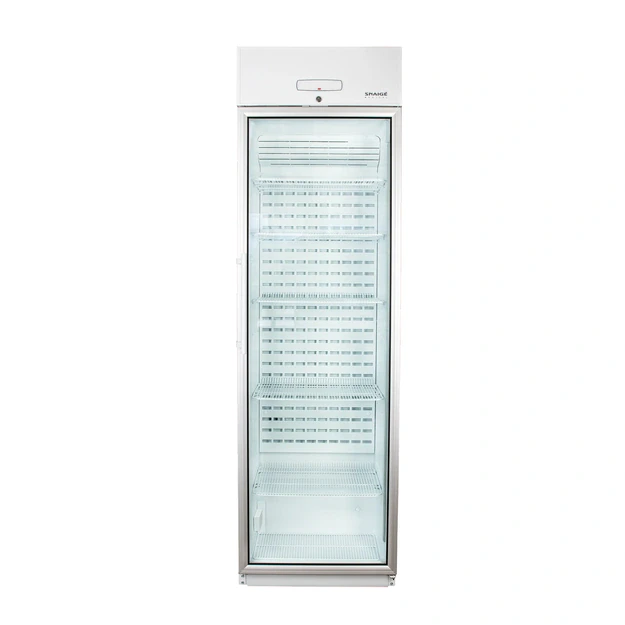
MD40DC-P301BEQ is a full-height medical/pharmaceutical refrigerator designed for medicines and other pharmaceutical products that require storage at +2…+8 °C. The factory setting is +5 °C. Gross capacity is 385 l and net capacity is 290 l, making it a practical choice for pharmacies, clinics, healthcare facilities, dental centres and other organisations that need to store a larger quantity of temperature-sensitive medicines in one cabinet.
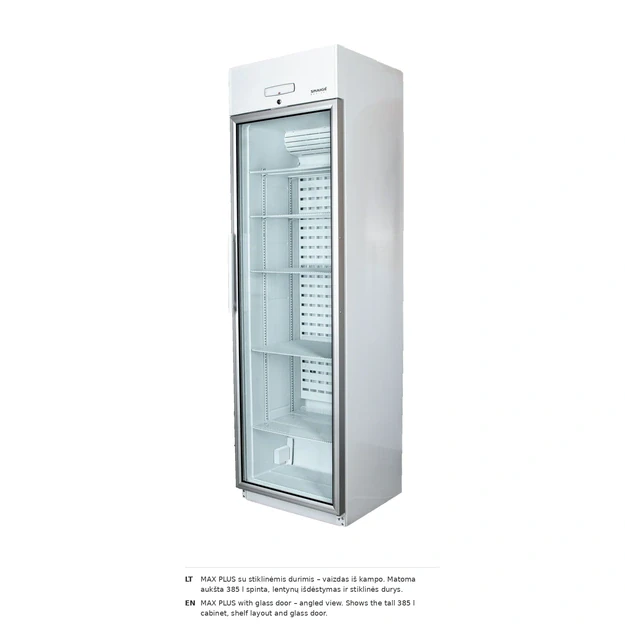
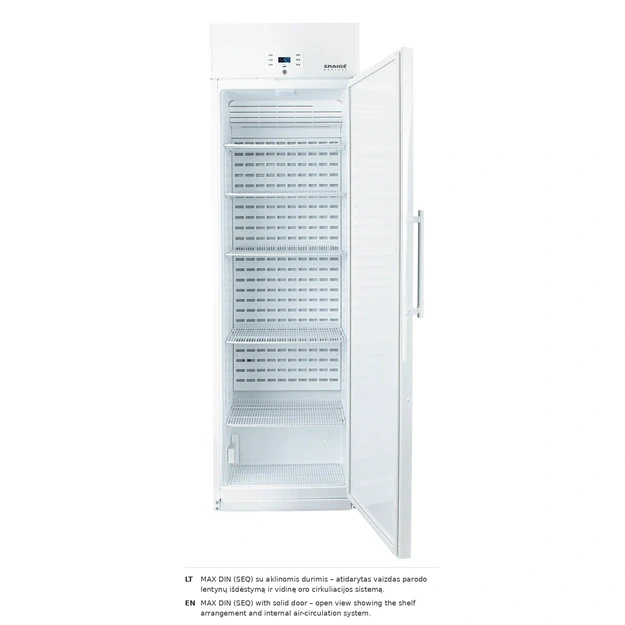
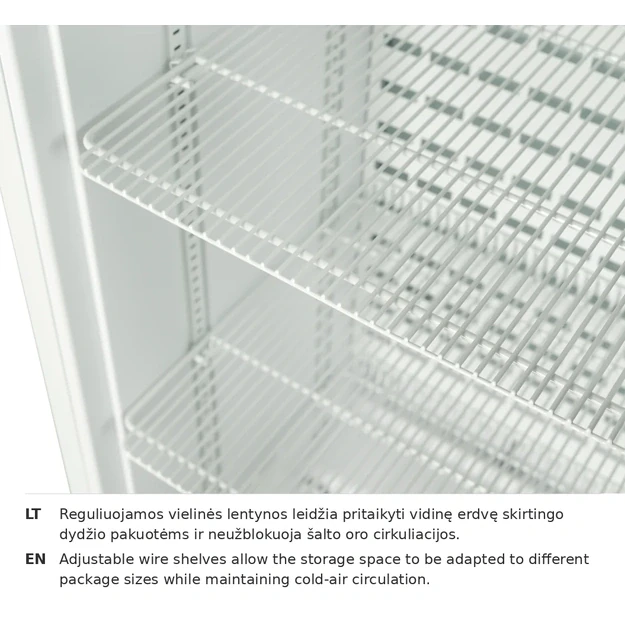
The glass door lets staff check stock without opening the refrigerator. This is useful for stock control and helps reduce unnecessary door openings. Inside there are 5 height-adjustable shelves plus one bottom shelf, with a maximum load of 40 kg per shelf. Fan-assisted cooling distributes cold air throughout the cabinet, while automatic defrost reduces routine maintenance.
A commercial refrigerator is normally designed mainly for food or beverage storage and convenient product display. A similar temperature setting alone does not make it suitable for medicine storage. With medicines, it is important to understand temperature stability, recovery after door opening, alarm behaviour and whether independent temperature monitoring can be added.
A medical/pharmaceutical refrigerator is designed specifically for medicines that require a +2…+8 °C storage environment. For this model the manufacturer declares a temperature fluctuation of 0.5 °C, a temperature gradient of 2.9 °C and approximately 8 minutes recovery after a 1-minute door-opening test performed according to the EN/IEC 60068-3 methodology. A visual and audible temperature alarm helps staff notice an out-of-range condition promptly.
A laboratory refrigerator is not automatically a “better medical refrigerator”. Laboratory equipment may be intended for reagents, samples or other materials and can be designed around different temperature and control requirements. If the main purpose is medicine storage at +2…+8 °C, choose equipment whose manufacturer explicitly states a medical/pharmaceutical application.
The STANDARD version is a good choice when you need a dedicated pharmaceutical refrigerator but your organisation handles temperature logging or remote monitoring through a separate system. The exact documentation and audit requirements applicable to your organisation should always be checked against your internal procedures and current regulatory requirements.
All eight configurations of this 385 l (270–290 l net, depending on configuration) pharmacy refrigerator are intended for medicines and pharmaceutical products that need +2…+8 °C storage. The difference is not the storage range but low-temperature protection, data logging and connectivity, energy use and operating noise.
| Parameter | STANDARD | MAX (USB) | MAX PLUS (Bluetooth) | SUPER MAX PLUS |
|---|---|---|---|---|
| Emergency controller backup | None | 12 hours | 24 hours | 24 hours |
| Temperature data export | None | USB to computer | Bluetooth / CONTROLLA (email report) | Bluetooth / CONTROLLA (email report) |
| Annual electricity consumption | Glass: 467 kWh/year Solid: 348 kWh/year | Glass: 695 kWh/year Solid: 525 kWh/year | Glass: 467 kWh/year Solid: 348 kWh/year | Glass: 288 kWh/year Solid: 250 kWh/year |
| Noise level | 44 dB(A) | 50 dB(A) | 44 dB(A) | 33 dB(A) |
Annual energy figures are declared by the manufacturer for glass and solid doors separately. Backup power maintains the controller and alarm functions, not the refrigeration system. Actual consumption depends on operating conditions.
How much can SUPER MAX PLUS save on electricity compared with MAX? At an electricity rate of €0.30/kWh, annual savings are (695 − 288) × 0.30 = €122.10 with a glass door, or (525 − 250) × 0.30 = €82.50 with a solid door. These are indicative yearly electricity cost savings based on manufacturer-declared energy consumption.
STANDARD provides electronic control, fan-assisted cooling, visual and audible temperature alarms and access for an additional external probe. It is the most economical option where temperature logging and documentation are handled by a separate system. STANDARD does not include protection against temperatures below +2 °C. The temperature alarm warns about deviations but does not replace that protection. STANDARD also has no integrated USB or Bluetooth temperature-data export. Noise level: 44 dB(A).
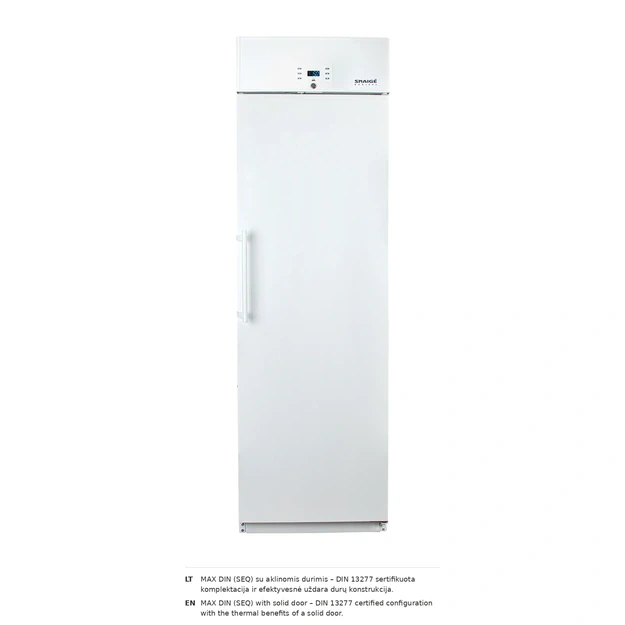
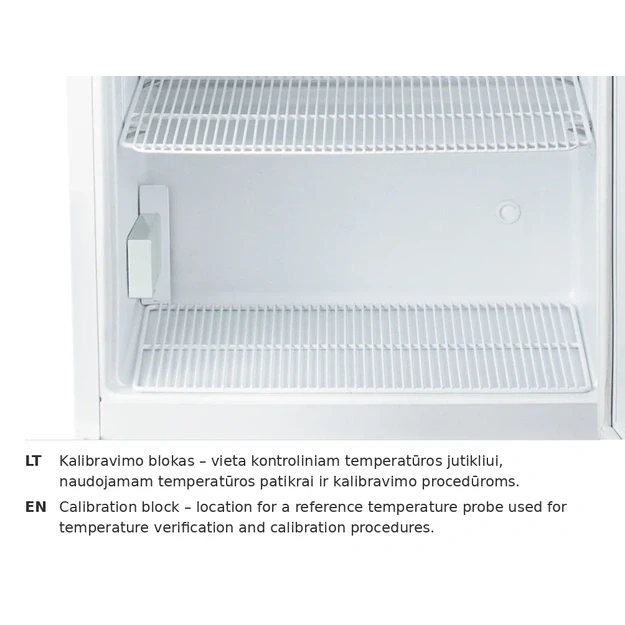
MAX is designed for organisations needing more advanced monitoring and records. The manufacturer states DIN 13277 compliance for this line. Compared with STANDARD, MAX adds protection against temperatures below +2 °C, a calibration block, a volt-free alarm contact, an external alarm connection, RS485, integrated temperature logging and USB data export.
MAX with USB (MD40DD-P301SEQ and MD40DD-P600SEQ) allows recorded temperatures to be transferred to a computer via USB. During a power failure, these MAX models maintain controller monitoring and audible/visual alarm functions for at least 12 hours; the backup does not keep the refrigeration system running. Their noise level is 50 dB(A). Do not confuse this with MAX PLUS: its Bluetooth / CONTROLLA models have 24-hour controller backup and operate at 44 dB(A).
MAX PLUS is intended for convenient monitoring and alarm-history review without local USB export. It includes the Bluetooth / CONTROLLA mobile application, a built-in data logger, LED touch screen, Min/Max temperature display, persistent alarm indicator, protection against temperatures below +2 °C, calibration block, RS485 and an external alarm connection.
Backup power supports controller monitoring and visual/audible alarms for at least 24 hours after mains power loss (it does not continue refrigeration). Noise is 44 dB(A), with substantially lower energy consumption than the USB-based MAX line. The manufacturer's September 2026 price list lists DIN 13277 certification as in progress for these Bluetooth variants.
SUPER MAX PLUS is a quieter, more energy-efficient MAX PLUS modification (also classified as MAX PLUS in the manufacturer's range). They retain Bluetooth / CONTROLLA, touch-screen control, temperature logging, protection against temperatures below +2 °C, RS485 and controller backup.
The key advantage is 33 dB(A) instead of 44 dB(A) plus reduced annual energy use: 288 kWh/year with a glass door rather than 467, or 250 kWh/year with a solid door rather than 348. That is approximately 38% and 28% less than the corresponding MAX PLUS versions. This option is well suited to treatment or consultation rooms where low noise matters.
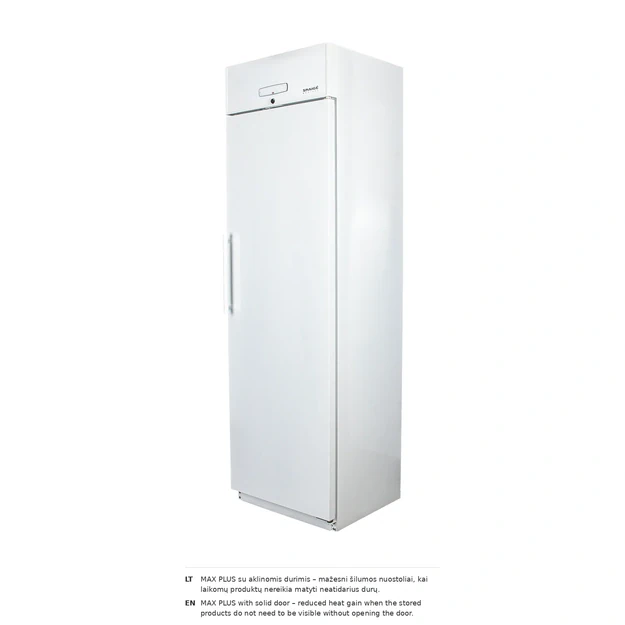
Model codes with P301 have glass doors, allowing staff to inspect contents without opening the cabinet. P600 identifies solid metal doors, usually the less expensive and more energy-efficient choice. Both door types are available for all four configuration levels.
If “Configuration” is left unselected, the base STANDARD glass-door MD40DC-P301BEQ is ordered. The field is optional, and choosing another version automatically adjusts the price.
Technical specifications of the base STANDARD glass-door model are shown in the separate Specifications section. The key differences among configurations are explained above.
Important application note: according to the manufacturer’s instructions, this refrigerator is intended for medicines and pharmaceutical products stored within +2…+8 °C. It is not intended for blood, plasma or other infusion/body fluids, or for chemically unstable or flammable materials.
| Technical data | |
|---|---|
| Ambient working temperatures | +10…+35 °C |
| Annual Energy Cons., kWh/year | 467 |
| Castors | 2 rear wheels |
| Climate Class | 7 (+10…+35 °C, RH ≤75%) |
| Controller Type | Electronic |
| Cooling Type | Fan forced cooling |
| Defrost Type | Automatic |
| Depth, mm | 620 |
| DIN 13277 compliance | Temperature and energy parameters comply with DIN 13277 requirements |
| Door / Lid No & Type | 1 hinged glass door – double-panel selective glass in aluminium profile |
| Door Reversible | Yes |
| Energy Consumption, kWh/24h | 1.280 |
| Exterior color | White |
| Exterior finish | White painted steel |
| External Dimensions (W×D×H), mm | 600×620×2025 |
| Feet / Legs | 2 adjustable front feet |
| Gross / Net Volume, l | 385 / 290 |
| Gross / Net Weight, kg | 82 / 76.5 |
| GTIN / EAN | 4770104040047 |
| Height, mm | 2025 |
| Input Power, W | 250 |
| Interior finish | HIPS polystyrene |
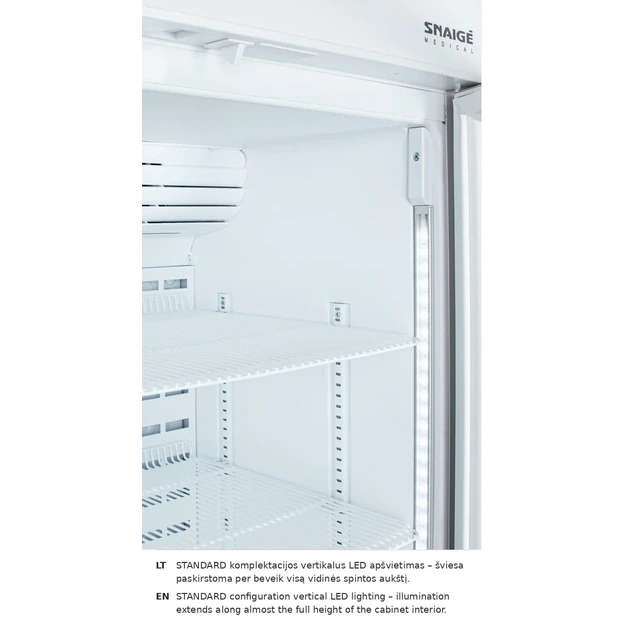
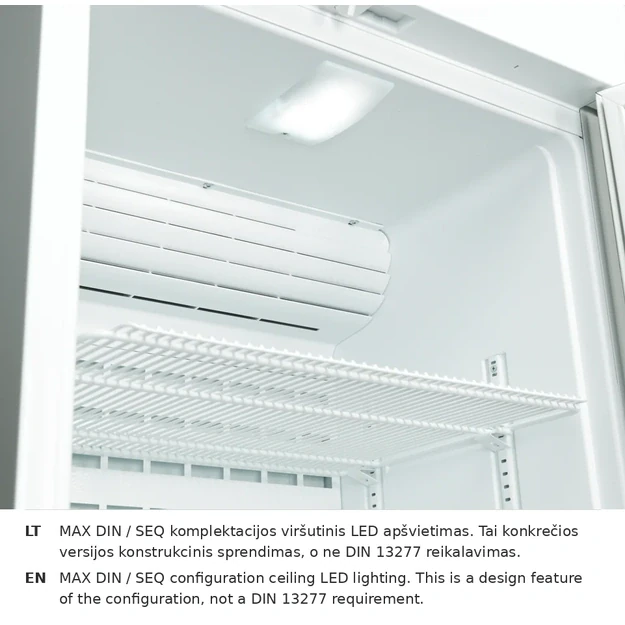
| Interior light | Vertical LED light strip on right side |
| Internal Dimensions (W×D×H), mm | 500×418×1645 |
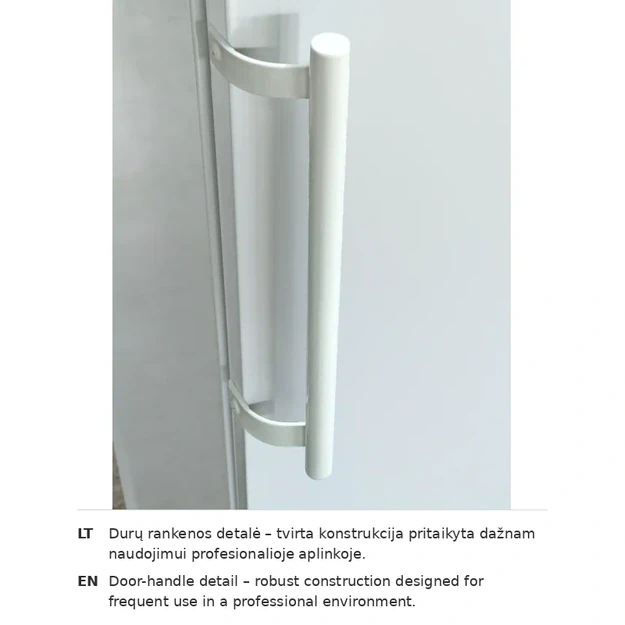
| Lockable door lock | Mechanical |
| Maximum load per shelf, kg | 40 |
| Noise Level, dB(A) | 44 |
| Packed Dimensions (W×D×H), mm | 620×630×2080 |
| Power current | 1.5 A |
| Protection against contact with cold surfaces | Yes |
| Protection against temperature below +2 °C | No |
| Purpose of cabinet | Medical / pharmaceutical refrigerator, STANDARD |
| Refrigerant | R600a |
| Replaceable door sealing strip | Yes |
| Shelf dimensions, mm | 495×380; bottom 483×265 mm |
| Shelf material | Wire shelves coated with white polymer paint |
| Shelves No & Type | 5 adjustable + 1 bottom |
| Temperature alarm | Optical and acoustical |
| Temperature Range, °C | +2…+8 |
| Temperature stability test standard | EN/IEC 60068-3 |
| Thermometer | Digital temperature display |
| Volt-free alarm contact | No |
| Voltage / Frequency, V/Hz | 220–240 / 50 |
| Width, mm | 600 |
There are no reviews for this product!