excl VAT
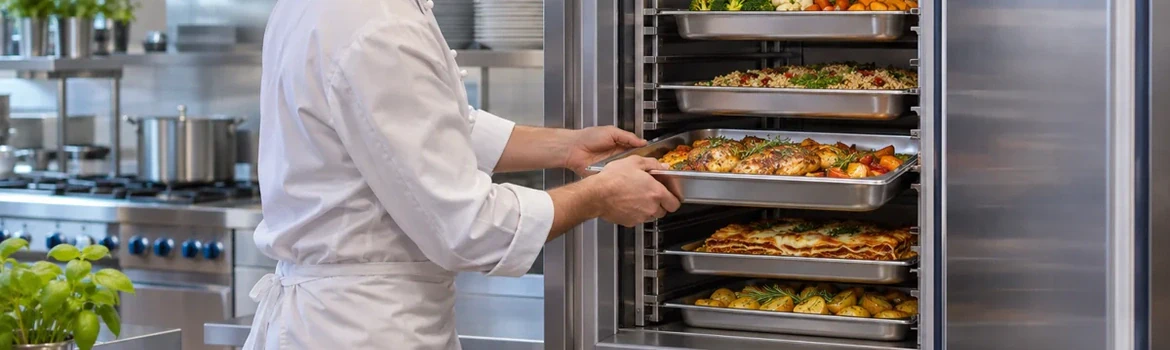
Late ingredient deliveries, absent staff and a sudden rush of customers can disrupt even an experienced kitchen. Restaurant managers often respond by hiring more people, preparing larger reserves or looking for faster cooking methods. Sometimes, however, the most effective solution is to change how the work is organised.
In an INFRICO podcast, Carlos Rubio, head of Quitec Colombia and a former restaurant professional, joins INFRICO representative Justina Rivero to discuss advance cooking and blast chilling, known as Cook & Chill. This approach allows selected dishes to be cooked in advance, chilled safely, stored under controlled conditions and finished quickly when needed.
The main benefit goes beyond keeping products for longer. It helps restaurants plan production, reduce waste, maintain more consistent food quality and ease pressure on staff during the busiest periods.
Carlos Rubio recalls that refrigeration often used to receive attention last when restaurants were fitted out. Cookers, ovens and other cooking equipment were purchased first, leaving the remaining budget and space for refrigerators.
This approach has drawbacks. A restaurant may invest in high-quality meat, fish, vegetables and other ingredients, but some of that value is lost if storage is unsuitable.
Rubio emphasises that refrigeration costs should be assessed beyond the purchase price. Spoiled ingredients, staff time, production interruptions, service speed and maintenance costs also matter.
Refrigeration should therefore be planned together with kitchen workflow: how much food is prepared at once, how quickly it must be chilled and where it will be stored before service.
In a traditional kitchen, many dishes are prepared after an order arrives. This suits many restaurants, but it can become difficult to manage as demand increases.
Advance cooking separates time-consuming production from final service.
For example, slow-cooked ribs need several hours of heat treatment. Instead of carrying out the entire process during service, the ribs can be cooked in advance, chilled correctly and stored under defined conditions. After an order arrives, they can be safely reheated, finished and served.
The approach consists of four connected stages:
Not every dish needs to be cooked in advance. The approach is most suitable for products and production stages that retain acceptable quality after chilling, storage and subsequent preparation.
Chilling should also be distinguished from freezing. These are different processes with different storage and subsequent-use requirements.
One of Rubio's most interesting examples concerns a large Colombian theme park serving thousands of visitors.
Previously, dishes were prepared only after orders arrived. As visitor numbers increased, pressure built up, orders accumulated and waiting times grew.
According to Rubio, the change began with staff training rather than equipment installation. Chefs were shown how their daily work would change if some production took place in advance.
With prepared products already available, the kitchen could focus on finishing and presenting dishes during service. Rubio reports that some dishes could be ready to serve in 5–7 minutes.
Kitchen capacity can be increased through better scheduling of production, alongside decisions about staff and premises.
A smaller restaurant can begin by identifying the tasks that place most pressure on the kitchen at lunch or dinner. If some can safely be completed earlier, staff can concentrate more on food quality and customer service during peak periods.
Not every restaurant can forecast daily visitor numbers accurately.
Justina Rivero describes roadside catering businesses in Paraguay, where demand depends on tourist buses, travel routes and unplanned stops. Several large groups may arrive one day and far fewer the next.
Preparing the whole expected quantity and holding it ready to serve would be risky. A properly prepared reserve held under controlled conditions can help businesses adapt to actual demand.
Rubio describes a similar issue in school catering: if meals are planned for 1,200 pupils but 100 do not attend, unused portions become a problem.
Planned production allows some food to be held as a reserve, with only the required quantity finished for service.
This applies to properly stored food that has not yet been issued. It does not apply to food already served or held under unsuitable conditions.
Event caterers can also gain flexibility. Rubio describes businesses that found it easier to accept orders of different sizes by planning part of their production in advance.
The aim should remain to prepare quantities that can be stored safely and are reasonably expected to be used.
Correct chilling of cooked food is a key part of this system.
An ordinary refrigerator is primarily designed to maintain the storage temperature of food that is already chilled. A large quantity of hot food may cool too slowly and raise the cabinet temperature, affecting other stored products.
A blast chiller is designed for this production stage. It rapidly lowers product temperature before food is moved to a storage refrigerator or cold room.
Rubio recalls a kitchen where cooked products were cooled in front of fans. This made temperature control difficult and could introduce additional hygiene concerns.
Seeing that food is cooling is not enough: a professional kitchen needs a controlled process that meets its food safety requirements.
Blast freezing has a different purpose. Rapid temperature reduction during freezing can help preserve the structure of some products and reduce moisture loss during thawing. Results depend on the product, preparation and freezing and thawing conditions.
Equipment selection should start with how the kitchen operates.
A smaller restaurant preparing a few dozen kilograms in advance may be served by a compact blast chiller. A larger caterer producing high volumes at once will need greater capacity.
INFRICO offers blast chilling and freezing equipment in a range of sizes.
For example, the INFRICO ABT51L has five tray levels and a stated capacity of up to 20 kg for chilling or 12 kg for freezing per cycle. It can be considered for smaller production batches.
The larger INFRICO ABT101L has ten levels and a stated capacity of 40 kg for chilling or 25 kg for freezing per cycle.
These are manufacturer ratings. Actual performance depends on product type, load, starting temperature and arrangement inside the unit.
A blast chiller alone does not constitute a complete Cook & Chill system. Suitable chilled or frozen storage equipment is also essential.
Rivero highlights temperature monitoring and maintenance. Modern equipment can help record operating data, monitor temperatures and identify problems, although available functions depend on the model and accessories.
Rubio suggests starting with the areas most likely to improve, rather than redesigning the entire kitchen.
A restaurant might select a few time-consuming dishes and assess how advance preparation changes everyday work.
Track discarded food, production time, order waiting times and actual refrigeration running costs. These figures make it possible to compare performance before and after the change.
The investment assessment should include installation, staff training, maintenance and any additional storage space, alongside the equipment price.
Working conditions also matter. Rubio notes that better organised kitchens allow staff to focus more on food quality and customers, with less time spent dealing with unexpected disruptions.
Cook & Chill creates value when the whole production process becomes more predictable, safe and manageable.
To introduce the system in a restaurant or catering business, contact Šaldymo sprendimai for equipment selection. Include the types of dishes, maximum batch size, production schedule and available installation space in your enquiry.
Open Blast Chillers & Freezers under professional kitchen refrigeration and select Infrico in the manufacturer filter. Choose the ABT series, then narrow the results by chilling capacity, tray count and tray format, such as GN 1/1 or 600 × 400 mm. Compare the five-level INFRICO ABT51L for smaller batches and the ten-level INFRICO ABT101L for larger workloads, checking chilling and freezing capacities per cycle separately in each product specification.


You must login or register in order to make comment!