excl VAT

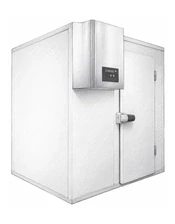
A modular cold room is a walk-in refrigerated storage space for businesses that need more capacity than upright cabinets can provide or want to keep bulk stock in one organised area. TEFCOLD CRPF and CRNF rooms combine interlocking insulated panels, anti-slip SS304 flooring and a monoblock refrigeration unit selected for the room volume. Once assembled, the plug-in system is ready for electrical connection in accordance with the specific model instructions.
The first decision is temperature, not size. CRPF rooms are designed for positive-temperature storage at 0…+8 °C and use 80 mm panels. CRNF freezer rooms operate at −20…−10 °C and use 120 mm panels. After that, evaluate external floor area, internal volume, door width, shelving layout, aisle space and the room into which the monoblock will reject heat.
The current SaldymoSprendimai.lt range includes many standard CRPF and CRNF sizes from 1.2 × 1.2 m up to 3.0 × 3.0 m, plus WD variants with an 850 mm door. This makes it possible to size the room around the real workflow: boxes, GN containers, trolleys, rack systems and the aisle width employees need for efficient access.
|
Group |
Best suited to |
Key points to check |
|---|---|---|
|
CRPF |
Chilled food, horeca, retail and bulk storage |
0…+8 °C; 80 mm panels; floor load up to 1500 kg/m² |
|
CRNF |
Frozen food and low-temperature bulk storage |
−20…−10 °C; 120 mm panels; floor load up to 2000 kg/m² |
|
Standard |
When a more flexible panel / door layout is useful |
Plan door and refrigeration-unit panel positions from the model assembly drawing |
|
WD |
Trolleys, larger loads and easier access |
850 mm door; fixed door position - plan orientation before ordering |
CRPF is a positive-temperature cold room for chilled stock. The typical manufacturer range is 0…+8 °C with 80 mm panels. CRNF is a freezer room for frozen stock, typically −20…−10 °C with 120 mm panels.
If the operation needs both chilled and frozen storage, a single room will normally not be suitable. Separate temperature zones or separate rooms are the more practical solution.
CRPF1212 is approximately 1.2 × 1.2 m externally, CRPF2130 approximately 2.1 × 3.0 m and CRPF3030 approximately 3.0 × 3.0 m. The same naming logic applies to CRNF. The current standard external height is 2.2 m.
Before ordering, check room height, assembly access, door swing, monoblock projection and service clearance, not just the cold-room footprint.
Panels and insulation reduce the internal dimensions. CRPF1212, for example, occupies 1.44 m² externally but has about 2.20 m³ internal volume. CRNF1212 has only about 1.81 m³ because its insulation is 120 mm thick.
Racks and aisle space reduce usable storage volume further. A professional layout should never assume that every theoretical cubic metre can be filled with product.
As a practical guide, rooms below about 4 m² external floor area often suit smaller kitchens or limited stock; roughly 4-6.5 m² provides more comfortable rack and aisle planning; larger rooms suit higher-volume bulk storage.
These are only planning categories. Final sizing should be based on boxes, containers, racks and stock turnover rather than a vague assumption that a certain footprint will be enough.
Door width on standard CRPF / CRNF rooms depends on the model; larger standard models commonly use doors around 700 mm wide. WD variants use an 850 mm door, making them more practical for trolleys, bakery racks and bulky loads.
On WD models, the door position is fixed. Plan the room orientation before ordering and make sure the door does not conflict with walls, equipment or the main aisle.
A standard CRPF / CRNF package includes a CRU monoblock selected by the manufacturer for the room size. This avoids designing a separate split system or sizing refrigeration capacity from scratch for a standard room.
Electrical supply, ventilation, condensate handling and service access still need to be prepared according to the installation manual for the specific model.
The condenser side rejects all heat removed from the cold room, plus compressor input energy, into the surrounding space. A small unventilated store room can therefore become very warm and reduce refrigeration-system operating margin.
Do not place the room in a tight, unventilated enclosure or directly beside ovens and other major heat sources. Mechanical ventilation may be required where natural heat removal is insufficient.
Positive-temperature CRPF rooms use 80 mm panels. CRNF freezer rooms use thicker 120 mm insulation because the temperature difference between inside and ambient is much greater.
As a result, a CRNF room has less internal volume than a CRPF room with the same external footprint. External dimensions alone are therefore not a fair capacity comparison.
TEFCOLD specifies anti-slip SS304 flooring with maximum floor loading up to 1500 kg/m² on CRPF rooms and up to 2000 kg/m² on CRNF rooms. This provides a strong base for boxes, racks and professional bulk storage.
Loads should still be distributed sensibly. Heavy trolleys or concentrated point loads should be considered as part of the real operating condition, not only against the headline kg/m² figure.
Rack systems are normally accessories rather than part of the basic cold-room package. TEFCOLD Shelf Rack System Kits are matched to specific CRPF / CRNF room models so that rack lengths, door position and airflow zones work together.
Before ordering, sketch the rack arrangement, main aisle, high-turnover product positions and the turning space required for boxes or trolleys.
Because a modular room has its own insulated floor, there is a threshold between the building floor and the room interior. If trolleys are used regularly, an access ramp can significantly improve workflow and reduce manual handling effort.
For hand-carried boxes only, a ramp may be lower priority, but it should still be planned early so sufficient clear floor space is left in front of the door.
TEFCOLD CRNF freezer rooms specify a strip curtain as part of the package and automatic hot-gas defrost on the monoblock. These features help reduce warm, humid air infiltration and manage evaporator frost.
Frequent door opening still increases moisture ingress and energy use. Organise the workflow so that freezer-room doors are not held open longer than necessary.
Energy use depends on room size, setpoint, ambient conditions, door opening and product heat load. A freezer room of similar dimensions will generally use more energy than a positive-temperature CRPF room because it operates at a much lower temperature.
A single kWh/24h number without temperature and volume context is not a useful buying criterion. Compare rooms with similar duty and capacity.
A standard CRPF / CRNF plug-in package is ideal when the factory sizes and monoblock arrangement fit the project. If you need non-standard height, multiple temperature zones, industrial doors, a much larger volume or a remote condensing unit, the job becomes a custom cold-room project.
In that case, panels, doors, evaporator, condensing unit and controls should be engineered as a system instead of forcing a standard plug-in room into an unsuitable application.
|
Example |
External size |
Internal volume |
Typical role |
|---|---|---|---|
|
CRPF1212 |
1.2 × 1.2 × 2.2 m |
2.20 m³ |
Small positive-temperature room |
|
CRPF2130 |
2.1 × 3.0 × 2.2 m |
11.24 m³ |
Medium / larger positive-temperature room |
|
CRPF3030 |
3.0 × 3.0 × 2.2 m |
16.45 m³ |
Large positive-temperature room |
|
CRNF1212 |
1.2 × 1.2 × 2.2 m |
1.81 m³ |
Small freezer room |
|
CRNF3030WD |
3.0 × 3.0 × 2.2 m |
14.93 m³ |
Large freezer room with 850 mm door |
CRPF is for chilled storage at 0…+8 °C with 80 mm panels. CRNF is for frozen storage at −20…−10 °C with 120 mm panels.
The active standard CRPF / CRNF plug-in models are supplied with a monoblock selected by the manufacturer for that room size.
The standard factory plug-in package is supplied as a charged refrigeration system. Final connection and commissioning must follow the manufacturer instructions.
The current standard range runs from approximately 1.2 × 1.2 m up to 3.0 × 3.0 m externally, typically with 2.2 m height.
The model code gives a quick indication of the external footprint: 2130 is approximately 2.1 × 3.0 m.
WD primarily identifies the 850 mm wide door. The overall room dimensions depend on the individual model.
TEFCOLD specifies a fixed door position on WD models, so orientation must be planned before ordering.
Normally no. Rack systems are accessories and should be selected for the exact CRPF / CRNF room model.
Yes, if door width and access are suitable. WD 850 mm doors and an optional ramp are more convenient for trolleys and bulky loads.
TEFCOLD CRPF / CRNF packages specify anti-slip SS304 stainless-steel flooring.
Yes. CRNF uses 120 mm panels, while positive-temperature CRPF rooms use 80 mm panels.
The monoblock condenser rejects it into the surrounding space, so adequate room ventilation is important.
It is not recommended. High ambient heat worsens condenser operating conditions and can increase energy use.
When standard sizes do not fit, or the project needs multiple zones, special doors, much larger volume or remote refrigeration. Then the system should be engineered individually.