excl VAT
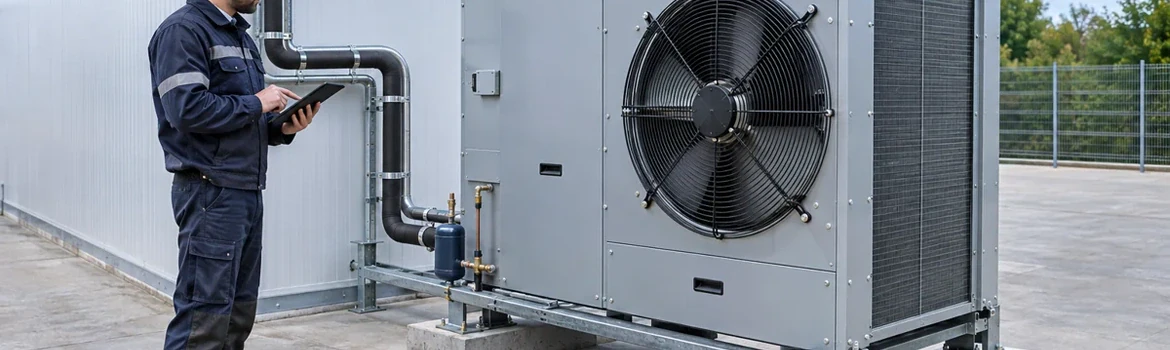
A2L refrigerants allow refrigeration equipment to be designed with a lower climate impact, but require a different approach to installation safety. Selecting cooling capacity and a compressor is not enough: the designer must assess where leaked refrigerant could accumulate, how it would be removed and whether ignition sources are nearby. This is particularly important for cold rooms in food production, warehouses, restaurants and retail premises.
This guide summarises ASHRAE 15 and 34 safety principles, the European EN 378 framework and the EU fluorinated greenhouse gas regulation. ASHRAE documents help assess risk, but do not replace EN 378 or applicable legislation in Lithuania. Permitted charge, installation location and safeguards must be established for each system.
Under the ASHRAE 34 safety classification, A indicates the lower-toxicity class, while 2L identifies lower flammability with a low burning velocity. A2L does not mean non-flammable: a suitable concentration in air and an ignition source can still result in ignition. A1 refrigerants show no flame propagation under the classification test, whereas A3 refrigerants, such as R290 propane, have higher flammability.
A practical example is R455A (A2L), used in some INTARCON and IMPAFRI units. Honeywell gives a global warming potential (GWP) of approximately 146 and a lower flammability limit (LFL) of about 0.431 kg/m³. These figures are not universal permitted room concentrations. A safe design charge depends on room volume, access category, system construction and protective measures.
ASHRAE 15 considers refrigerant class, the use of the space served and the likelihood of refrigerant entering an occupied area after a fault. In a direct-expansion system with an evaporator and pipework inside the cold room, an outdoor condensing unit does not isolate the entire refrigerant circuit from indoor spaces.
Charge limits, possible leak concentrations, intended equipment use, ignition sources and machinery-room safeguards require separate assessment. Refrigeration machinery rooms may require restricted access, safe exits, leak detection, emergency ventilation and control actions. Exact requirements depend on system type and the current standard edition. US standard clearances should not be copied as universal Lithuanian installation rules.
Outdoors, on a roof or beside an open building wall. These are often convenient locations for a condensing unit if airflow, manufacturer clearances, service access and safe refrigerant dispersal are provided. Check nearby windows, doors, ventilation intakes, stairwells, basement light wells and recessed areas. Calling a location “outdoors” is insufficient if a leak could enter the building or collect below the unit.
In a dedicated refrigeration machinery room. Installation can be possible where the room is designed to EN 378: calculated ventilation, safe exhaust discharge, controlled ignition hazards, required detectors, alarms, emergency shutdown and staff protection. A closed storeroom does not become a compliant machinery room simply because the unit fits inside.
Inside a cold room, workplace or other accessible space. This can be permitted only where the product is intended for the application and the calculated charge limits and safeguards comply with EN 378 and the applicable product standard. Assess the actual available volume, potential leakage, access category, evaporator fans, electrical equipment and other refrigerant-containing components.
In basements, recessed niches, beneath stairs or enclosed underground garages. These locations are particularly challenging because many A2L vapours are heavier than air and can collect in pits, shafts or near floors. They are unsuitable for standard installation without a specific design assessment. Where applicable requirements permit a particular system there, effective leak detection, air removal and protective measures must be demonstrated; otherwise reject the location.
Do not install equipment where prohibited by the manufacturer, where the calculated charge limit is exceeded, or where refrigerant could enter an escape route or air intake without the necessary safeguards. Uncontrolled electrical, heating or open-flame ignition sources in a hazardous area are also unacceptable. Neither “all basements are prohibited” nor “every roof is suitable” is a universal rule.
In Lithuania, the provisions of LST EN 378-1 and LST EN 378-3 are relevant to location selection. EN 378-1 addresses access categories, system location classes and charge-limit methods. EN 378-3 covers installation sites, personal protection, machinery rooms and ventilation. Flammability risk assessment may also require hazardous-area assessment under EN IEC 60079-10-1.
A small enclosed cold room with an internal evaporator and a large warehouse using the same unit are not equivalent locations. Dividing total refrigerant mass by room volume alone cannot establish the permitted charge. Select the appropriate EN 378-1 Annex C calculation route according to access category, refrigeration application, location class and system construction. The most restrictive applicable limit determines the final permitted mass.
Assess the entire possible leak path: evaporator, piping, joints and the charge in each independent circuit. Pay special attention where pipes pass through other rooms, shafts or floor recesses. A small unit charge does not automatically permit installation anywhere.
If the risk assessment or product safety design requires a detector, it must suit the specific A2L refrigerant and be positioned where leakage could accumulate. For many R455A systems, low-level areas need consideration, but airflow, potential leak points and manufacturer instructions determine final placement. Detecting gas is insufficient unless the response of the whole safety chain is verified.
Define the response to an alarm: warning occupants, stopping relevant equipment, isolating valves, providing safe emergency ventilation and an appropriate fault-reset procedure. Exhaust air must discharge safely and must not recirculate into another occupied room. Fan electrical and mechanical construction must suit the assessed hazardous area.
Not every A2L system requires the same detector or emergency-ventilation arrangement. Requirements depend on system type, charge, application and the certified product design. In every case, the installer must check ignition sources, prevent gas accumulation and maintain safe service access.
Regulation (EU) 2024/573 reduces the use of high-GWP fluorinated refrigerants. From 1 January 2025, a GWP limit of 150 applies to most new self-contained refrigeration equipment placed on the market, excluding chillers, with the regulation's safety exceptions. From 1 January 2030, a GWP limit of 150 also applies to other stationary refrigeration equipment, subject to separately regulated categories and safety exceptions. These are placing-on-the-market restrictions, rather than an automatic instruction to dismantle existing lawfully installed systems.
With a manufacturer-stated GWP of approximately 146, R455A can be considered where a lower-GWP fluorinated refrigerant is required. A GWP below 150 alone does not establish suitability: assess flammability safety, performance, temperature application and component compatibility. An existing A1 system must not simply be converted to A2L without a safe solution supported by the manufacturer or an appropriate engineering redesign.
Competence requirements apply to individuals and companies undertaking installation, servicing and decommissioning. Implementing Regulation (EU) 2024/2215 defines certificate types including A1, A2, B and C and their scopes. An installer's A1 or A2 certificate category is not the same as refrigerant safety class A1 or A2L. Check valid qualifications and Lithuanian implementation arrangements.
Depending on the equipment, the Pressure Equipment Directive 2014/68/EU, electrical safety and electromagnetic compatibility requirements may also apply, with relevant ATEX measures where hazardous atmospheres arise. CE marking does not establish that any refrigerant charge can be installed safely in any room. Mandatory leak checks and record-keeping depend on the criteria in Regulation 2024/573, blend composition, charge and equipment classification.
R455A (A2L) models checked in the Saldymosprendimai.lt catalogue include the wall-mounted INTARCON MCV-NN-2024A for positive-temperature rooms, the wall-mounted INTARCON BCV-NN-2034A for freezer rooms, and the ceiling-mounted IMPAFRI CBTARN0018 for freezer rooms. These illustrate different mounting arrangements; they do not demonstrate suitability without a site-specific risk assessment.
A factory-built monoblock contains the refrigeration circuit within one assembly, generally reducing site-installed refrigerant piping compared with a split system. Assess condenser-side heat rejection, the cold-room opening, drainage, power supply, ventilation and safe maintenance. Where the evaporator and condensing unit are farther apart, a manufacturer's A2L-compatible split system may be appropriate, but must be evaluated against its own documentation.
Our new Refrigeration systems category also includes INTARCON and IMPAFRI split equipment, but some models use R449A or R452A rather than an A2L refrigerant. Check the individual product's refrigerant and safety class instead of relying on the category or unit name.
A2L systems offer lower direct refrigerant climate impact and equipment options aligned with EU requirements. The final solution must remain safe, appropriately designed and maintained throughout its life. Successful installation starts with risk assessment and a suitable location.
For an A2L refrigeration unit suitable for a particular site, contact Šaldymo sprendimai. Include cold-room dimensions and target temperature, the products stored or processed, proposed unit location and ventilation conditions.
ASHRAE 15/34 (2024): safety and refrigerant classification principles; LST EN 378-1 and LST EN 378-3: charge, installation location and personal protection; Regulation (EU) 2024/573: F-gas restrictions; Regulation (EU) 2024/2215: individual and company certification; Honeywell R455A technical information: refrigerant properties. Designs must use the current full standard editions and the specific manufacturer's installation instructions.
Find the packaged units discussed here under Cold Room Monoblocks in Industrial refrigeration and select INTARCON as the manufacturer. In the series filter, choose INTARBLOCK A2L CV-NN, INTARTOP A2L CR-NN or IMPAFRI A2L – R455A to separate them from PRO and R290 equipment. Refine by room temperature range and recommended room volume, then confirm R455A refrigerant, mounting arrangement and cooling capacity at the specified operating conditions. Compare the wall-mounted INTARCON MCV-NN-2024A for positive-temperature rooms, wall-mounted INTARCON BCV-NN-2034A for freezer rooms and ceiling-mounted IMPAFRI CBTARN0018, with final selection subject to the site's installation safety assessment.


You must login or register in order to make comment!