excl VAT
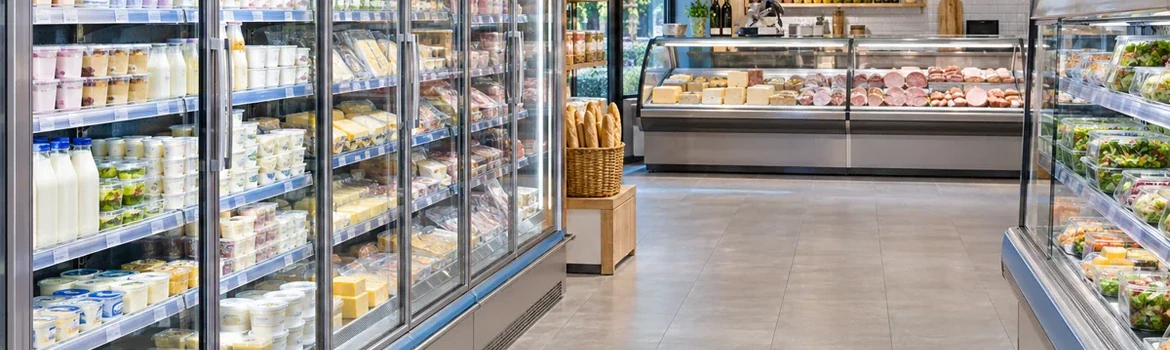
In a food shop, refrigeration equipment has two equally important jobs: preserving product quality and presenting products conveniently to customers. Even a high-quality cabinet is unsuitable if it obstructs movement, makes restocking difficult or exceeds the premises' technical capacity.
These issues are discussed in an INFRICO podcast by Manuel Oria Díaz, a third-generation representative of the Spanish food retail group Grupo El Jamón, and José Antonio Chamizo, commercial director of INFRICO Supermarket. Their experience shows that fitting out a shop starts with the retail concept, customer habits and the premises as a whole.
Oria Díaz explains that Grupo El Jamón focuses on neighbourhood shops. His family business aims to let customers buy everyday food close to home without visiting several shops. This calls for a broad range even where sales space is limited.
Multideck length and cabinet numbers should therefore not be determined solely by available wall space. First decide where dairy products, packaged meat, frozen goods and fresh-food service counters will be located. Then consider how shoppers move between these areas, where they stop with baskets and whether staff can replenish stock without obstruction.
The same principle applies to a small Lithuanian food shop. Before ordering a cabinet, mark the most frequently visited product groups, restocking routes and aisle widths on a plan. An attractive equipment layout on paper does not automatically make everyday operation convenient.
Oria Díaz highlights visibility, accessibility and lighting. In his experience, the same products can look more appealing after refurbishment because the surroundings are tidier and the display clearer. This is an observation from retail practice, rather than a promise that a new cabinet alone will increase sales.
Chamizo pays particular attention to cabinets for fresh meat, fish and other sensitive products. Unsuitable temperatures can affect food before customers notice visible changes. Good lighting and extensive glazing must be combined with the appropriate temperature range, air circulation and easy cleaning.
When comparing cabinets, look beyond total volume in litres. Ask how much visible shelf space is available, whether shelves suit real packaging sizes, how much stock can be displayed safely and whether stacked packs will obstruct airflow. Check temperature suitability separately for specialised fresh-food displays: one general-purpose display does not suit every product.
The speakers describe a familiar situation: a retailer knows where a multideck should go, but site conditions require changes. Depth, electrical supply, ventilation, access routes or servicing space may be limiting factors. Chamizo argues that these questions should be answered early, because changing a layout after opening is much harder.
A self-contained cabinet with an integrated refrigeration unit is often convenient for a smaller shop. It does not need a separate central refrigeration system, but the heat it releases must be removed and servicing access provided.
Another option is a semi plug-in cabinet. INFRICO's Detroit range combines a large display with refrigeration equipment integrated into the cabinet, avoiding a separate external refrigeration supply. Suitability still depends on ventilation, room heat load and the manufacturer's installation requirements.
A remote or central refrigeration system may be appropriate for larger projects. Chamizo also mentions carbon dioxide (CO₂) technologies, while stressing that not every site suits them. Selection should consider shop size, infrastructure, installation cost and maintenance, alongside the preferred refrigerant.
Open multidecks once dominated many sales floors. Oria Díaz recalls the increasing use of glass doors to improve energy efficiency. Open displays can still be useful where quick access to products is a priority.
Assess the specific situation. Open cabinets are sensitive to airflow, entrance proximity and air-conditioning outlets. Doors can reduce the entry of warm room air, but door opening space, customer traffic and restocking convenience also need attention.
For example, the INFRICO Munich ML9 PC M1 in our catalogue is an open multideck with adjustable shelves and lighting for a clear, accessible display. The INFRICO Rotterdam ML12 DCPC M1 has double-glazed doors for an enclosed retail display. For greater display capacity, consider the INFRICO Detroit ML12 DGU M1, a semi plug-in multideck with glass doors. These are examples of different constructions selected from our range, rather than models directly recommended by the podcast speakers.
All three must be assessed against the products' storage requirements and the selected factory temperature class. Request energy-consumption figures, installation requirements and maintenance information when comparing quotations.
One practical example concerns refurbishment. Oria Díaz describes shops acquired by the group containing equipment from different manufacturers and periods. Sometimes removing an old cabinet even required temporary dismantling of the checkout area.
Chamizo explains that a new shop can be planned from empty premises. In an operating shop, teams often work only during defined hours, must maintain product storage conditions and need to confirm in advance that new equipment will pass through the available openings.
Start a refurbishment with measurements, a removal route for old equipment and a temporary food-storage plan. Then schedule electrical and refrigeration connections, commissioning and actual temperature checks before returning products to display. This helps limit unplanned downtime, although duration depends on the site.
Oria Díaz emphasises that the group's success depends on several factors: location, a suitable range, reliable partners and well-preserved products. Refrigeration is part of this wider decision, so comparing expensive and inexpensive cabinets should go beyond their purchase prices.
Assess expected electricity use, servicing and repair costs, potential downtime and product losses. Chamizo discusses variable-speed compressors, but a specific saving percentage cannot be predicted without comparing models under equivalent conditions. Compare energy consumption over the same period and for a similar display area, rather than compressor power alone.
Before replacing equipment, review shelf loading, unobstructed airflow, door seals, replenishment procedures and temperature recording. Track discarded stock, restocking time, actual electricity use and breakdown frequency. These indicators help distinguish equipment problems from everyday operating practices.
The main lesson from Grupo El Jamón's cooperation with INFRICO is that the retail concept must match the site's technical possibilities. Correctly selected refrigeration supports both product storage and convenient operation for customers and staff.
If planning a new food shop or replacing existing multidecks, contact Šaldymo sprendimai for equipment selection. Provide a floor plan, main product groups, required display area and details of existing refrigeration and electrical infrastructure.
Open Multideck Display Refrigerators under Commercial refrigerators and select Infrico in the manufacturer filter. Use the series filter to separate Munich, Rotterdam or Detroit DGU models, then choose the required temperature range and compare electricity consumption in kWh/24 h. For open displays, use the open-front feature filter; check door construction, dimensions and shelf arrangements in the individual specifications when comparing enclosed models.

You must login or register in order to make comment!