excl VAT

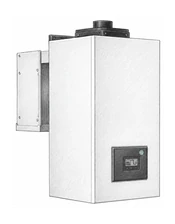
A monoblock refrigeration unit combines the main refrigeration components in a single factory-assembled housing and is designed to maintain the required temperature in a cold room or freezer room. Compared with a split system, installation can be simpler because the principal refrigeration circuit is already assembled. The current SaldymoSprendimai.lt assortment is based mainly on TEFCOLD CRU and the newer WRA range.
The correct starting point is not price or input power but the application: positive or negative temperature, internal room volume, panel thickness, required setpoint, ambient temperature on the condenser side and mounting method. TEFCOLD identifies room size, ambient temperature and setpoint temperature as the three key factors when selecting a monoblock.
The CRU range is convenient for standard 3-20 m³ rooms because each model has a defined manufacturer room-volume band. CRU-P units are rated for 0…+8 °C and CRU-N for -20…-10 °C. WRA-M and WRA-L provide a more flexible project-based approach for thicker panels, broader temperature ranges and multi-unit operation.
|
Group |
Temperature / duty |
When to choose |
|---|---|---|
|
CRU-P |
0…+8 °C; positive-temperature cold room |
Standard 3-20 m³ room with straightforward volume-based selection |
|
CRU-N |
-20…-10 °C; freezer room |
Frozen-product room in the 3-20 m³ range |
|
CRU w/o Panel |
P or N; no factory panel |
Existing or third-party cold room; fits 80-150 mm panels |
|
WRA-M |
-5…+15 °C; medium / positive temperature |
Broader performance selection, panels up to 200 mm or multi-unit systems |
|
WRA-L |
-25…-10 °C; low temperature |
Flexible freezer-room solution, panels up to 200 mm or multi-unit systems |
A monoblock is particularly practical for small and medium cold rooms when a compact factory-assembled unit is preferred over a separate outdoor condensing unit and long refrigerant pipework. Installation is simpler and the main refrigeration components and controller are integrated into one unit.
If condenser heat must be rejected outside the building, very high capacity is required, or many rooms are served from one system, a split or central refrigeration system may be more suitable.
CRU-P units are positive-temperature coolers. Current TEFCOLD specifications list a 0…+8 °C temperature range. CRU-N units are low-temperature freezer units rated at -20…-10 °C.
The model suffix is important: P means positive / cooler and N means negative / freezer. Select the N version for a freezer room rather than relying on a generic product title.
CRU model codes map to clear manufacturer cold-room volume bands. This gives a convenient first selection for standard insulated rooms operating close to the manufacturer’s reference conditions.
The volume band does not replace heat-load assessment. High ambient temperature, frequent door openings, warm product loading or weaker insulation all increase refrigeration demand.
|
CRU size code |
Manufacturer cold-room volume range |
Available versions |
|---|---|---|
|
3050 |
3-5 m³ |
P / N; panel-mounted or w/o Panel |
|
5175 |
5.1-7.5 m³ |
P / N; panel-mounted or w/o Panel |
|
7610 |
7.6-10 m³ |
P / N; panel-mounted or w/o Panel |
|
1015 |
10.1-15 m³ |
P / N; panel-mounted or w/o Panel |
|
1520 |
15.1-20 m³ |
P / N; panel-mounted or w/o Panel |
Standard CRU units can be supplied pre-mounted on a factory cold-room panel, which is convenient for TEFCOLD plug-in rooms. A “w/o Panel” version is the refrigeration unit without that factory panel and is intended for existing, custom or third-party rooms.
TEFCOLD specifies approximately 80-150 mm panel compatibility for CRU “w/o Panel” versions. Before ordering, also check the opening, structural support, door switch, service access and installation drawing.
WRA-M is the premium medium / positive-temperature monoblock range. TEFCOLD specifies -5…+15 °C. This is wider than the standard CRU-P range and supports more varied process requirements.
WRA performance should not be reduced to one universal “up to X m³” figure. TEFCOLD advises selecting from performance information according to ambient temperature and required setpoint.
WRA-L is designed for low-temperature duty and current specifications list -25…-10 °C. This provides a lower operating limit than the -20 °C CRU-N range.
WRA-L is useful where greater project flexibility, thicker panels or a larger multi-unit arrangement is required.
WRA units are designed for saddle mounting on the cold-room wall. TEFCOLD states compatibility with panels up to 200 mm thick, while installation requires openings to be cut in the cold-room panels.
This is different from a factory panel-mounted CRU. WRA should therefore be selected together with the room construction before panel manufacture or installation.
The WRA platform supports serial / multi-unit connection, with one unit assigned as the master controller. This allows several monoblocks to operate for the same cold room under one temperature control strategy.
It provides a flexible way to increase total capacity for larger rooms. Final unit quantity and model choice should be based on TEFCOLD performance data and the actual heat load.
Two 10 m³ cold rooms can require different refrigeration capacities. Panel U-value, door size and opening frequency, warm product load, lighting, people and ambient temperature all influence the heat load.
Use the CRU volume band as a quick guide for standard conditions. For non-standard rooms, verify the heat load and unit capacity at the real operating point.
A monoblock rejects all heat removed from the cold room into the space on the condenser side. TEFCOLD lists CRU operation up to +43 °C and 65% relative humidity, but this should not be treated as a design target for a small unventilated room.
Higher ambient temperature reduces capacity reserve and increases electrical load. Warm kitchens or small plant spaces may require mechanical warm-air extract and replacement air.
The refrigeration load removed from the cold room, plus compressor electrical energy, is ultimately rejected on the condenser side. In a small enclosed room this can raise the surrounding temperature quickly.
Do not aim the hot air discharge at a permanent workstation or install the unit next to ovens or other strong heat sources. Maintain the model-specific airflow and service clearances.
Current CRU and WRA ranges use R290 refrigerant. Their technical data lists automatic hot-gas defrost; CRU also includes automatic condensate evaporation.
These features reduce routine attention but do not eliminate condenser cleaning, drain checks and planned refrigeration maintenance.
The main advantages of a monoblock are simpler installation, factory assembly and less refrigerant pipework on site. The trade-off is that condenser heat and some noise remain in the same area as the hot side of the unit.
A split system can move the condenser outdoors or to a plant area, reducing heat rejection into the kitchen or store. It requires more installation work, pipework, evacuation, leak testing and design.
Catalogue kWh/24h values help compare similar units, but real consumption depends on setpoint, ambient temperature, insulation, door openings and product loading.
A larger nominal unit is not automatically more efficient for a small room. TEFCOLD also notes that oversizing a small room can create unnecessary purchase and energy cost.
First define the required room temperature. Then determine internal volume, panel thickness and installation location. For a standard room up to 20 m³, check the appropriate CRU-P or CRU-N volume band; for custom, larger or up-to-200-mm-panel applications, evaluate WRA-M or WRA-L.
Finally verify ambient temperature, electrical supply, panel opening / mounting, condenser airflow, service access and whether the surrounding space can remove the heat rejected by the monoblock.
CRU-P is a positive-temperature monoblock rated at 0…+8 °C. CRU-N is a low-temperature unit rated at -20…-10 °C.
The CRU range has manufacturer volume bands of 3-5, 5.1-7.5, 7.6-10, 10.1-15 and 15.1-20 m³. Use them as a starting point under standard conditions.
It is the refrigeration unit without a factory-attached cold-room panel. CRU “w/o Panel” versions are intended for existing or custom rooms and fit approximately 80-150 mm panels.
WRA is a more flexible premium range: panels up to 200 mm, saddle mounting, wider temperature ranges and multi-unit operation.
TEFCOLD specifies -5…+15 °C.
TEFCOLD specifies -25…-10 °C.
Yes. The WRA platform supports multi-unit connection with one unit acting as the master controller.
For outdoor installation in this category, choose only a wall-mounted INTARCON INTARBLOCK PRO CV-NPD monoblock with the separately ordered Adaptation for outdoor operation (Outdoor kit). The PRO name alone is not enough: select the accessory in the product options when ordering. The standard configuration does not include outdoor adaptation.
How do I find suitable models? Open the monoblock category product filter, expand Series and select INTARBLOCK PRO (CV-NPD). This is the wall-mounted PRO range. You may also select Mounting type – Wall-mounted. Choose a model according to cold-room temperature, required refrigeration capacity and volume, then open the product and select Adaptation for outdoor operation. The displayed surcharge is added to the selected unit price.
The accessory covers factory adaptation for outdoor installation. The specific configuration and permitted ambient temperature range are confirmed when ordering, according to the selected model and site conditions. Installation, electrical connection and commissioning are not included in this surcharge. Outdoor adaptation and ducting the warm condenser exhaust are separate solutions; a duct-compatible fan does not replace outdoor adaptation.
This accessory is not offered for ceiling-mounted INTARTOP PRO (CR-NPD) models. Do not select standard TEFCOLD CRU/WRA or other standard monoblocks in this category for outdoor installation. For an outdoor cold room, provide its dimensions, required internal temperature and expected outdoor conditions before ordering so that the unit and its configuration can be confirmed.
Yes. The condenser rejects heat to the surrounding space, so sufficient air volume and often active ventilation are required.
Only if the heat can be removed. Otherwise ambient temperature rises, capacity reserve falls and operating conditions deteriorate.
Only when the specific model has a manufacturer-approved condenser-fan configuration suitable for ductwork. IMPAFRI A2L monoblocks offer an optional centrifugal condenser fan with horizontal or vertical discharge. It can overcome the pressure resistance of an exhaust duct. The standard axial condenser fan is not intended for duct connection: insufficient airflow may result if a duct is attached. The IMPAFRI option does not automatically apply to other brands.
IMPAFRI provides duct-sizing guidance for an equivalent duct length of up to 20 m with the optional centrifugal condenser fan. Each 90° bend counts as 5 m of straight duct. For example, two 90° bends leave up to 10 m of straight duct (10 + 5 + 5 = 20 m). Use the duct cross-section recommended by the manufacturer; flexible or semi-flexible ducts may require a larger section. The final design must account for the fan's available static pressure and the total system resistance.
First select the optional centrifugal condenser fan and a suitable discharge direction. Depending on the duct connection and installation, an adaptor to a circular duct and a non-return damper may be required. Adequate replacement air must also reach the condenser. Verify accessory compatibility, duct dimensions and pressure losses before ordering.
No. Oversizing increases cost and can be unnecessary. Select enough capacity with a justified reserve for the real heat load.
Yes. TEFCOLD lists 80-150 mm panel compatibility for CRU “w/o Panel” models.
Consider split refrigeration when condenser heat should be moved outside, capacity is larger or non-standard, or several refrigeration loads will share one system.
Yes. Condenser cleaning, airflow, drainage, controller settings, system condition and other service points should be checked according to the manufacturer’s instructions.
First calculate the room's actual heat load at its required temperature, volume, insulation, door use, product loading and condenser-side ambient conditions. If one suitable unit cannot meet the load, consider two compatible monoblocks with the optional “Master–Slave control adaptation (alternating and simultaneous)”. In simultaneous mode, both units work together for the same room and their cooling capacities at the same operating point add together. Two identical units can provide approximately twice the capacity of one when both operate under their rated conditions. This offered configuration connects two monoblocks. Model compatibility, electrical supply, controls and combined capacity must be checked against manufacturer data. If two units are still insufficient, a different capacity refrigeration system is needed.
Alternating mode offers a standby unit for a pair of compatible monoblocks, for example when storing particularly valuable temperature-sensitive goods. Normally one unit operates while the other waits, or they alternate according to controller settings. If the controller detects a configured fault in the running unit, the standby unit starts according to the programmed controls. That standby unit must itself be able to cover the room's required heat load; otherwise temperature cannot be maintained. Confirm fault detection, alarms, maintenance and an emergency plan before ordering. Control redundancy does not replace temperature monitoring and equipment maintenance.