excl VAT
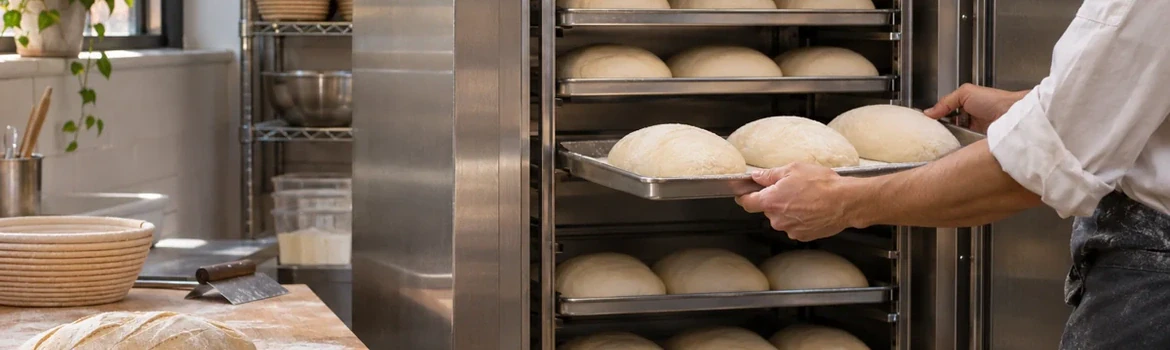
The same flour, the same recipe and the same baker, yet one day the bread rises beautifully and the next it loses shape or becomes too dense. In traditional bakeries, these differences often involve temperature, humidity and the time dough spends before baking, as well as ingredients.
In an INFRICO podcast, Rubén Contreras senior, who has worked for more than 43 years in his family's bakery in La Rambla, Córdoba, Spain, and his son Rubén Contreras junior, an INFRICO equipment engineer, discuss their experience. It shows how controlled fermentation can preserve traditional bread characteristics while improving work organisation.
When Contreras senior began working in his father's bakery, many tasks were manual. Dough pieces were shaped by hand and proved on wooden boards in the bakery. The season, weather and hot oven determined the temperature.
During summer, when dough rose too quickly, bakers carried the boards outside to try to slow the process. He recalls that moving dough at the wrong moment could cause it to collapse, making the desired bread quality unattainable. This was everyday experience before more precise temperature control became available.
The lesson remains relevant. Even with a consistent recipe, differences in dough temperature and ambient conditions change fermentation speed. Recording ingredients alone is insufficient: dough condition and proving conditions should also be tracked.
During fermentation, yeast and other starter microorganisms act on substances in the dough, producing gas and developing bread characteristics. Temperature influences the process speed; humidity helps maintain a suitable dough surface. An excessively dry surface can form a skin and restrict even expansion.
Contreras junior emphasises that proving equipment adds value by maintaining stable settings. This reduces dependence on unpredictable room temperature and helps repeat successful results across batches.
No single temperature or proving time suits all baked goods. Settings depend on flour, dough composition, yeast or starter, piece size, the intended product and earlier production stages. Bakers should observe dough volume, elasticity, surface condition and readiness for the oven as well as the clock.
The family bakery works in batches: while one rises, another is mixed and shaped. The oven and staff cannot process everything at once. If a batch waits too long for an earlier one to finish baking, fermentation can progress too far.
Contreras senior watches the final pre-baking stage particularly closely. For his bread, he identifies roughly the final half-hour as a sensitive period when delays can spoil the result. This describes his particular process, rather than a universal timing rule.
A practical approach is to plan batches backwards from the oven schedule. Knowing when oven space becomes available allows mixing, shaping and final proving to be coordinated. If the chamber can retard fermentation, there is more flexibility to limit waiting and overlapping batches.
Assess changes using simple records: batches baked too early or too late, products that missed the intended shape and discarded output. Start with a few closely observed products rather than changing the entire production process.
The engineer describes another solution in the family bakery. His father uses a larger proving room and a separate INFRICO cabinet. Main bread production can therefore prove in one area while pastries requiring a different programme are prepared in another.
The advantage extends beyond additional capacity: different products no longer have to wait for another batch to finish in a shared room. This may suit bakeries producing rolls, laminated pastry or other goods alongside traditional bread.
Select the additional cabinet around actual workflow. Assess the number and size of trays proved simultaneously, product height, spacing between levels and whether staff work more conveniently with individual trays or a trolley. Total cabinet volume in litres does not answer these questions.
The baker also recalls preparing a traditional preferment: dough was mixed with a small amount of yeast and held for later production. Refrigeration subsequently allowed some dough or preferment to be prepared earlier and coordinated more conveniently with the work schedule.
Distinguish products and processes. A yeast-based preferment is not necessarily the same as a natural sourdough starter with its own microbial culture. Refrigeration can slow fermentation, but storage time, temperature and subsequent use must be defined for the recipe and food safety procedure. Freezing is not equally suitable for all cultures.
Equipment with retarding and subsequent proving functions can help when dough is prepared today for proving and baking tomorrow. However, an ingredient-storage refrigerator and a programmable dough fermentation cabinet perform different jobs. Check which cooling, heating, humidity and timing stages a specific model supports.
A bakery needing a separately controlled space for smaller batches can consider the INFRICO FC900BT. This 785-litre retarder-prover combines refrigeration, heating and humidity control. The INFRICO FC900BTCR offers the same capacity with a glass door for viewing products without opening the cabinet. Choose according to working conditions, rather than door appearance alone.
For trolley-based production and larger batches, the 1,224-litre roll-in INFRICO FCR1P is another example. These models were selected from our catalogue as equipment examples; the podcast did not identify them as the exact cabinets used by the baker.
Before selecting equipment, confirm tray or trolley dimensions, production volume, required fermentation programmes and accessories. Programmes for individual products should be approved by the bakery's technologist or responsible baker.
Contreras senior openly discusses his reluctance to rush bread merely to shorten working hours. Preserving the family's methods and manual work matters to him. He also acknowledges that modern equipment helps organise the day, postpone some processes and allow more rest.
His son's engineering perspective complements this experience: a proving chamber should assist the traditional baker. It can preserve hand shaping and distinctive recipes while reducing dependence on unpredictable room temperature.
They also recognise the equipment's limits. During mixing, dividing and shaping outside the chamber, dough remains exposed to room air, work-surface and ingredient temperatures. Stable proving must therefore be part of a well-organised overall process.
To start with small improvements, choose one regular product and record dough temperature, proving time, room conditions and finished quality over several batches. This helps identify whether the main losses arise from recipe variation, poor coordination with the oven or insufficient fermentation control.
To improve proving control or organise production more flexibly, contact Šaldymo sprendimai for equipment selection. State the products made, maximum batch size, tray or trolley dimensions and desired production and baking schedule.
Look under Upright Commercial Refrigerators in the professional kitchen refrigeration section. Select Infrico as the manufacturer and the feature for dough proving; the FC series filter helps separate this equipment from ordinary food-storage cabinets. Next compare shelf or tray dimensions and fermentation programmes in each specification; for trolley-based production, also check the roll-in feature and exact trolley compatibility.

You must login or register in order to make comment!