excl VAT

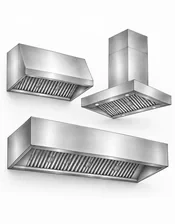
Novameta professional extraction hoods serve cooking lines, dishwashing areas and other workplaces producing heat and vapour. Start with the process and equipment layout: does the air contain grease particles or mainly heat and moisture, and is the equipment installed against a wall or in the centre of the kitchen?
HNPD, HNPA, HPPD and HFPD are wall canopy families for equipment arranged along a wall. HNCD, HNCA, HPCD and HFCD are island hoods for central cooking equipment. An island installation needs sufficient overhang and consideration of air movement from every open side.
HNPA and HNCA use a tapered profile for low ceilings. The manufacturer associates these families with moderate cooking loads, such as snack bars and cafeterias. This designation refers to the geometry: their standard catalogue body height is also 480 mm.
For processes releasing grease particles, choose a family with stainless steel cyclonic grease filters. Their channels rotate the airflow, separating particles onto the channel walls before collected grease drains into the collection area. Filters can be washed in a commercial dishwasher; schedule cleaning according to the workload.
HKCD condensate hoods are recommended for dishwashing areas. Condensate plates replace grease filters, helping turn vapour into liquid and reducing moisture entering the ventilation system. HNPDC filterless hoods extract heat and fumes where grease and steam loads are limited. HKCD is the more appropriate family for a heavily steaming dishwashing area.
HPPD and HPCD introduce air jets that help direct the rising thermal plume towards the filters and contain it inside the hood. Exhaust and jet airflow must be balanced as part of the ventilation design.
HFPD and HFCD also supply make-up air at low velocity through the perforated front panel, bringing air towards the occupied cooking area. Capture-assisting jets and make-up air serving the kitchen are separate functions.
A more advanced family is worth considering when its features address a specific problem: difficult plume capture, intensive operation or insufficient air near cooking equipment. Higher price alone does not determine the result; the complete, balanced ventilation design does.
The manufacturer's sizing diagram calls for at least 300 mm overhang beyond equipment edges on open sides, with at least 450 mm on the door side of ovens. It recommends a hood lower-edge mounting height of 2000–2100 mm above the floor. Final installation must suit the equipment and room design.
The specified maximum exhaust airflow describes the hood's technical limit, rather than the capacity of an included fan. Operating airflow and fan selection depend on heat and vapour loads, pressure losses, ductwork and make-up air. HNPDC product pages omit this value because its catalogue table does not state one.
Each family description identifies the standard configuration. Product options offer catalogue-priced LED lighting, light switches, adjustment dampers, removable collection trays and joining connectors. Damper choices cover all connections of the relevant type on that model, with surcharges calculated for the stated quantity.
Cover panels depend on the required area; powder coating and custom solutions are quoted individually. Z-FAN air jet fans are selected for the project and do not replace the main exhaust fan. The exhaust fan, ductwork and installation are not included in the hood price and are quoted for the installation site. Product images may show optional accessories.
No. Consider the equipment, heat and vapour loads, layout, overhang and air supply.
Wall hoods serve equipment against a wall; island hoods serve open central cooking areas. Their construction and dimension ranges differ, so equal length does not make them interchangeable.
HKCD serves moisture and vapour loads, particularly in dishwashing areas. Grease-producing cooking equipment requires a family with grease filters.
HNPA and HNCA have a tapered profile. Assess the complete geometry and installation conditions rather than body height alone.
The jet system primarily assists capture of the thermal plume. HFPD and HFCD provide an additional make-up air function.
No. The ventilation design determines operating airflow from the processes and pressure losses. The maximum rating helps compare technical capabilities.
Optional LED lighting is included only when selected or separately agreed. The exhaust fan and duct system are selected separately.
The manufacturer offers custom dimensions and multi-hood assemblies. Their connections and price require individual agreement; listed product pages cover priced catalogue sizes.