excl VAT

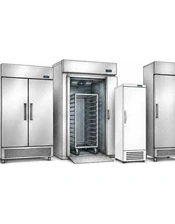
Upright refrigerated cabinets are professional refrigerators and freezers designed to hold chilled or frozen stock in restaurants, hotels, bakeries, production kitchens, canteens and other HoReCa environments. Cabinets that look very similar from the outside can belong to very different duty classes: one may be intended for simple storage, another for a hot high-intensity kitchen, another for 600×400 bakery trays, while a dedicated fish cabinet uses a different internal design altogether.
The current category includes several generations and applications at the same time: economical SD/SDU and UR storage coolers, UF storage freezers, shallower RK/RF 500/505/1010 models, GN2/1 RK/RF gastro cabinets, the newer high-efficiency RK/RF X1 generation, BK/BF Euronorm bakery cabinets, the dedicated RKS600 fish cooler and glass-door RK710G / RK1420G units. Capacity and price alone therefore do not identify the right cabinet - duty class and internal format come first.
Start with the product and process: chilled or frozen; storage room or hot kitchen; GN2/1, 600×400 or ordinary packaged stock; one or two doors; frequency of door opening; required ambient capability; static, fan-assisted or ventilated cooling; manual or automatic defrost; and whether features such as self-closing doors or HACCP data export are genuinely useful.
|
Type / range |
Best suited to |
Key points to check |
|---|---|---|
|
SD / SDU storage |
Simple chilled stockholding where low purchase cost and compact dimensions matter. |
Mechanical control, fan-assisted cooling, shelf format, ambient limit. |
|
UR / UR-W / UR-X |
General chilled storage; larger models use GN2/1. New W/X generation is substantially more efficient. |
White or stainless exterior, GN2/1, energy class, old vs new generation. |
|
UF / UF-V / UF-S |
Frozen storage from compact cabinets to larger upright freezers. |
Fixed freezing shelves vs ventilated V model, defrost method, shelf flexibility. |
|
RK / RF 500-1010 |
Professional kitchens needing a shallower 700 mm-class cabinet or smaller footprint. |
Chilled / frozen, number of doors, depth, shelf format. |
|
RK / RF X1 GN2/1 |
High-duty kitchens where climate class 5, SS304, energy efficiency and HACCP control matter. |
1 or 2 doors, GN2/1, A/B energy class, Bluetooth/NFC controller. |
|
RK710G / RK1420G |
Professional kitchens where staff benefit from seeing stock without opening the door. |
Glass doors, GN2/1, visibility vs energy demand. |
|
BK850 / BF850 |
Bakeries and pastry production using 600×400 / 600×800 trays. |
Euronorm guides, 990 mm depth, cooler or freezer. |
|
RKS600 |
Fresh fish and seafood in dedicated trays. |
Static cooling, 400×600 fish trays, SS304, corrosion-adapted refrigeration components. |
Start with duty level rather than volume. SD/SDU and UR storage coolers are rational for reserve stock where door openings are less frequent and the environment is less demanding. They are typically simpler and more economical.
RK/RF gastro cabinets are designed for higher-intensity professional kitchens. The current RK/RF X1 generation combines SS304 construction, self-closing doors, adjustable GN2/1 shelves, castors, climate class 5 and a more advanced controller.
Positive-temperature cabinets hold already chilled ingredients and prepared food according to the product specification. RK X1 operates from about -2 to +8 °C, while many storage coolers operate around +2 to +8 or +2 to +10 °C.
Upright freezers hold already frozen product. RF X1 operates around -22 to -18 °C, while UF models use similar negative-temperature regimes depending on version. A holding freezer is not a blast freezer for rapidly freezing a large warm load.
RK710X1 and RK1420X1 are one- and two-door GN2/1 upright coolers; RF710X1 and RF1420X1 are the matching freezers. The X1 ranges use ventilated cooling, automatic defrost, self-closing doors, SS304 and climate class 5.
The controller adds Bluetooth and NFC connectivity plus HACCP-compliant data export. TEFCOLD states that RK710X1 and RK1420X1 use about 36% and 53% less energy than the models they replace, while RF710X1 and RF1420X1 save about 51% and 64% against their predecessors. These are manufacturer comparisons between specific old and new models.
RK710X1 provides about 408 l net and RK1420X1 about 954 l net. The cooler models are EU energy class A; the matching X1 freezers are class B.
The store still lists earlier RK710, RK1420, RF710 and RF1420 units alongside shallower RK/RF 500/505/1010 formats. They can remain a rational purchase where price, dimensions or availability matter, but compare annual kWh, ambient class, controller functions and cabinet generation rather than price alone.
RK500SNACK / RF500SNACK and RK505 / RF505 are approximately 700 mm deep, which can be valuable in a narrow kitchen where an 875 mm-deep GN2/1 X1 cabinet would compromise the aisle.
The UR range is intended for simpler chilled storage. The store still shows UR200, UR400, UR550, UR600 and stainless variants, while TEFCOLD is transitioning to the new UR-W / UR-X generation. UR200 / UR200S remain, while larger previous UR and UR-S models are being replaced by W (white exterior) and X (stainless exterior) versions.
TEFCOLD describes the new UR-W / UR-X range as A / A+ rated with improved airflow and 47-57% lower energy use than the specific models being replaced. UR600W1 / UR600X1, for example, provide about 570 l net and use GN2/1 shelving.
SD and SDU are simpler storage coolers with white exterior, ABS interior, mechanical control, fan-assisted cooling, automatic defrost and adjustable wire shelves. They are useful when the application does not require a stainless gastro cabinet.
SD1280 and SDU1280 are around 595 mm wide and 640 mm deep. Their compact footprint makes them useful in a store room or secondary zone, but they should not be compared with RK X1 solely by price or litres.
Base UF200 / UF400 / UF550 / UF600 models commonly use fixed freezing shelves. The shelf is part of the refrigeration system, so it cannot be repositioned like a normal wire shelf; manual defrost is common in these versions.
UF200V / UF400V / UF700V and stainless VS versions use ventilated cooling, adjustable shelves and automatic defrost. The V suffix therefore indicates a meaningful construction and maintenance difference rather than a cosmetic option.
Internal format is a key specification. RK/RF X1 and some UR models accept GN2/1, allowing kitchens already using Gastronorm containers to standardise storage.
BK850 / BF850 are Euronorm bakery cabinets with guides for 600×400 and 600×800 trays. They are deeper, at about 990 mm, because the cabinet is built around the bakery process. SD/SDU and some storage coolers use conventional wire shelves.
BK850 is the positive-temperature Euronorm cooler and BF850 the matching freezer. Both use SS304, reversible self-closing doors, ventilated cooling, automatic defrost, castors and ten bakery-tray guides. BK850 operates around -2 to +10 °C; BF850 around -24 to -18 °C.
The value of these cabinets is workflow rather than the 850-litre label: trays can move through the bakery process without repacking ingredients or products into a different storage format.
RKS600 shows why a universal refrigerator is not always the correct choice. It is designed for fresh fish and seafood, uses static cooling and comes with 400×600 fish trays. TEFCOLD recommends crushed ice to help maintain freshness and moisture.
The interior and exterior are SS304, while internal refrigeration components are specially protected against corrosion associated with the fish-storage environment. Its temperature range is -6 to +8 °C.
Solid doors are normally the practical default in a professional kitchen: they insulate well and hide working stock. Glass-door RK710G / RK1420G can be useful when staff need to see stock without opening the cabinet or when the unit sits in a more visible front-of-house zone.
Choose glass for a real workflow benefit rather than appearance alone, and compare the energy data with the equivalent solid-door format.
Catalogue temperatures are valid only within the manufacturer’s specified ambient conditions. RK/RF X1 are climate class 5 cabinets designed for demanding gastro conditions. SD/SDU, BK/BF, RKS and many storage models are typically climate class 4.
Assess the local environment around the cabinet, not the restaurant dining room temperature. Ovens, fryers, dishwashers and enclosed niches can create a much higher heat load around the condenser.
Ventilated cooling actively circulates air and helps temperature recovery after frequent door opening, which is valuable in high-duty kitchens. Fan-assisted storage coolers also use a fan to improve distribution, but the overall cabinet construction is less intensive.
Static cooling is appropriate in specific applications such as RKS600 fish storage and some freezers with fixed evaporator shelves. The correct system depends on product, duty and defrost method.
Ventilated gastro cabinets commonly use automatic defrost. Base UF freezers with fixed freezing shelves may use manual defrost, requiring planned stock relocation.
Regardless of defrost type, clean door gaskets, keep air channels clear and maintain the condenser area. A maintenance-free condenser reduces routine work but does not remove the need for ventilation and general hygiene.
In a busy kitchen, door mechanics affect both energy use and ergonomics. RK/RF X1 doors self-close but can remain open at about 105° while loading. The single-door X1 models can be configured for the required hinge direction.
Measure not only cabinet width but also the working space needed to open doors. Two doors can be more practical than one very wide door because less of the cabinet is exposed during each opening.
An upright cabinet often runs 24/7, so annual kWh becomes significant over its service life. Compare kWh/24 h or kWh/year, energy class and usable capacity rather than compressor wattage alone.
The current RK/RF X1 and UR-W / UR-X generation changes are especially important because TEFCOLD reports substantial energy reductions versus the models they replace. Where old and new generations are listed together, whole-life energy should be part of the purchase decision.
A holding refrigerator is designed to maintain already chilled food, not to rapidly cool a large quantity of freshly cooked hot product. A warm load can raise the temperature throughout the cabinet and affect other stored food.
Use a blast chiller / blast freezer for rapid controlled temperature reduction, then move the product into the normal holding cabinet for storage.
The condenser needs airflow and service access. Do not block ventilation grilles or enclose the cabinet in furniture unless the exact installation instructions permit it. Castors on gastro cabinets make cleaning and servicing easier.
Avoid direct proximity to ovens, fryers, radiators and dishwasher steam. Also check door swing, floor level, electrical access and the delivery route: a 990 mm-deep bakery cabinet is a very different installation object from a 595×640 mm SDU.
Professional cabinets are designed for commercial duty, heavier loading, easier cleaning and specified ambient conditions. Gastro models also add GN compatibility, self-closing doors, robust castors and stainless construction.
Storage class is rational for reserve stock and less frequent door opening. Choose gastro class for a hot, high-intensity kitchen where higher ambient capability, hygiene, GN shelving and fast temperature recovery matter.
X1 adds SS304 construction, climate class 5, Bluetooth/NFC control, HACCP data export and substantially lower manufacturer-rated energy use versus the specific models it replaces.
RK710X1 is a single-door GN2/1 cooler with about 408 l net capacity; RK1420X1 is a two-door model with about 954 l net. Choose according to stock volume, available width and how you organise product groups.
Yes, but it is a storage range rather than the same high-duty gastro class as RK X1. It is rational where climate class 5 and the full premium construction are not required.
They are the newer storage-cooler generation: W denotes a white exterior and X a stainless exterior. TEFCOLD introduced them as lower-energy replacements for larger previous UR / UR-S models.
Base UF models commonly use fixed freezing shelves and manual defrost. V / VS versions use ventilated cooling, adjustable shelves and automatic defrost, making the interior more flexible and reducing manual maintenance.
GN2/1 is the Gastronorm format used widely in restaurant kitchens. 600×400 and 600×800 are bakery tray standards. Choose the cabinet around the containers and trays already used in your process.
They are designed around 600×400 / 600×800 bakery trays and corresponding guides, so the approximately 990 mm depth is a workflow requirement rather than unnecessary cabinet size.
Not always optimally. RKS600 is specifically designed for fish with static cooling, fish trays and corrosion-adapted refrigeration components. It is a more appropriate reference point for fresh fish and seafood.
Only when visibility genuinely improves workflow or merchandising. In a closed professional kitchen, solid doors are normally more practical and energy-efficient.
It indicates a cabinet designed for more demanding ambient conditions than many storage models. This matters in a hot professional kitchen, but the exact declared test conditions should always be checked on the selected model.
A holding cabinet is not intended for rapid cooling of hot food. Use a blast chiller for controlled rapid cooling and transfer the food to the holding cabinet once chilled.
When the kitchen is very hot, aisle width is limited, you use specific GN or bakery formats, need a fish solution, are choosing a two-door cabinet, or want to compare old and new generations by whole-life energy cost.
The “Shelf dimensions, mm” filter uses a consistent format, such as 400 x 600 or 600 x 800. GN 1/1 measures 530 x 325 mm and GN 2/1 measures 650 x 530 mm; rotating the shelf gives the equivalent 530 x 650 mm orientation used in many cabinets. Bakery formats of 400 x 600 and 600 x 800 mm differ from GN, so check your existing trays and containers before choosing.
Actual shelf dimensions can differ from a standard container format, so the specification follows the particular model. Compatibility with a GN container does not mean every shelf has the same dimensions. Cabinets supplied only with tray guides or trolley space may have no applicable shelf dimensions; check tray or trolley compatibility and the included equipment in the description.
A refrigerated storage volume of “260 + 260” means two separate 260-litre compartments. Size each compartment for its own workload: spare capacity in one zone cannot replace missing space in the other. “Gross / net volume, l” compares two different volume measurements of the same cabinet; the slash in that attribute does not mean there are two temperature compartments.
Roll-in trolley: RIC880X1 and RIC1760X1 accept a compatible loaded trolley. RTC880X1 and RTC1760X1 also carry the “Roll-through” feature: access from both sides supports workflow between two areas. Trolleys are not included; check trolley dimensions and entry requirements.
Pastry: BK850 and BF850 use guides for bakery trays, while BF850I has nine wire shelves measuring 600 x 800 mm. Check the equipment included with the individual model and compatibility with your trays. Fish storage: RKS600 has an interior designed for fish trays.
Ice cream (Napoli pans): BF850I also accommodates up to 54 five-litre Napoli ice cream pans, which are not included. It is a −24…−18 °C storage freezer. Its application and temperature differ from INFRICO Gelato line models, some of which reach −40 °C.
A model may have several features: BF850I can be found under either “Pastry” or “Ice cream (Napoli pans)”. Features complement temperature, dimensions, manufacturer and the other filters.
Choose a cabinet around the food you store, the containers you use and the way products move through your kitchen. INFRICO adds dedicated fish, pastry, ice cream, dough proofing and trolley solutions to conventional refrigerators and freezers. The Manufacturer filter lets you compare INFRICO with TEFCOLD; Features identifies specialist applications and selected INFRICO ranges. Ordinary cabinets do not necessarily have an additional feature assigned. Clear that filter to see the complete selection.
NACIONAL and AGB families offer different capacities, doors and shelf formats. A series name or litre figure alone is insufficient: check the internal format, supplied shelving, temperature range, climate class and energy rating. An inverter compressor or a particular energy class is stated only where the manufacturer declares it for that model.
iLine is a professional range for everyday storage with a practical standard configuration. Compare the specific steel grade, insulation, permitted ambient temperature and energy consumption with the closest NACIONAL or AGB alternative. The INFRICO name does not mean every range has identical construction or uses AISI 304 stainless steel.
Americana line includes AN23, AN49, AN67 and related models. The AN range, for example, uses the GN 2/1 format and AISI 430 construction, with a lock and castors including front brakes. Door count, capacity and operating temperature vary. Americana is a separate manufacturer range; it should not automatically be treated as iLine or confused with every other cabinet whose code begins with AN.
Fish cabinets such as AP and specialised ANDP models organise fresh fish storage in suitable containers. Their operating temperatures and internal fittings differ from general storage cabinets. ANDP1003TFG and ANDP1004TFG combine general refrigerated storage with dedicated fish compartments; they are not refrigerator/freezer combinations.
Pastry cabinets should match the exact tray format and runner arrangement. EURONORM 600 × 400 mm and 600 × 800 mm solutions are different. Where a cabinet is supplied with runners but without shelves or trays, allow for those items separately. Matching formats lets a tray move directly between work stages and reduces handling.
Two temperature compartments identifies cabinets with separate, independently controlled compartments. A model designed for the purpose can hold chilled stock in one compartment and frozen stock in the other. For example, “−2 to +8 / −25 to −18” gives the chiller range followed by the separate freezer range. Models with −18 °C, −25…−18 °C and −22…−18 °C freezer specifications remain separate filter choices.
ANDP1003TFG and ANDP1004TFG combine general refrigeration with a fish compartment at −2…+8 °C and −2…+2 °C; they are not refrigerator-freezer combinations. Americana line models with two temperature compartments retain their range feature as well. Two doors alone do not establish independent temperature control: use the “Two temperature compartments” feature to find these models.
Roll-in cabinets accept a compatible loaded trolley. They suit bakeries, canteens, hotels and production sites moving batches of trays or containers. Check maximum trolley dimensions, the entrance and included equipment: a trolley is not always supplied.
Pass-through cabinets provide access from both sides. They can transfer food between preparation and service areas, reducing walking and opposing traffic. Shelved pass-through cabinets and roll-through trolley models have different interiors, so opposite doors alone do not establish suitability.
A more expensive cabinet offers the greatest practical value when its construction removes a repeated daily task: transferring trays, carrying products or making unnecessary trips. Compare staff time, compatibility with your existing containers, cleaning and electricity consumption as well as purchase price per litre.
Dough proofing FC retarder-proofer models manage fermentation using refrigeration, heating and humidity control. They help schedule dough preparation around working hours and should be assessed as process equipment. Choose the tray format, batch capacity and control functions required by your production.
Gelato line identifies cabinets intended for ice cream storage and very low storage temperatures. AGB901BT operates at approximately −25…−22 °C and accommodates an arrangement of up to 54 five-litre ice cream tubs; tubs are not included. AGB901UBT has a −40…−20 °C operating range. These are storage cabinets, so blast-freezer throughput in kilograms per cycle is not the appropriate selection criterion.
1. Is a more expensive range always the better choice?
Value depends on your working conditions. Steel grade, climate class, insulation, energy consumption, shelf format and supplied equipment may matter more than extra litres or a familiar range name. Compare models intended for the same application.
2. How do climate class and energy class differ?
Climate class describes the manufacturer's test environment; energy class describes efficiency under the methodology applicable to that equipment. Check the stated ambient conditions and daily kWh consumption. Different types of equipment cannot always be compared through a single label.
3. Are all containers, trays and trolleys shown in photographs included?
Check the product specification and accessory selections. Photographs may illustrate an application. Accessories are assigned to compatible models; an item from one family is not automatically suitable for another.
4. When should I choose a trolley cabinet instead of a shelved cabinet?
Consider batch size and the number of daily transfers. If food is already prepared on a compatible trolley, roll-in storage can shorten loading. A shelved cabinet may be more convenient for smaller quantities of frequently changing individual products.
5. What warranty and lead time apply to INFRICO?
INFRICO products carry a two-year warranty. The standard stated order lead time is 4–6 weeks; the delivery date for a particular order is confirmed when its configuration is agreed.
Series identifies the manufacturer’s model family: the model-code letter prefix for TEFCOLD, or the corresponding line or family name for INFRICO. Features describes a specific specialist application or construction. Ordinary appliances need not have an additional feature assigned. Dimensions and temperature range can be compared across manufacturers; shelf dimensions do not apply to models that store products in drawers or on a trolley.