excl VAT

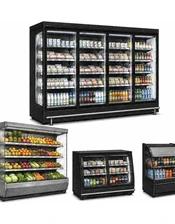
Multideck display coolers are upright multi-shelf refrigerated cabinets designed to keep chilled products highly visible and easy for customers to reach. They are widely used in supermarkets, convenience stores, petrol stations, cafés, delis, grab-and-go areas and other self-service retail environments. Their main advantage is a large display area within a relatively small footprint: products are merchandised across several shelf levels, allowing a single wall section to become a complete chilled sales zone.
The current range includes several very different concepts rather than one cabinet in different widths: low open-front NOC and ODC impulse units, stainless-steel MCX open multidecks with a security shutter, full-height Galaxy+, PC and EXTRA glass-door cabinets, the shallower MDCA supermarket range and the new deeper MDCB range. Each concept is intended for a different traffic level, store geometry and stock requirement.
The best starting point is not “how many litres does it hold?” but five practical questions: what will be stored, does the customer need completely open access, how much shelf depth is required for the packs, how much aisle space can be given to cabinet depth, and what ambient temperature and airflow conditions will exist at the installation position.
|
Type / range |
Best suited for |
Key selection point |
|---|---|---|
|
NOC / ODC low open-front |
Checkout zones, impulse sales, drinks, snacks and fast customer access. |
Open access, higher energy use, night blind, draught-free location. |
|
MCX open stainless |
Canteens, hotels, schools, cafés and controlled grab-and-go service. |
Open display during service, lockable security shutter after service, mobility. |
|
Galaxy+ / PC with doors |
Retail and supermarkets where large displays and lower running costs matter. |
Frameless glass doors, shelf width, energy class and total display area. |
|
MDCA |
Full-height retail where aisle width is important. |
Shallower cabinet, shelf depth, energy class B models and connected controller. |
|
MDCB |
Higher-capacity retail where deep shelves are the priority. |
600 mm shelves, greater cabinet depth, 3M1, energy class B and multiplexing. |
|
EXTRA CD / FD |
CD for chilled products; FD for frozen products. |
Do not confuse CD and FD - temperature class and product application are different. |
This is the most important decision because it directly affects both shopper behaviour and running costs. An open-front multideck has no physical barrier between the shopper and the product. Customers can see and pick up an item in one movement, making open cabinets particularly effective for impulse sales, grab-and-go food, sandwiches, drinks and snacks.
The trade-off is that an open cabinet must continuously maintain a refrigerated air curtain while warm ambient air tries to enter the display. Glass doors reduce heat infiltration and generally allow substantially lower energy consumption. For long operating hours, larger stores and multi-cabinet runs, doors are therefore often the more economical solution.
Doors do not automatically mean poor merchandising. Frameless full-vision glass, vertical and horizontal LED lighting and well-designed shelving can maintain excellent product visibility. Choose according to the retail format: maximum one-motion access for fast impulse sales, or glass doors when long-term energy control and larger continuous displays are the priority.
Low-height cabinets, typically around 1.4-1.6 m, are useful where refrigeration should not block sightlines through the store. They work well near checkouts, around the perimeter or as part of an island arrangement. NOC and ODC concepts are designed around smaller, immediately accessible impulse displays.
Full-height multidecks make better use of vertical space and provide more shelf levels within the same floor area. They are a logical choice for dairy, beverages, packed fresh meat, ready meals, vegetables and other chilled products where the retailer needs a broad range and a large front-facing display.
Height also influences store planning. A tall cabinet can block visibility to another department and requires a different replenishment workflow. A lower unit offers less capacity but preserves the customer’s view across the store and can help shape traffic flow.
Depth is one of the most important and frequently underestimated specifications. A shallower multideck leaves a wider aisle and suits smaller stores, but fewer packs fit from front to back. A deeper cabinet takes more floor area but increases stockholding on each shelf and reduces replenishment frequency.
The current MDCA and MDCB ranges illustrate this clearly. MDCA is the shallower supermarket concept, while the new 2026 MDCB range uses 600 mm deep shelves and a 650 mm base for much greater storage and display capacity. TEFCOLD states that MDCB will replace the EXTRA-CD multideck range. For new projects it therefore makes sense to compare MDCB against older EXTRA-CD installations rather than treating EXTRA-CD as the only deep-shelf option.
Measure the aisle in real working conditions, not in an empty shop. Allow for shopping trolleys, two customers passing, open doors, a replenishment trolley and staff working space. A difference of a few centimetres may look insignificant in a specification sheet but can materially change a long retail aisle.
Gross and even net volume are not always the best way to compare multidecks. Customers buy from the visible shelves, so the usable shelf and front-facing display area matters more. Two cabinets of the same width can have different shelf depths, shelf counts and very different real product capacity.
Compare total display area, shelf dimensions, number of shelves, maximum shelf load and whether the shelves can be tilted. Tilting is useful for bottles, cans and many packaged foods because it improves front-facing visibility. Acrylic front risers and ticket strips help keep the display organised and retail-ready.
Galaxy+ and PC are good examples of modern glass-door multidecks. Frameless glass doors maintain clear product visibility, while vertical and horizontal LED lighting gives even illumination across the display. Ventilated cooling distributes air throughout the cabinet and supports faster temperature recovery after the doors have been opened.
A representative Galaxy+ GP10FGD Black is energy class B and operates in the -1 to +5 °C range. The similarly wide “Maxi” version is deeper and offers more shelf depth. PC1250B also uses frameless doors, five adjustable shelves, LED lighting below each shelf, an electronic controller and temperature class 3M1. These ranges are suited to packed fresh meat, dairy, beverages, ready-made sandwiches and similar chilled goods when the product requirements match the exact cabinet specification.
MDCA and MDCB look similar at first glance but are designed around different space priorities. MDCA focuses on a strong display with a smaller overall depth. The range includes energy class B models, adjustable tilting shelves, vertical and horizontal LED lighting, stainless-steel bumper bars and a controller with Bluetooth and NFC connectivity.
MDCB was launched in 2026 as the deeper-capacity alternative. TEFCOLD highlights 600 mm shelves, temperature class 3M1, a low-energy and low-noise refrigeration system, a variable-speed compressor and a Bluetooth controller that can simplify data export for HACCP records. Multiple cabinets can be joined into uninterrupted runs where the range supports multiplexing.
The practical rule is simple: if aisle width is critical, start with the shallower concept. If the priority is maximum stockholding per metre of frontage, allow the extra floor depth for MDCB.
NOC and ODC are lower open-front self-service displays designed to bring the shopper physically closer to the product. They suit checkout zones, drinks, desserts, snacks, prepared sandwiches and other products commonly bought on impulse. Shelves are adjustable and, depending on the model, can be tilted, while LED lighting highlights the display.
ODC models include a night blind. This is not simply a cosmetic accessory: closing the front outside trading hours reduces warm-air infiltration and cuts unnecessary energy loss. An open cabinet should be selected when the commercial value of barrier-free access genuinely justifies the higher running cost.
NOC60CC uses a curved glass top/front and is positioned more like a premium impulse-sales module. It can be combined with a neutral corner section to create an island layout. These applications depend heavily on store design, so shopper movement around the cabinet should be planned before ordering.
MCX is distinguished by a stainless-steel construction and a rigid lockable security shutter. During service the multideck remains open for fast grab-and-go access; once the service area closes, the shutter helps protect the products. Castors also make the cabinet easier to reposition.
This concept is especially relevant to hotels, schools, universities, workplace canteens and conference or self-service areas that trade only during defined hours. Here the ability to close and secure the display can be as important as the refrigeration specification itself.
In 3M1, the number 3 identifies the climate class and M1 identifies the temperature class of product-simulating test packages. The M1 test limits are -1 to +5 °C; they are not automatically the controller setpoint or supply-air temperature range. Check the application range and intended use on the exact product card.
The printed temperature range is not enough on its own. Check the temperature class, controller, packaging, maximum loading line and manufacturer’s intended application. In open-front cabinets, product temperature depends strongly on the stability of the air curtain, so incorrect loading or a draught can matter more than changing the setpoint by one degree.
|
Important category exception |
EXTRA-CD models are for chilled products and use glass doors, deep shelves and multiplexing options. In 2026 TEFCOLD announced that the new MDCB range will progressively replace EXTRA-CD, so new projects should check the current replacement model.
EXTRA-FD models are multideck freezers with heated self-closing glass doors and temperature class 3L1. They are intended for frozen goods. If a customer is browsing specifically for positive-temperature multidecks, FD products should be clearly separated by filtering, copy or category structure to avoid an incorrect purchase.
In a ventilated multideck, refrigerated air is distributed through the rear and upper sections and returns through the lower intake zone. In an open-front unit this forms an invisible air curtain across the front. If products extend beyond the loading line or cover the return-air grille, the airflow pattern breaks down and front or upper packs may warm.
Do not try to fill every centimetre of visible space. Keep the specified airflow zones open, respect the shelf-front loading limit and follow the manufacturer’s maximum loading instructions. A deep shelf is only useful when the product layout still allows the refrigeration air to circulate correctly.
Multidecks are particularly sensitive to ambient air movement, especially open-front units. Performance can deteriorate when a cabinet is placed next to frequently opened external doors, in a direct air-conditioning or ventilation stream, beside large sunny windows, or near heaters, ovens and other heat sources.
Many models in this category are climate class 3, corresponding to standard test conditions around +25 °C and 60% relative humidity. This is not merely a suggested room temperature - it is the environment used for the declared performance. If the shop regularly becomes hotter in summer, either the room cooling or the equipment specification needs to address that condition.
A plug-in multideck contains its own compressor and condenser, so all heat removed from the products is released back into the shop. Air-intake and hot-air exhaust zones must remain unobstructed. Do not cover lower grilles with decorative plinths, advertising panels or furniture.
There is no universal “leave 5 cm” rule for every multideck. Some cabinets are designed around front ventilation, while others require clearance at the rear or above. Check the installation instructions and service access for the exact model before building cladding, a niche or a continuous cabinet run.
When several cabinets are multiplexed into one line, the end walls, intermediate joining kits, electrical points, cabinet sequence and future service access should all be coordinated before ordering. A continuous run should be designed as one system rather than assembled from unrelated standalone cabinets.
Multidecks often run for very long hours, so a small daily energy difference can become significant over several years. Compare kWh/24 h, annual kWh, energy class and usable display area. Input power in watts alone does not describe annual electricity consumption.
An open-front cabinet and a glass-door multideck are not perfectly comparable by a single absolute kWh number because their sales functions differ. However, where both can serve the same product and retail scenario, doors are usually the primary way to reduce warm-air infiltration. For larger stores and long operating hours, the lifetime energy cost should be considered before purchase.
A good multideck is also a merchandising tool. Fast-moving products should be easy to see and reach, while heavier packs are better placed on lower levels. Adjustable shelf height helps separate product categories, and a tilting function can improve the visibility of pack fronts.
LED lighting should illuminate more than the top shelf. Premium supermarket ranges use vertical lighting at the sides and horizontal lighting at the top, and some use lighting beneath shelves as well. Ticket strips, clear front risers and mirrored end-wall interiors also contribute to a clean, organised display.
A multideck is a multi-shelf retail cabinet designed around a large vertical merchandising area and may be open-front or fitted with glass doors. A conventional glass-door display refrigerator is usually a more self-contained cabinet with shallower shelving and clearly separated door compartments.
Choose it when one-motion product access and impulse sales are the main priorities. Open-front units are ideal for grab-and-go retail but are more sensitive to draughts and generally consume more energy.
Modern frameless full-vision doors reduce visibility only slightly. Good LED lighting, clear glass and mirrored end-wall interiors can create a strong retail presentation while reducing heat infiltration.
MDCA is more suitable when overall cabinet depth and aisle space are critical. MDCB is designed for higher capacity with 600 mm shelves and was introduced in 2026 as the replacement direction for EXTRA-CD.
It is a commercial refrigeration temperature class commonly used for chilled food retail. Always check the exact cabinet temperature range and the storage requirements of the specific product.
A small quantity can be added, but a large warm load will raise cabinet temperature temporarily. Multidecks are primarily holding and display cabinets, not blast chillers.
The cabinet needs a defined airflow path. Products that block the return-air grille or extend beyond the loading line can disrupt the air curtain and cause uneven product temperatures.
It is strongly discouraged. Warm humid air and draughts can disturb the air curtain, increase energy use and reduce temperature stability.
No. A strong air stream can distort the refrigerated air curtain. Coordinate cabinet position with the building ventilation and air-conditioning layout.
It covers the open display outside trading hours and reduces warm-air infiltration. If the cabinet includes a night blind, use it every night.
Yes, when the range has a manufacturer-approved multiplexing kit. Plan end walls, electrical points, cabinet sequence and service access before ordering.
CD models are positive-temperature refrigerated multidecks. FD models are negative-temperature multideck freezers for frozen goods. They should not be selected solely on visual similarity.
For multidecks, shelf dimensions and total display area are often more useful. They better represent how much product the shopper can actually see and reach.
When planning a long multiplexed run, built-in cladding, restricted aisles, difficult ventilation, high ambient temperatures or a non-standard electrical layout. In such cases the entire store layout should be reviewed, not only one specification sheet.
Start with the retail task: open product access, glass doors, a low display, substantial shelving or frozen-food merchandising. Cabinet depth affects both capacity and aisle space. Choose the temperature modification to match the storage requirements of the actual assortment.
| Range | Suitable application | Selection point |
|---|---|---|
| Dublin | Low-height chilled merchandising with glass doors. | SMS and SML have different depths; M1 and M2 share one product card for each size. |
| Glasgow | Low open self-service displays and quick product selection. | M2 application; a draught-free position is particularly important for an open front. |
| Elegance VEG IU | Low display-counter styling with open access and a stainless interior. | The IU AISI 304 interior is included; this does not mean a fully stainless exterior. |
| Rotterdam | Versatile full-height merchandising behind glass doors. | Three depths; M1 base, M2/H1 factory modifications. H1 has fewer shelves and an upper mirror. |
| Munich | Full-height open merchandising prioritising direct access. | Three depths; M1/M2 and fruit-and-vegetable H1 configurations. |
| MSBA / MSDCBA | Specialist cheese or salted-fish displays. | Follow the verified application of the exact code. Product-contact areas are specified as AISI 316. |
| Detroit DGU | High-capacity supermarket merchandising with clear doors. | Top-mounted unit, low base deck, electronic fans and an optional VSC inverter. |
| Detroit DGU22 | An additional shelf level and substantial vertical merchandising. | M1/M2 have five shelves plus the deck. Assess overall height including the top unit. |
| Casablanca | Large open displays; H1 for fruit and vegetables. | M2 base; H1 has an upper mirror and one fewer shelf. Night curtain included. |
| Montreal | Tall, high-capacity frozen-food merchandising. | Top-mounted unit, L1, triple-glazed doors and vertical LED lighting. |
| Vancouver | Substantial frozen-food display without additional roof-unit height. | 2000 mm cabinet, L1, four wire shelves and the base deck. |
Temperature class describes product-simulating test-package temperatures. It is not the supply-air temperature or controller setpoint range. In a designation such as 3M1, 3 identifies the climate test class and M1 identifies the product temperature class.
| Class | Test-product limits | INFRICO application-range example |
|---|---|---|
| M1 | -1 to +5 °C | 0 to +2 °C |
| M2 | -1 to +7 °C | +2 to +4 °C |
| H1 | +1 to +10 °C | +4 to +6 °C |
| H2 | -1 to +10 °C | Only where declared for the exact cabinet. |
L1 and L2 are frozen-product test classes. L1 places a stricter upper limit on the warmest test package: -15 °C compared with -12 °C for L2. Both also have an additional -18 °C test criterion. These figures must not be read as a simple thermostat adjustment range. The exact freezer application is stated on its product card.
Factory modifications can differ in electrical input, daily energy use, shelf count, capacity and price. Product cards therefore include comparison tables. A higher input-power figure in watts does not automatically mean higher daily energy use: compare kWh/24 h under matching test conditions.
Our base INFRICO configuration includes both standard end panels. The stated overall width already accounts for their thickness. For cabinets with roof-mounted units, consider the complete appliance height and the service clearances specified in the installation instructions.
Solid panels with an interior mirror are the base choice where offered for the range. Display glass panels improve visibility from the side; Detroit also offers panoramic panels. An upgrade is priced as the difference between panel pairs, because the standard pair is already included.
Rotterdam and Munich INOX configurations combine the stainless interior, shelves, exterior and matching stainless end panels. A second panel pair is not required. INOX is offered only for priced sizes and M1/M2 versions; it is not offered for 2500 mm or H1 versions. Painted interior and exterior colours follow the palette for the exact range.
Canopy lighting illuminates the display from above. Under-shelf LEDs help illuminate products on the levels below; the kit depends on the number of shelf rows. Vertical LED lighting is a separate arrangement illuminating levels from the sides. Where offered, choices include neutral-white 4000 K, warmer 2700 K and RT lighting for meat displays.
Shelf-front retaining strips help keep packs within the display edge. Select them for the required shelf rows. SCC is a glass-condensation reduction option; results also depend on ambient humidity and door use. Castors are offered only for compatible sizes and in the required set quantity.
VSC adapts compressor speed to refrigeration demand. Under partial load this can reduce electricity use, noise and waste heat while supporting more stable temperature. Compare its surcharge against the expected electricity saving for the exact configuration and operating hours. Savings reported for one manufacturer example must not be applied automatically to every size.
These are different factory modifications. The selection may change shelving, display layout and other parameters as well as the application range.
In the relevant ranges, an upper mirror replaces a shelf to support this type of merchandising. The temperature must still match the requirements of the particular produce.
Yes. Our base configuration includes two standard panels. Other panel types are selected for the price difference.
The Rotterdam and Munich INOX configuration already accounts for matching panels. A second pair is not required.
The versions offered here have their own refrigeration units. Suitable power, airflow and other conditions in the installation instructions must be provided.
This requires coordination of the range, module sequence, end panels, connections and service access. Contact us before ordering a complete line.
The compatible choices in each card follow its modification and shelf count. Lighting and front upstands are offered as a complete set for the standard shelf rows. An additional shelf row is supplied without LED; its lighting is agreed separately. Painted exterior and interior colours are selected separately, while a quoted INOX modification includes its matching end-panel pair.
For the VSC option, read our guide to the INFRICO VSC inverter: how load adaptation works, what the manufacturer’s efficiency examples demonstrate, and how to estimate payback for your operating conditions.