excl VAT

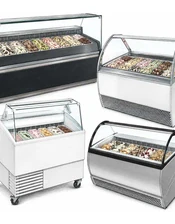
Ice cream and gelato display freezers are designed for storing, presenting and serving scoop ice cream, artisan gelato and sorbets during retail service. The range includes simple static cabinets for 5 L plastic tubs as well as professional ventilated display cases for 5 L Napoli pans, built for high-throughput gelato shops and premium product presentation.
Choosing the right display is not just about the number of flavours or the purchase price. You should consider what type of product you sell, which pan format you use, the required serving temperature, whether reserve storage is needed, the ambient conditions in the shop and how important product visibility is to your sales concept.
The current range includes value-focused IC / NIC style cabinets, compact ventilated FIJI displays, BERMUDA and BERMUDA VIEW ranges, professional MILLENNIUM cabinets, premium SUPER CAPRI models and the dual-temperature-zone DELTA NEW. These are not simply different designs: the cooling method, controls, climate class, reserve storage and day-to-day operating logic differ significantly.
|
Requirement |
What to consider first |
|
Low budget, traditional scoop ice cream |
Consider a static IC / NIC style cabinet. Confirm whether you use 5 L plastic tubs or require a separate basket set for Napoli pans. |
|
Small shop, but professional gelato presentation matters |
Compact ventilated FIJI range: Napoli pans, electronic control, automatic defrost and a shallow cabinet depth. |
|
High sales volume plus reserve stock below the display |
BERMUDA / BERMUDA VIEW type ventilated cabinet with refrigerated storage for additional Napoli pans. |
|
Premium presentation and maximum product visibility |
MILLENNIUM or SUPER CAPRI. High-visibility display, heated glass and professional airflow; some models have no reserve storage below. |
|
Different products require different serving temperatures |
Dual-zone DELTA NEW: 6 + 6 Napoli pans with two independent electronic controllers. |
There is no single universal serving temperature for every frozen dessert. Recipe balance, sugar and fat content, overrun, stabilisers and the desired texture all affect the correct serving temperature. The temperature range shown on a cabinet data sheet therefore does not automatically tell you what setpoint to use.
As a practical rule of thumb, TEFCOLD states that conventional ice cream is often served at around -18 °C and gelato at around -14 °C. Carpigiani Gelato University materials also show professional artisan gelato displayed around -11 to -12 °C, with ready-to-sell pans often stored or tempered around -12 to -14 °C. The important conclusion is that the cabinet setpoint should follow the product formulation and supplier guidance, not simply the lowest temperature the cabinet can reach.
If you buy finished ice cream from a supplier, follow its specified storage and serving temperature. If you produce gelato in-house, the cabinet setting should be coordinated with your recipe and production process.
In a static scoop freezer, cold is distributed through natural convection. Value-focused IC / NIC type cabinets typically combine this with sliding glass lids, a mechanical thermostat and manual defrost. The design is simple, the initial investment is low and the absolute energy consumption of compact closed-lid models can be very modest.
This is a sensible solution for traditional scoop ice cream where a high raised gelato display is not required and reliable operation at a lower investment is the priority. Temperature distribution across the full height of the display is less uniform than in a professional ventilated cabinet, so the product should not be built up above the level intended by the cabinet design.
In a ventilated display, fans actively circulate cold air around the pans. This provides more even temperature distribution, helps keep gelato consistency uniform and makes it possible to position the product higher in the customer's field of view. Professional FIJI, BERMUDA, MILLENNIUM, SUPER CAPRI and DELTA-type cabinets typically combine ventilated cooling with electronic controls and automatic defrost.
A ventilated cabinet is not automatically more or less energy efficient simply because of the cooling principle. Premium cabinets use large glass areas, glass heaters, fans and more open display architecture, so their absolute kWh/24 h consumption can be much higher than a compact static chest-style freezer. Compare actual kWh/24 h, energy class, capacity and operating conditions for the specific models.
This is one of the most common practical mistakes. Two containers can both be described as “5 L” and still have completely different shapes and basket requirements.
Value-focused IC / NIC ranges are often designed around plastic scoop-ice-cream tubs. Some SCE-SO models can be converted for Napoli pans with the correct optional basket set, but the number of pans changes. Professional FIJI, BERMUDA, MILLENNIUM, SUPER CAPRI and DELTA-type displays are designed around Napoli pans, although the Napoli pans themselves are often not included as standard.
Before ordering the cabinet, confirm the exact container format in which your ice cream is supplied or produced. If you plan to change supplier or move from plastic tubs to Napoli pans, this should be checked before the equipment is purchased.
Cabinet size should be based not only on the number of flavours, but also on turnover. A 12-flavour offer may need considerably more than 12 pans if the best-selling flavours require immediate backup stock.
Many value-focused static cabinets provide substantial reserve storage below the serving area. FIJI models also provide under-display storage for additional pans. BERMUDA RV10 serves 10 Napoli pans and stores 10 more underneath, while RV13 serves 13 and stores up to 14 additional pans.
Premium MILLENNIUM and SUPER CAPRI models prioritise the visual display and some versions have no reserve storage below. In that case a separate storage freezer or frozen storage cabinet must be planned nearby. This workflow point can be more important than the headline number of flavours on display.
An ice cream display is not only a freezer; it is usually the main sales counter in a gelato shop. Better visibility of colours, textures and the full flavour selection makes it easier for customers to choose.
In basic static cabinets the product normally sits lower behind sliding glass lids. Angled SCE-type lids improve visibility. FIJI uses a compact curved-glass presentation, BERMUDA VIEW lowers the front glass for a larger sight line, MILLENNIUM is available with curved LX or flatter ST glass, while SUPER CAPRI uses an approximately 11° angled deck and separate double airflow over the two rows of pans.
On premium models, heated front and/or side glass helps reduce condensation, while LED lighting improves product presentation. These features become particularly valuable in humid, high-traffic summer trading conditions.
The busiest ice cream season is also the hottest time of year, so climate class is not a minor catalogue detail. It indicates the ambient temperature and relative humidity conditions for which the cabinet has been designed to maintain its declared operating performance.
The current range includes very different specifications. Some value-focused IC models and FIJI cabinets are rated for approximately +40 °C / 40% RH; BERMUDA RV is typically around +30 °C / 55% RH; while premium MILLENNIUM, SUPER CAPRI and BERMUDA VIEW versions can be rated for around +35 °C / 75% RH.
A higher climate-class number should not be treated as a simple quality ranking. The cabinet must be matched to the real environment. If the shop has large sun-facing windows, weak air conditioning or high summer humidity, this parameter needs to be checked before selecting the model.
Heated glass reduces the risk of misting, but it cannot override unsuitable ambient conditions. If the cabinet is operated outside its climate-class limits, next to frequently opened exterior doors or in a constant stream of warm humid air, condensation may still occur.
Do not position an ice cream display in direct sunlight, next to ovens or other heat-emitting equipment, immediately beside the shop entrance, or where an air-conditioning outlet or ventilation diffuser blows directly onto the cabinet. Manufacturer manuals list draughts, sunlight, disturbed airflow, unsuitable built-in furniture and a dirty condenser among common causes of high cabinet temperature or glass condensation.
Condenser air inlets and outlets must remain unobstructed. Required clearances depend on the individual cabinet design, so if the display is to be built into a niche, fitted between furniture or enclosed with custom joinery, contact us before the furniture is manufactured so the installation can be checked.
A professional display is designed to maintain serving temperature, not to rapidly freeze a large mass of newly produced warmer gelato. Loading product whose core temperature is far above the cabinet setpoint creates a large heat load, and the product can change texture and volume while the display slowly pulls the temperature down.
Carpigiani Gelato University recommends using blast chilling in the production workflow to bring the gelato core close to display temperature, followed by tempering / stabilisation in a storage cabinet. This is especially important in professional artisan gelato production, where cold is treated as one of the ingredients of the recipe.
If you sell factory-produced ice cream supplied frozen, the display should likewise be pre-cooled to operating temperature before it is fully loaded.
The strength of value-focused static IC / NIC type models is simplicity: a mechanical thermostat, separate thermometer and manual defrost are common. The design is straightforward, but staff must monitor frost build-up and defrost the cabinet when required.
Professional ventilated displays usually use an electronic controller, digital temperature indication and automatic defrost, often hot-gas defrost. In a busy gelato shop this reduces manual intervention and helps keep the operating temperature more stable throughout the day.
If you want to serve products that work best at different temperatures in the same display, one common setpoint will always be a compromise. The DELTA NEW type cabinet has two independent sections, six Napoli pans per zone, each with its own electronic controller.
This makes it possible to separate, for example, harder conventional ice cream from softer gelato or sorbet groups. The manufacturer declares a very wide -20 to +10 °C control range, so this type of cabinet should be viewed as a flexible process tool rather than simply another 12-pan display.
Input power in watts does not tell you the real operating cost. Compare kWh/24 h, annual kWh, energy class and actual serving capacity.
For example, TEFCOLD data lists roughly 1.49 kWh/24 h for the small static IC202SC-SO and about 8.49 kWh/24 h for the professional ventilated FIJI 6. Premium MILLENNIUM and SUPER CAPRI class displays can use more again because they combine large open presentation areas, forced-air cooling and heated glass. They also deliver a very different level of product visibility, temperature uniformity and selling capacity.
The useful question is therefore not “which cooling type uses less electricity?”, but how much energy does the specific cabinet use to provide the display quality and operating performance your business actually needs?
Ice cream displays often work hardest during the hottest months, making condenser cleanliness critical. A condenser blocked with dust and fluff rejects heat less effectively, forcing the compressor to run longer, increasing energy consumption and potentially raising cabinet temperature.
Manufacturer manuals identify a dirty condenser, obstructed air inlets / outlets and incorrect built-in installation as common causes of excessive cabinet temperature. Cleaning frequency depends on the environment, so sites exposed to flour, dust or street air may need more frequent inspection.
IC / NIC and similar static cabinets - for a low initial investment, simple construction and traditional scoop ice cream in plastic tubs. Confirm the basket type and Napoli compatibility before ordering.
FIJI 4 / 6 / 7 - for a compact professional ventilated Napoli display. The approximately 630 mm cabinet depth is a strong advantage in smaller cafés, kiosks and narrow service areas.
BERMUDA / BERMUDA VIEW - when you want ventilated cooling, heated glass and meaningful reserve storage for additional Napoli pans below the display. VIEW models prioritise an even larger sight line.
MILLENNIUM LX / ST - for a professional gelato shop where high-humidity climate capability, heated glass, a large flavour selection and premium design are important. LX uses curved glass; ST has a flatter, more contemporary glass architecture.
SUPER CAPRI - for premium installations where the display is a focal point of the interior. Double airflow separately cools the two pan rows, the deck is angled towards the customer and heated glass supports visibility in humid conditions.
DELTA NEW - when a 12-pan display needs to be divided into two independent temperature groups or when you want more flexibility for different frozen products.
If you are unsure, send us the planned number of flavours, the pan format, the expected summer room temperature and the available space. If the cabinet will be installed in a niche or between furniture, we recommend checking the installation before the joinery is produced.
There is no single universal setpoint. TEFCOLD gives around -18 °C for conventional ice cream and around -14 °C for gelato as a rule of thumb, while Carpigiani materials show professional artisan gelato displayed around -11 to -12 °C. The correct setting depends on recipe balance and the supplier or producer recommendation.
A static cabinet relies mainly on natural convection and is usually simpler and lower-cost. A ventilated display actively circulates cold air, providing more even temperature distribution around the pans and making it better suited to professional gelato presentation.
No. 5 L plastic tubs and 5 L Napoli pans have different shapes. Some cabinets require a different basket set, and some value-focused models are not suitable for Napoli pans at all.
In professional Napoli displays the pans themselves are often not included. Value-focused cabinets may include standard baskets, while dedicated scoop-tub or Napoli basket sets can be optional.
Consider turnover as well as the menu. A 12-flavour offer may require extra reserve pans for best sellers. Check the under-display reserve storage or plan a separate frozen storage cabinet.
For professional production, the display should not be treated as a rapid-freezing machine. Gelato is better pre-chilled and stabilised close to serving temperature so that texture and volume remain consistent during service.
Common causes include high ambient humidity, excessive room temperature, draughts and poor airflow. Heated glass helps, but cannot fully compensate for unsuitable ambient conditions.
It is not recommended. Frequently opened exterior doors bring in warm humid air, increasing refrigeration load and the risk of condensation.
No. A direct air-conditioning or ventilation stream can disturb the cabinet airflow and operating conditions. The display should be positioned away from direct air jets.
The exact requirement depends on where the individual model takes in and exhausts condenser air. Ventilation grilles must never be blocked or sealed inside a tight niche. If the cabinet will be integrated into furniture, confirm the installation before the niche is built.
It defines the ambient temperature and humidity conditions for which the cabinet is designed. This is especially important in summer: the range includes models rated around +30 °C / 55% RH, +40 °C / 40% RH and premium models around +35 °C / 75% RH.
Compare actual kWh/24 h and capacity for specific models. Small closed static cabinets often have low absolute consumption, while large premium displays use more because of forced-air cooling, heated glass and a larger presentation area. The correct comparison is model efficiency versus the performance and presentation you need.