excl VAT

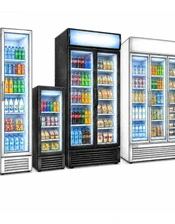
Glass-door display coolers are designed not only to chill products but also to keep them clearly visible and attractively presented. They are used in shops, petrol stations, cafés, bakeries, bars, hotels and other retail or food-service locations where customers should be able to see chilled drinks or food without opening the refrigerator.
This category includes compact and full-height one-, two- and three-door display coolers, models with hinged or sliding glass doors, versions with or without an illuminated advertising canopy, and white, black or stainless-steel finishes. The differences go well beyond size and capacity: the type of temperature control, refrigeration system, energy consumption, climate class, glass construction and installation location all matter.
For this reason, we recommend choosing a display cooler by more than one specification such as litres or the lowest temperature shown in the catalogue. Start with three questions: what will you store, how much product do you want to display, and under what ambient conditions will the cooler operate?
One of the most important but often overlooked differences is the type of temperature controller: mechanical or electronic.
Display coolers controlled by a mechanical thermostat are simple, reliable and very suitable for beverages. A mechanical thermostat, however, has greater control inertia. Even if the technical specification shows a range such as +2...+8 °C or +2...+10 °C, that does not automatically mean the appliance is the best option for products that must be held very precisely at +2 or +3 °C. For example, the FSC1450 in our range has a declared +2...+8 °C range but uses a mechanical controller.
We therefore recommend these models primarily for bottles and cans where the practical goal is to keep drinks stably chilled at around +6...+8 °C.
If the display cabinet will hold products that need tighter temperature control, choose a model with an electronic controller and a digital temperature display. Electronic control allows a more precise setpoint and, depending on the controller, adjustment of the temperature differential - for example 2 K. TEFCOLD UR400G and UR600G are examples of glass-door display coolers with electronic controllers.
When choosing a refrigerator for food, therefore, check not only the temperature-range line in the specification but also the controller type.
A one-door display cooler is a rational choice where retail space is limited or a very large stock is not required. The range includes very narrow models, standard-width full-height cabinets and larger GN2/1-format professional units.
A two-door model is often a good compromise between footprint, visible display area and capacity. It allows different groups of drinks or food to be separated within one appliance without opening the entire display at once.
A three-door display cooler is best suited to higher drink or food turnover where a wide presentation area and a large quantity of products are required in one location. Such models are particularly suitable for shops, petrol stations and other high-traffic retail sites.
Do not assess capacity by gross litres alone. Net volume, shelf area, number of shelves and the actual number of bottles or cans are more practical indicators. For some models the manufacturer separately states the capacity for 330 ml cans, 330 ml bottles and 500 ml PET bottles - information that is often more useful to a buyer than a simple “400 litres”.
If there is enough space in front of the cooler, conventional hinged doors are a simple and convenient solution.
When the appliance stands in a narrow aisle, behind a counter or anywhere with insufficient swing space, sliding glass doors are worth considering. Measure not only cabinet width and depth but also the working space in front of the equipment.
An upper LED advertising canopy is relevant when the display cooler is not only storage equipment but also a sales and brand-communication tool.
It is particularly useful for beverage retail, petrol stations, self-service areas and other locations where customers make their purchase decision next to the refrigerator. The canopy can carry a brand, product category or custom graphic.
If the unit will stand in a kitchen, storage area or another location where the top is not clearly visible to customers, it is usually more rational to spend the budget on capacity, lower energy consumption or more accurate temperature control instead.
Even a high-quality display cooler can perform poorly if it is installed in the wrong place.
Do not push the rear of the cooler completely against the wall. The condenser and compressor compartment need airflow to reject the heat generated by the refrigeration system. In practice we recommend allowing at least about 6-8 cm, but the installation manual for the exact model always takes priority and some commercial units may require more clearance. The freer the condenser area can breathe, the better the operating conditions.
For the same reason, do not enclose the display cooler with furniture or decorative panels in a way that blocks air-intake or exhaust grilles.
If the cooler will be built into a niche, positioned between furniture panels or installed under custom cladding, contact us before ordering. For the exact model we can help assess niche dimensions, ventilation space and service access.
The performance of a glass-door display cooler depends directly on the environment in which it operates.
Avoid locations next to frequently opened external doors or windows where draughts continuously bring warm, humid outdoor air into the room. Such conditions increase refrigeration load and the risk of condensation on the glass.
Likewise, do not position the cooler where an air conditioner or strong ventilation jet blows directly onto it.
The unit should not stand in direct sunlight or next to ovens, cooking equipment, radiators or other heat sources. The warmer the surrounding air, the more heat the refrigeration system must remove.
The cabinet temperature stated in the catalogue applies only under the ambient conditions defined by the manufacturer.
Check the climate class or the maximum permitted ambient temperature and relative humidity. Many professional glass-door display coolers, for example, are designed for conditions of approximately +30 °C and 55% relative humidity.
This is especially relevant in small shops, summer retail locations, kiosks, rooms with large display windows and any premises where summer temperatures rise significantly.
Operating outside the manufacturer’s stated ambient limits can increase electricity consumption, reduce temperature stability and cause more condensation on the glass.
Condensation on the glass does not necessarily indicate a refrigeration fault.
Moisture can condense when warm, humid air reaches a cold glass surface. The risk is therefore higher near external doors, in rooms with high humidity, with poorly directed air-conditioning or under other unstable ambient conditions.
If the retail location has difficult humidity conditions, select the model with attention to glass construction, heated elements, climate class and the actual installation position.
Dynamic, or ventilated, refrigeration relies on free circulation of cold air.
Products must not block supply or return air channels. The cabinet should also not be filled so tightly that practically no space remains for air movement between products.
Incorrect loading can cause uneven temperature distribution inside the cabinet.
Another common mistake is filling a newly switched-on cooler with room-temperature drinks and expecting everything to become equally cold within a short time.
The primary purpose of a display cooler is to maintain the temperature of already chilled products, not to remove a large heat load from warm stock quickly. Allow the unit to reach its operating temperature first and then load pre-chilled products whenever possible.
Loading a large quantity of warm drinks at once will temporarily raise the internal temperature and keep the compressor working hard for an extended period.
Do not compare display coolers by input power in watts alone.
A 200 W compressor or appliance rating does not mean the cooler consumes 200 W continuously for 24 hours. The compressor cycles according to the controller, so kWh/24 h, annual kWh and energy class are much more useful for comparing actual models.
If the cooler operates 24 hours a day throughout the year, even a small difference in daily energy consumption can become significant over the equipment’s service life.
Finish should mainly be chosen according to the location and purpose of the display cooler.
White models are versatile and often economical. Black interior and exterior finishes suit modern retail areas, bars, cafés and branded beverage displays because colourful packaging often stands out particularly well against a dark background.
A stainless-steel exterior is worth choosing where professional-kitchen aesthetics, intensive use or visual consistency with other stainless-steel equipment are important.
If the main purpose is beverages, start with the required bottle and can capacity, door type, product visibility, energy consumption and available space.
If food will be stored, temperature range and controller type become especially important. For products where temperature accuracy matters, we recommend an electronically controlled model.
For intensive retail use, give more weight to self-closing doors, energy efficiency, shelf capacity and easy daily replenishment.
If space rather than capacity is the main problem, narrow cabinets, compact units and sliding-door models can make better use of a restricted sales area.
If you are unsure, contact us with details of what you plan to store, the required temperature and the available dimensions. Consultation is particularly important before fitting a cooler into a niche or between furniture, because external dimensions alone do not describe its ventilation requirements.
A commercial display cooler is designed primarily for more intensive use and product presentation. Glass doors let customers see the contents without opening the cabinet, while adjustable shelves, LED lighting and dynamic cooling help organise a retail display. Models also differ in climate class, capacity and door construction.
Yes, but the unit must be selected according to the product’s required storage temperature and the refrigerator’s control system. Mechanical-thermostat models are excellent for drinks. For food products where temperature accuracy is more important, we recommend an electronic controller.
A mechanical thermostat has greater control inertia and is not intended for maintaining an extremely precise single temperature. In practice we therefore recommend it for beverages that only require a stable temperature of roughly +6...+8 °C, even if the manufacturer’s overall adjustment range starts at +2 °C.
It allows a more precise setpoint, provides a temperature display and, depending on the controller, may allow adjustment of the temperature differential. This gives more control when product temperature is important.
Do not push the cooler completely against the wall. In practice we recommend at least about 6-8 cm, but the exact model’s installation manual takes priority and may specify more. For niche installation, contact us before ordering so the ventilation space can be checked.
We do not recommend it. Frequently opened external doors create draughts and bring warmer, more humid air into the room, increasing refrigeration load and the risk of misting on the glass.
No. Position the cooler so that direct air-conditioning or a strong ventilation stream does not blow onto it.
Not recommended. Direct sunlight heats the cabinet and glass and increases refrigeration load. Ovens, radiators, cooking equipment and other heat sources should also be avoided.
Most often because of ambient humidity and the temperature difference between warm air and cold glass. Open external doors, high room humidity, draughts and poor positioning increase the risk. Condensation does not automatically mean the equipment is faulty.
They can, but cooling them will take time and place a high load on the refrigeration system. Display coolers are primarily intended to maintain the temperature of pre-chilled products. Best results are achieved by letting the unit reach its set temperature first and then loading chilled stock.
Yes, within the manufacturer’s shelf-load limits, but internal supply and return air openings must not be blocked. Sufficient space must remain for air circulation between products or temperature may become uneven in different parts of the cabinet.
If there is enough working space in front of the cooler, hinged doors are usually convenient. Sliding doors are especially useful in narrow aisles or behind a counter because they do not require extra swing space.
Choose one door for a smaller retail location or lower stock volume. Two doors usually provide a good balance between capacity and footprint. Three doors make sense when a large display and high product turnover are required.
Yes, if the cooler will stand in a customer-facing location and you want to use it for brand or category communication. In a back-of-house or kitchen area, an illuminated canopy is usually not an important selection criterion.
Compare kWh/24 h or annual kWh first, not only the appliance power in watts. Also consider energy class, climate class and capacity. A larger cooler may consume more electricity in absolute terms but can still be more efficient per litre or per displayed product.