excl VAT


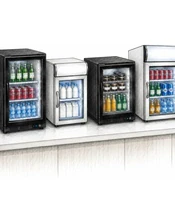
Countertop refrigerators are compact commercial refrigeration units designed to stand on a bar, counter, preparation table or serving line. This category includes several different types of equipment: small glass-door drink coolers, countertop display freezers, specialist SUB ZERO displays and stainless steel GN ingredient displays. Before choosing a model, first decide what will be stored inside: packaged drinks, frozen desserts, delicatessen products or open ingredients in GN pans.
This category should not be confused with back bar refrigerators. Back bar units are installed under the counter and are normally used to store a larger quantity of beverages on the staff side of the bar. Countertop models are placed above the work surface: they need to be visible, easy to reach and compact enough not to waste valuable counter space. They are commonly used in coffee areas, till points, pizzerias, fast-food lines, petrol stations, small self-service zones and as an additional display next to larger refrigeration equipment.
The key principle is simple: choose the unit according to the product and the installation position. A model that works well for drinks may not be suitable for open sandwiches or salads. A GN ingredient display may be ideal for a preparation line but unsuitable for taller packaged products. For that reason, do not look only at the temperature range. Also check the controller type, cooling method, air movement, door design, ventilation requirements and the real operating environment.
|
Group |
Typical use |
Key selection criterion |
|
Countertop drink coolers |
Bottles, cans and quick self-service sales on a bar, counter or till area. |
Capacity in cans/bottles, illuminated canopy, door type and controller type. |
|
Countertop display freezers |
Packaged frozen desserts, ice cream and small frozen items that need visibility through a glass door. |
Whether the products are already frozen, target temperature and whether static cooling is sufficient. |
|
SUB ZERO / specialist displays |
Caviar, delicatessen items or products that need a colder zone than a standard chiller. |
Exact temperature range, heated glass door, electronic controller and product sensitivity. |
|
GN ingredient displays |
Pizza, salad, sandwich, kebab, burger or preparation-line ingredients in GN pans. |
GN size, number of pans, glass sneeze guard or stainless lid, hygiene and installation position. |
Small countertop drink coolers are used for cans, small bottles and impulse sales of chilled beverages. They are placed where the customer or staff member can quickly see and take the product: near the till, on a bar, in a self-service coffee area, hotel breakfast area, petrol station or small snack display.
For these models, the practical capacity often matters more than the total litre volume. Check how many 330 ml cans, 500 ml PET bottles or small glass bottles the unit can actually hold. A compact model may have a modest net volume but still be the best choice if its shelf layout matches the packaging you sell.
Models with an illuminated LED canopy are useful when the refrigerator is visible to the customer and should support impulse sales or brand communication. If the unit will stand on the staff side or in a back-of-house area, the canopy is usually less important than capacity, energy consumption, noise level and door type.
Some small countertop drink coolers use a mechanical thermostat. This is a simple and reliable solution for beverages, but it has a larger temperature control inertia. Even if the specification shows a range starting from +2 °C, that does not automatically mean the unit is ideal for products that require a precise +2 or +3 °C storage condition.
Mechanical control is best treated as a beverage solution, where the practical objective is to keep bottles and cans pleasantly chilled. For food products, delicatessen items or ingredients, choose a model with an electronic controller and a temperature display. Electronic control gives better accuracy and, depending on the controller, may allow a defined differential, for example 2 K.
GN ingredient displays and SUB ZERO specialist units usually need more precise control because the goal is not only to chill the product, but to keep a stable working temperature throughout the day.
Several cooling principles are used in this category. Drink coolers often use fan-assisted or ventilated cooling because it distributes cold air more evenly and helps cool cans and bottles faster after the door has been opened or the unit has been restocked.
For open food or ingredients, strong air movement may be undesirable because it can dry the product surface. GN ingredient displays therefore often use static cooling. Static cooling is not intended for rapidly chilling large quantities of warm product, but it is suitable for holding pre-chilled ingredients in GN pans during service, provided the loading level and hygiene requirements are respected.
Countertop display freezers with glass doors are intended for already frozen packaged products. They are not blast freezers. If you load room-temperature products into such a freezer, the unit will be overloaded and the freezing process will not be as safe or as fast as in equipment designed for that purpose.
GN ingredient displays are a separate group within countertop refrigeration. They are designed for ingredients in GN pans: vegetables, sauces, cheese, meat products, salad components, pizza toppings, sandwich fillings, burger ingredients and similar preparation-line items. These units are usually made of stainless steel and include an electronic controller, temperature indication and compatibility with GN1/4 or GN1/3 pans.
Important: GN pans are often not included. Check which GN size the unit accepts, how many pans it holds, which pan depth is allowed and whether lids are required. A glass sneeze guard is useful when ingredients need to be visible and protected, while a stainless steel lid is practical for closing the unit between service peaks or after working hours.
Open ingredients must not be filled above the permitted loading level. If a pan is overfilled, the top layer may be warmer than the declared storage temperature. Do not load warm ingredients into the display. The ingredients should be pre-chilled. The unit is designed to hold temperature during service, not to replace a blast chiller or the main storage refrigerator.
Some countertop models are not standard beverage coolers. SUB ZERO type displays operate in a lower temperature range and are suitable for caviar, delicatessen products or other items that require a colder display zone. These models need accurate electronic control, heated glass doors, vertical LED lighting and stable air distribution.
Do not choose a specialist low-temperature model simply because it “cools more”. Lower temperatures are not suitable for every product. If the product is sensitive to freezing, too low a temperature may damage texture or appearance. Select such a unit according to the product’s technical storage requirements, not just by looking for the widest temperature range.
In small commercial areas, the door opening space is as important as the width of the cabinet. Hinged doors are convenient when there is enough space in front of the unit and shelves need to be restocked easily. Sliding glass doors are better for narrow counters, till areas or locations where customers or staff move directly in front of the equipment.
For GN ingredient displays the choice is often between a glass sneeze guard and a stainless steel lid. The glass guard protects ingredients while keeping them visible. The stainless steel lid is practical in a staff preparation area where the unit should be closed between busy periods or at the end of the day.
A countertop refrigerator must stand on a stable, level and sufficiently strong surface. It should not be placed on the very edge of a counter where it can be accidentally pushed. Always consider the full working weight: the unit itself plus products, GN pans and any liquids.
Do not push the unit against a wall in a way that blocks air intake or hot air discharge. As a practical minimum, allow around 6-8 cm, but the instruction manual of the specific model always takes priority. If you plan to recess the unit into a niche, place it between furniture panels, cover it with decorative cladding or install it under a shelf, contact us before ordering. We will check whether the model can ventilate properly and be serviced safely.
Even a small countertop unit releases heat into the room. Without air circulation around it, the compressor will run longer, energy consumption may increase, temperature stability may suffer and the service life of the equipment may be reduced.
A poor installation position can cause condensation, temperature fluctuations, higher energy consumption and longer compressor running times. Condensation on glass does not automatically mean a fault; it is often the result of humidity, air movement and glass surface temperature.
The declared temperature range is valid only when the equipment is used under the ambient conditions specified by the manufacturer. Many countertop models in this category are climate class 4 or specified for approximately +30 °C and 55% relative humidity. If the unit will stand in a hot summer sales area, near a window or in a poorly ventilated space, temperature stability should be assessed more carefully.
Climate class is especially important for small glass displays, because they often have a relatively large glass area and operate in customer-facing environments that are less stable than a back-of-house cold room.
When comparing countertop refrigerators, look at kWh/24 h and annual energy consumption, not just input power in watts. Input power shows the instantaneous electrical load, but not the real yearly consumption. For equipment running continuously, even a small daily difference can become visible over a full year.
Noise level also matters because countertop units are often very close to staff or customers. In a coffee bar, hotel reception, small bakery or office self-service zone, the difference between models may be more noticeable than in a large retail store.
Maintenance includes regular cleaning of condenser grilles, internal surfaces, GN pan areas and glass. Ingredient displays require particular attention to hygiene because food residues, acidic sauces, salt and fats can affect stainless steel surfaces. Products containing vinegar, salt, mayonnaise or marinades require more frequent and careful cleaning.
A countertop refrigerator stands on a bar, counter or worktable and is used for visible display or ingredients within reach. A back bar refrigerator is installed below the counter and usually stores a larger volume of beverages on the staff side.
For packaged snacks or beverages, yes, if the temperature requirements are suitable. For open food, salads or ingredients, choose a GN ingredient display with electronic control and a clearly defined food-preparation purpose.
A mechanical thermostat has a larger temperature control inertia. This is usually acceptable for beverages, where the aim is to keep products pleasantly chilled. Products requiring precise temperature control should be stored in an electronically controlled model.
Only if the specific model has sufficient ventilation and service access. Air intake and hot air discharge must not be blocked. We recommend checking the niche dimensions with us before installation.
A practical minimum is often 6-8 cm, but the specific model’s manual takes priority. If the unit is under a shelf, between panels or close to a wall, the full airflow path must be assessed, not just the rear clearance.
Often not. Many GVC-type units are compatible with GN1/4 or GN1/3 pans, but pans and lids are usually ordered separately. Always check the exact model configuration.
No. The display is designed to hold pre-chilled ingredients during service. Warm products should first be chilled using suitable equipment.
Choose a glass guard when ingredients need to remain visible and protected. Choose a stainless steel lid when the unit is mainly used in a staff preparation area and needs to be closed between service peaks or after hours.
It is intended to hold and display already frozen products, not to freeze warm products quickly. For rapid freezing, use a blast freezer or another purpose-built system.
Usually because of warm humid air, draughts, air conditioning airflow, nearby outside doors or high room humidity. Condensation does not automatically indicate a fault; first check the installation position and ambient conditions.
Not recommended. Coffee machines, dishwashers, ovens, grills and other heat or steam sources increase the load on the refrigeration system and may cause condensation or temperature instability.
For drinks, count the actual packaging: 330 ml cans, 500 ml PET bottles or glass bottles. For ingredient displays, calculate the number and size of GN pans and the required preparation-line width.